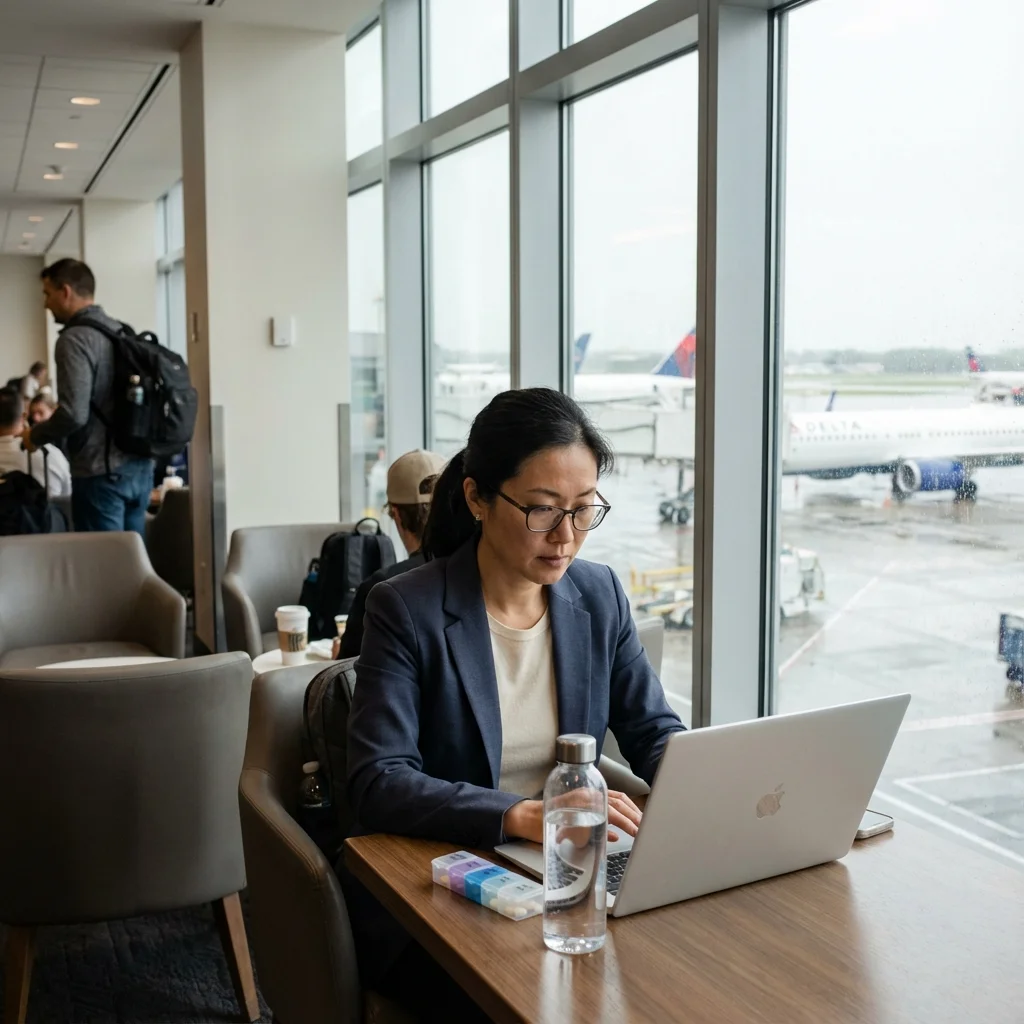

The Air Travel Strategy is a clinical playbook for frequent flyers. Cabin pressure, dehydration, cosmic radiation, and circadian disruption all add up. The protocol covers pre-flight gear, in-flight hydration and movement, post-flight light and sleep stacking, and a phosphatidylserine based jet lag strategy for eastbound and westbound travel.
Read Time: 20 Minutes
Focus: Radiation, Hypoxia, Dehydration, Circadian Rhythm.
Flying looks passive. You sit in a chair for six hours, watch a movie, eat a tray of pasta, and arrive. Biologically, that is not what is happening. Cabin pressure equivalent to 6,000 to 8,000 feet, humidity below 10%, cosmic radiation roughly equivalent to a chest X-ray on a transatlantic flight, and a forced change in your circadian rhythm. Flying is an athletic event. Most people just don't train for it.
The Air Travel Strategy is the protocol we use with our frequent-flyer patients to mitigate the physiological cost of frequent flight. It covers pre-flight, in-flight, and post-flight, plus a specific approach to jet lag based on phosphatidylserine and timed light exposure. The goal is to land in London or LA with the same cognitive capacity you had when you left Philadelphia.
Guidance from the Clinic
"In our practice, we often see busy patients who view travel as 'downtime', a chance to sit and catch up on movies. But biologically, flying is an athletic event. You are exposing your body to altitude, radiation, and disruption. This strategy is about arriving in London or LA with the same cognitive capacity you had when you left Philadelphia."
- Dr. Ash
I. The Reality Check
When you sit in an airline seat, it might feel like you are doing nothing. From a physiological perspective, your body is actively managing a significant load. We want you to understand the specific stressors involved so we can mitigate them together.
- Hypoxic Stress: Cabin pressure is generally maintained at the equivalent of 6,000 to 8,000 feet. Your blood oxygen (SpO2) often drops to 92% to 94%. For a healthy person this is manageable, but it represents a mild hypoxic stressor that contributes to fatigue and mild cognitive blunting.
- Radiation Exposure: A trans-Atlantic flight exposes passengers to cosmic radiation levels roughly equivalent to a chest X-ray. For frequent flyers, this cumulative exposure adds up.
- Systemic Dehydration: Cabin humidity often hovers below 10% (for context, the Sahara Desert is around 25%). You can lose approximately 8 oz of water per hour simply through respiration.
Our Goal: To optimize your physiology so you land ready to perform, rather than needing a day to recover.
II. Pre-Flight (The Load Out)
Travel is a controlled environment, which means we can prepare for it. We recommend assembling a "Go-Bag" specifically for your trips.
1. The Gear
- Compression Socks: Wirecutter Recommendation.
- Strategy: 20 to 30 mmHg. Put them on before you arrive at the airport.
- The Why: This supports venous return and prevents blood pooling (reducing DVT risk), which helps keep systemic fatigue low.
- Noise Canceling Headphones:
- The Why: The constant drone of an airplane engine can trigger a low level cortisol response, contributing to allostatic load. Silence helps conserve energy.
- Eye Mask:
- The Why: You cannot control cabin lighting, but you can control your retinal exposure. Creating your own darkness signals "night" to your brain and protects your circadian rhythm.
2. The Supplement Stack (TSA Friendly)
- Thorne Creatine Monohydrate (Packets):
- The Why: Creatine supports cellular hydration by pulling water into the cell. Emerging data suggests it may help buffer the cognitive fatigue associated with mild hypoxia.
- Tactical: Single serve packets are easier to manage through security than loose powder.
- Electrolytes:
- The Why: In a dry cabin environment, water alone isn't enough. Sodium helps your body retain the fluid you drink.
- Magnesium Glycinate:
- The Why: Nervous system regulation. Airports are inherently stressful environments. Magnesium acts as a gentle brake pedal for the nervous system.
III. In-Flight (The Strategic Roadmap)
1. Hydration
- The Guideline: We aim for 8 oz of water mixed with electrolytes for every hour of flight.
- What to Avoid: We strongly advise against alcohol and soda during flight.
- Alcohol: It is a diuretic. Combined with cabin hypoxia, it can lead to significant dehydration and disrupt REM sleep quality.
- Soda: Gas expands at altitude. This causes abdominal distension and discomfort, which distracts from rest.
2. Nutrition (The Fast)
- The Strategy: Consider fasting or eating very lightly during the flight.
- The Why: Airline food is often high in sodium and preservatives. More importantly, digestion requires significant blood flow to the gut. At altitude, we want to prioritize blood flow to the brain.
- The Benefit: Fasting simplifies your biology during the stress of travel and can assist in resetting your circadian clock (more on this below).
3. Mobility
- The Problem: Sedentary tension and tightness in the hip flexors.
- The Fix:
- Seated: Perform calf raises every hour to assist the muscle pump in your legs.
- Aisle: If you feel comfortable, finding space in the galley to do a few squats can be very effective.
- Tool: A Lacrosse Ball takes up minimal space. Sit on it for 5 minutes per side to help release tension accumulated from flat airline seats.
IV. Post-Flight (After You Land)
1. Grounding (Light & Air)
- The Strategic Roadmap: If possible, spend 10 minutes outside with your shoes off on grass or sand.
- The Mechanism: While the theory regarding negative charge exchange is debated, the benefits of immediate fresh air and sunlight are well documented for circadian anchoring.
- The Reality: It helps signal to your body that you have arrived and the travel stress is over.
2. The "Hotel Sleep" Stack
Sleep in a new environment is often compromised due to the "First Night Effect", an evolutionary mechanism where one hemisphere of the brain remains more alert to monitor for threats.
- Glycine: 5g.
- The Why: Helps lower core body temperature, which is a key signal for sleep onset. Particularly helpful if you cannot control the hotel room thermostat.
- Phosphatidylserine: 100mg to 300mg.
- The Why: Helps modulate cortisol. If you feel "tired but wired" from travel stress, this supports the natural drop in stress hormones required for melatonin to rise.
- Magnesium Glycinate: 400mg. A foundational support for relaxation.
Fishtown Medicine
A 90-minute conversation with Dr. Ash. A written plan you can follow.
V. The Time Zone Strategy (Phosphatidylserine)
Many people try to just "power through" jet lag. We prefer to use biology to move the clock.
The Tool: Phosphatidylserine (PS). The Mechanism: Cortisol and Melatonin work in opposition. When Cortisol is naturally high (daytime), Melatonin is low. When traveling East (for example, to London), you are trying to sleep when your body believes it is 5:00 PM (a time of peak cortisol). PS helps blunt that cortisol signal, allowing sleep to occur.
1. The Pre-Game (1 to 2 Days Before)
- Strategy: Begin shifting your sleep window by 1 hour toward your destination time.
- The Dose: Taking 100mg of PS 1 hour before your new target bedtime helps signal to the brain that it is time to wind down, even if your internal clock disagrees.
2. Eastward Travel (Philly to London/Paris)
- The Challenge: This is the harder direction because you lose time and must sleep when your body is alert.
- The Strategic Roadmap:
- Flight: Prioritize sleep on the plane. Use your eye mask and earplugs immediately after takeoff.
- Arrival: Avoid naps if possible. Seek out sunlight to stimulate alertness.
- Bedtime: Take 300mg PS at 6:00 PM local time. This helps counteract the "afternoon" cortisol peak your body is expecting (since your internal clock thinks it is late afternoon).
3. Westward Travel (Philly to LA/Colorado)
- The Challenge: Generally easier, as you gain time. The goal is to stay awake later.
- The Strategic Roadmap:
- Flight: Limit naps to 20 minutes. Caffeine can be used strategically, but stop before 2 PM local destination time.
- Bedtime: If you wake up at 3:00 AM (because your body thinks it is 6:00 AM), taking 100mg of PS can help you fall back asleep.
4. The Return Reset
- When returning to Philadelphia, use this same light and PS strategy to help snap your rhythm back to Eastern Standard Time.
VI. Medication Logistics & Safety
1. The "Carry-On" Rule
- Always keep essential medication with you. Checked bags can get lost, and we want to avoid a medical crisis in a foreign city.
- The Bottle: Keep pills in their original prescription bottles. Customs agents in certain regions can be strict regarding unmarked medication.
2. The "Runway" Warning (Sleep Aids)
- The Risk: Please do not take sleep aids (like Ambien) while at the gate.
- The Why: Safety is essential. If there is a mechanical issue or an evacuation is required on the runway, you need to be fully alert.
- Strategy: Wait until the aircraft has reached cruising altitude (typically signaled by the "ding" at 10,000 feet) before taking sleep medication.
3. Timing Sensitive Meds
- Insulin/Birth Control: While you are crossing time zones, the half life of your medication does not change.
- Strategy: Switch your phone clock to the destination time immediately upon boarding, but track your doses by elapsed hours rather than "time of day" for the travel day to ensure consistent coverage.
Actionable Steps for Frequent Flyers
- Build the Go-Bag: Compression socks, eye mask, noise canceling headphones, electrolyte packets, magnesium glycinate, phosphatidylserine. Keep it packed.
- Prep two days out: Move your sleep window by an hour. Hydrate thoroughly.
- Day of flight: 8 oz water plus electrolytes per flight hour. No alcohol. Light or fasting on the plane.
- At destination: 10 minutes of sunlight on arrival. Use the timed phosphatidylserine protocol matched to direction of travel.
VII. Conclusion
The constant traveler who ignores their physiology often burns out. The traveler who treats flight like a sport lasts for decades. Let's make sure you recover like a pro.
Tell Dr. Ash what's going on. Let's figure this out together and build a travel kit that works for you.
Scientific References
- Hypoxia and Cognitive Function: McMorris, T., et al. (2017). "Effect of acute hypoxia on cognition: A systematic review and meta-regression analysis." Neuroscience & Biobehavioral Reviews, 74(Pt A), 225-232. (Meta-analysis showing acute hypoxia produces a moderate negative effect on cognitive performance, relevant to pressurized cabin altitudes.)
- Radiation Exposure in Air Travel: Langner, I., Blettner, M., et al. (2004). "Cosmic radiation and cancer mortality among airline pilots: results from a European cohort study (ESCAPE)." Radiation and Environmental Biophysics, 42(4), 247-256. (Quantifies cumulative cosmic radiation dose in aircrew.)
- Melatonin and Jet Lag: Herxheimer, A., & Petrie, K. J. (2002). "Melatonin for the prevention and treatment of jet lag." Cochrane Database of Systematic Reviews, (2), CD001520. (Evidence base for circadian shifting strategies.)
- Hydration and Cognitive Performance: Popkin, B. M., D'Anci, K. E., & Rosenberg, I. H. (2010). "Water, hydration, and health." Nutrition Reviews, 68(8), 439-458. (Impact of mild dehydration on cognitive tasks.)
- Phosphatidylserine and Cortisol: Starks, M. A., Starks, S. L., Kingsley, M., Purpura, M., & Jäger, R. (2008). "The effects of phosphatidylserine on endocrine response to moderate intensity exercise." Journal of the International Society of Sports Nutrition, 5, 11. (Mechanism for cortisol modulation.)

Frequently Asked Questions
Common Questions
Deep-Dive Questions
Ready when you are
The chat is our AI assistant, answering from our published guides. To talk it through with Dr. Ash himself, start with the intake.