
FishtownFish wrapped around the rod of AsclepiusMedicine
Philadelphia Primary Care
How It Works
What People Say
Patient reviews across 6 platforms
Pricing & Membership
Transparent membership pricing
Articles
Symptoms
What your body is telling you
Treatments
Protocols, prescriptions, therapies
Longevity
Medicine 3.0 strategies
Heart Health & Risk
Protect your heart & vessels
Metabolism
Insulin, blood sugar, weight
Hormones
TRT, thyroid, menopause, andropause
Performance
VO2 max, muscle, sleep, gut
Playbooks
Step-by-step frameworks
Dispensary
Dr. Ash's professional-grade supplement picks
About
Meet Dr. Ash
Your Physician
GER·O·SPAN
Our Clinical Framework
FAQ
Common Questions
Book a Free Call
Lp(a): The Genetic Heart Risk
Fishtown Medicine•6 min read

Lp(a): The Genetic Heart Risk

Ashvin Vijayakumar MD

Medically Reviewed

Ashvin Vijayakumar MD•Updated June 1, 2026
On This Page
  • What is Lp(a) and why is it dangerous?
  • What does the science say about Lp(a)?
  • What is the Fishtown strategy if Lp(a) is high?
  • What treatments actually move Lp(a)?
  • Guidance from the Clinic
  • Actionable Steps in Philly
  • Common Questions
  • What is Lp(a)?
  • Can diet fix high Lp(a)?
  • Should my kids be tested for Lp(a)?
  • Is Lp(a) linked to other diseases?
  • Why does Lp(a) need to be tested only once?
  • How is Lp(a) reported?
  • Will insurance cover Lp(a) testing?
  • Does pregnancy affect Lp(a)?
  • Deep Questions
  • How does Lp(a) actually damage arteries?
  • Why do statins not lower Lp(a)?
  • What is pelacarsen and how does it work?
  • What is olpasiran and how does it differ from pelacarsen?
  • How does PCSK9 inhibition lower Lp(a)?
  • What is lipoprotein apheresis?
  • How does Lp(a) drive aortic valve stenosis?
  • Should every adult know their Lp(a)?
  • How does smoking interact with Lp(a)?
  • What is the role of low-dose aspirin in high Lp(a)?
  • How does Lp(a) relate to family history of heart disease?
  • Why does Fishtown Medicine test Lp(a) on every adult?
  • FAQ: Lp(a)
  • Can diet fix it?
  • Should my kids be tested?
  • Is it linked to any other diseases?
  • Scientific References

Get a preventive doctor that knows you.

Consult Dr. Ash
TL;DR · 30-second take

Lipoprotein(a), said L-P-little-A, is a genetic cholesterol particle that raises heart attack and stroke risk and can damage heart valves. About 1 in 5 adults carry high levels. Standard cholesterol panels miss it. Test once, treat the surrounding risk, and watch for new gene-silencing drugs in trial.

Lp(a): The Cholesterol Particle Doctors Miss

What is Lp(a) and why is it dangerous?

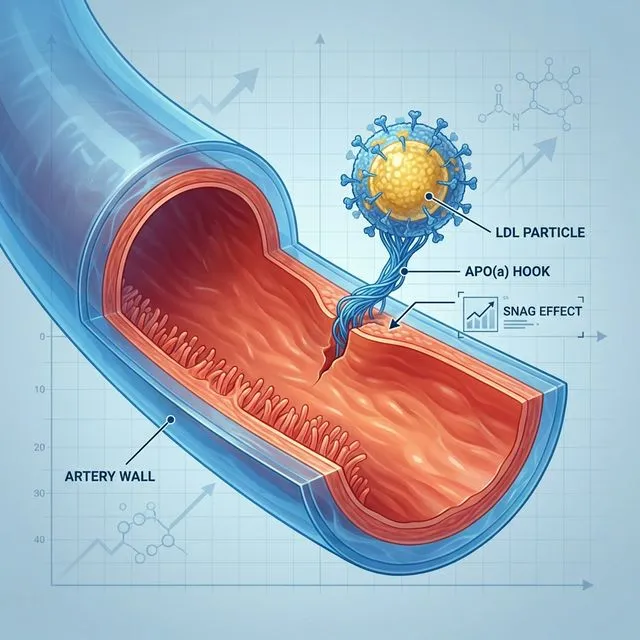
Lp(a), or lipoprotein(a), is a type of cholesterol particle that you inherit from your parents. About 1 in 5 adults carry high levels. Standard cholesterol panels do not test for it. You can have "perfect" cholesterol and still die of a heart attack. The cause is often Lipoprotein(a). Imagine an LDL particle (the bad cholesterol). Now imagine it carrying a sticky tail (Apo(a)). That is Lp(a). It digs into the artery wall, encourages clotting, and speeds up plaque buildup faster than ordinary LDL. It is one of the leading causes of "premature" heart attacks in fit, healthy people.2

What does the science say about Lp(a)?

The science says Lp(a) risk is real, linear, and causal. The 2022 European Atherosclerosis Society (EAS) consensus statement confirmed that higher Lp(a) means higher cardiovascular risk in a dose-dependent way.1
  • Genetic: Lp(a) is roughly 90% determined by your genes. Diet and exercise do not lower it.
  • Independent risk: Even if your LDL is 70, a high Lp(a) still drives risk.
  • Aortic stenosis: Lp(a) also calcifies the aortic heart valve, narrowing the valve over time, not just the arteries.
In Medicine 3.0, we test every patient for Lp(a) once. Because it is genetic, the level rarely changes. If you do not know your number, you are flying blind.

What is the Fishtown strategy if Lp(a) is high?

The Fishtown strategy if Lp(a) is high is to lower the surrounding risk while we wait for new specific drugs to mature. There are no FDA-approved drugs designed only for Lp(a) yet, though pelacarsen and olpasiran are in late-stage trials.4 If you have high Lp(a), we act on the rest of the picture:
  1. Crush ApoB: We drive your other harmful cholesterol particle count down to 60 mg/dL or lower. If we cannot remove the sticky particles (Lp(a)), we remove the standard particles (ApoB) so total burden drops.
  2. Baby aspirin (if appropriate): Lp(a) raises clot risk. Low-dose aspirin can help in select patients. We discuss bleeding risk first.
  3. Proactive imaging: We order a CT Coronary Angiogram (CTA) with Cleerly AI at age 40 (or earlier with strong family history) to see if the Lp(a) is already causing soft plaque that a calcium score would miss.
  4. Tight blood pressure and glucose control: Less stress on the artery wall.

What treatments actually move Lp(a)?

Treatments that move Lp(a) are limited today, but the field is changing fast.
InterventionEffect on Lp(a)Use Case
StatinsNeutral or slight increaseUsed to lower ApoB, which still reduces overall risk
PCSK9 inhibitors (Repatha, Praluent)Lowers Lp(a) about 25 to 30%Often the only currently approved drug class that meaningfully lowers Lp(a). Often covered for high-risk patients.3
NiacinLowers Lp(a) about 20%Rarely used now due to side effects and lack of outcome benefit
Pelacarsen, olpasiran (in trials)Lowers Lp(a) about 80% in trialsLikely available within a few years if outcome trials succeed
Lipoprotein apheresisLowers Lp(a) acutely about 60 to 80%Reserved for very high risk patients with progressive disease

Guidance from the Clinic

Dr. Ash
"Its like driving on icy roads. You cannot change the weather, but you can drive slower and put on snow tires."
Why We Start Early: At Fishtown Medicine, we have seen what happens when high Lp(a) is left unmanaged for decades. Our approach is shaped by years of treating those late-stage outcomes. That experience is why we test early and act early.
A common conversation: "Dr. Ash, my dad had a heart attack at 45. Is this why?" Our answer: "It is very likely. Lets test you." If you have a family history of early heart attacks, Lp(a) is a leading suspect. Having high Lp(a) is like driving on ice. You cannot change the weather (genes), but you can drive slower (lower ApoB) and put on snow tires (lifestyle, blood pressure control, low-dose aspirin when appropriate). You can still arrive safely.

Actionable Steps in Philly

Get the test. Then get a plan.
  1. Ask for it by name: At your next blood draw, write in "Lipoprotein(a)" or "Lp(a)." The cash price is usually about $40 if it is not covered.
  2. Interpret the number:
    • Under 30 mg/dL (or 75 nmol/L): Low risk.
    • 30 to 50 mg/dL (or 75 to 125 nmol/L): Grey zone.
    • Above 50 mg/dL (or 125 nmol/L): High risk. Apply the full Fishtown strategy.
    • Above 150 mg/dL (or 430 nmol/L): Very high risk. Consider PCSK9 inhibitors.
  3. Crush ApoB: Lower your other particle count to under 60 mg/dL.
  4. Test your kids once they are adults: Lp(a) is autosomal dominant, which means each child has a 50% chance of inheriting it.
Unmask the risk. Book Your Warm Invitation Call Here

Scientific References

  1. Kronenberg F, et al. "Lipoprotein(a) in atherosclerotic cardiovascular disease and aortic stenosis: a European Atherosclerosis Society consensus statement." European Heart Journal. 2022.
  2. Tsimikas S. "A Test in Context: Lipoprotein(a): Diagnosis, Prognosis, Controversies, and Emerging Therapies." Journal of the American College of Cardiology. 2017.
  3. O'Donoghue ML, et al. "Lipoprotein(a), PCSK9 Inhibition, and Cardiovascular Risk." Circulation. 2019.
  4. Tsimikas S, et al. "Lipoprotein(a) Reduction in Persons with Cardiovascular Disease." New England Journal of Medicine. 2020.
Medical Disclaimer: This resource provides clinical context for educational purposes. In the world of Precision Medicine, there is no "one size fits all", the right plan must be matched to your unique lab work, physiology, and goals. Consult Dr. Ash to determine if this approach is right for you, especially if you have chronic health conditions or are taking prescription medications.
Ashvin Vijayakumar MD (Dr. Ash)

Fishtown Medicine | Cardiovascular risk

2418 E York St, Philadelphia, PA 19125·(267) 360-7927·hello@fishtownmedicine.com·HSA/FSA Eligible

Frequently Asked Questions

Common Questions

Lp(a), or lipoprotein(a), is a cholesterol particle similar to LDL with an extra protein called apolipoprotein(a) attached. The extra protein makes it stickier and more likely to drive plaque, clotting, and valve calcification.
No, diet cannot fix high Lp(a) in any meaningful way. You can be a vegan marathon runner and still have high Lp(a) because it is roughly 90% genetic. Do not blame yourself or assume more salads will solve it.
Yes, your kids should be tested for Lp(a) once if you carry high levels. It is autosomal dominant, so each child has a 50% chance of inheriting it. Adult testing is fine for most, earlier if there is a strong family history of heart events.
Lp(a) is mostly linked to heart attack, stroke, and aortic valve stenosis (a narrowing of the heart valve). Some data also links low Lp(a) to slightly higher diabetes risk, but the cardiovascular link is the main concern.
Lp(a) needs to be tested only once because it is set by your genes and stays roughly the same for life. Levels can shift slightly with kidney disease, hormones, or thyroid issues, but the basic value is stable.
Lp(a) is reported in two units: mg/dL (mass) and nmol/L (particle count). The nmol/L unit is preferred today because it is less affected by particle size differences. Many labs report both. We treat at about 75 nmol/L or 30 mg/dL as the threshold.
Insurance often covers Lp(a) testing, especially with a personal or family history of early heart disease. If not covered, the cash price is usually around $40. We help you frame the order so coverage is more likely.
Pregnancy can raise Lp(a) levels temporarily because of hormonal changes. We avoid testing during pregnancy and a few months after delivery for an accurate baseline. Otherwise, Lp(a) is stable enough to trust a single test.
No. You can be a vegan marathon runner and still have high Lp(a). It is genetic. Do not blame yourself.
Yes. Lp(a) is autosomal dominant, meaning each child has a 50% chance of inheriting it. If you have it, test your children once they reach adulthood, or earlier if there is strong family history.
Mostly heart attack, stroke, and aortic valve stenosis (valve narrowing). Some data links lower Lp(a) to slightly higher diabetes risk, but cardiac risk is the main concern.

Deep-Dive Questions

Lp(a) damages arteries by combining the plaque-driving features of LDL with an extra protein, apolipoprotein(a), that resembles a clotting protein called plasminogen. That sticky, pro-clotting structure gets stuck in damaged endothelium and accelerates both plaque growth and clot formation.
Statins do not lower Lp(a) because they work by raising LDL receptors in the liver, while Lp(a) clearance does not depend mainly on those receptors. Statins still lower overall risk by lowering ApoB, which is why we use them in patients with high Lp(a).
Pelacarsen is a medication in late-stage trials that uses an antisense oligonucleotide (ASO), a short genetic snippet that tells the liver to stop producing the apolipoprotein(a) protein. In early trials, it has lowered Lp(a) by up to 80%. We are watching outcome trials closely.
Olpasiran is another Lp(a)-lowering drug in trials. It uses small interfering RNA (siRNA), a different way to silence the same gene. Both pelacarsen and olpasiran target the LPA gene in the liver. Olpasiran is dosed less often, every few months instead of every few weeks.
PCSK9 inhibition lowers Lp(a) modestly, by about 25 to 30%, by raising the number of LDL receptors on liver cells, which can also clear some Lp(a) particles. It is the only widely available drug class that lowers Lp(a) and ApoB at the same time.
Lipoprotein apheresis is a dialysis-like procedure that filters apoB-containing particles, including Lp(a) and LDL, out of the blood. It can lower Lp(a) acutely by 60 to 80% per session. It is reserved for very high risk patients with progressive disease who fail medications.
Lp(a) drives aortic valve stenosis by depositing in the valve leaflets, where it triggers inflammation and calcium buildup over years. The valve thickens and narrows, eventually limiting blood flow out of the heart. People with very high Lp(a) face higher rates of aortic stenosis at younger ages.
Yes, every adult should know their Lp(a) at least once. It is one of the cheapest tests in medicine and one of the most important. Knowing your number changes how intensive we are with ApoB targets, blood pressure goals, and imaging.
Smoking interacts with Lp(a) by damaging endothelial function and adding more inflammation to artery walls. People who smoke and carry high Lp(a) face dramatically higher heart attack rates than either factor alone. Quitting smoking is one of the highest-yield steps for high-Lp(a) patients.
Low-dose aspirin in high Lp(a) is used in select patients to counter the clotting risk that Lp(a) raises. We discuss bleeding risk and other medications before recommending it. Some data suggests aspirin may reduce events specifically in carriers of high Lp(a).
Lp(a) explains a meaningful share of family histories of early heart disease that have no other obvious cause. If a parent or sibling had a heart attack before 55 in men or 65 in women, Lp(a) is a leading suspect. Cascade testing of relatives is high-value.
Fishtown Medicine tests Lp(a) on every adult because the result changes treatment intensity for the rest of life. Testing once is cheap, fast, and informs how hard we work on ApoB, blood pressure, and imaging. Not testing leaves a major risk hidden in plain sight.

Still have a question?

He answers personally. Usually within a few hours.

Related Intelligence

Erectile Dysfunction: The Canary in the Coal Mine

Erectile Dysfunction: The Canary in the Coal Mine

ED is not just a sexual issue. It is the earliest warning sign of cardiovascular risk. Learn how to treat the root cause, not just the symptom.

Read Deep Dive
Longevity Strategies | Fishtown Medicine

Longevity Strategies | Fishtown Medicine

Strategies to extend your healthspan and optimize lifespan in Philadelphia.

Read Deep Dive
Metabolic Health

Metabolic Health

Why you feel tired at 3 PM, and how to fix it.

Read Deep Dive

Talk it through with Dr. Ash.

If anything you read here raised a question, this is a free 20-minute Warm Invitation Call. Pick a time and we’ll work through it together.

HSA/FSA eligible
No initiation or cancellation fees
No copays

Loading scheduler...

Having trouble with the scheduler? Book directly on Dr. Ash’s calendar

FishtownFish wrapped around the rod of AsclepiusMedicine
Philadelphia Primary Care
2418 E York St, Philadelphia, PA 19125Home visits in Greater PhiladelphiaPricing & membership

Serving Fishtown · Art Museum · Bella Vista · Callowhill · Center City · Center City West · Chestnut Hill · East Kensington · Fairmount · Fitler Square · Graduate Hospital · Logan Square · Manayunk · Northern Liberties · Old City · Olde Richmond · Poplar · Port Richmond · Queen Village · Rittenhouse · Roxborough · Society Hill · Southwark

Explore by topic

Women’s Health
  • Perimenopause
  • Menopause 3.0
  • PCOS
  • Fertility
Men’s Health
  • TRT Therapy
  • TRT Safety
  • TRT vs Enclomiphene
  • Low Libido
Metabolic
  • Medical Weight Loss
  • Ozempic vs Metformin
  • Fasting Protocols
  • Visceral Fat
Cardiovascular
  • apoB & Heart Health
  • apoB vs LDL
  • Lp(a) Cholesterol
  • ED & Heart Risk
Longevity + Performance
  • Healthspan vs Lifespan
  • Biological Age
  • VO2 Max
  • Zone 2 Training
Supplements
  • Magnesium
  • Creatine
  • Omega-3
  • Foundational Stack
  • Shop the Dispensary
Care in Philadelphia +
Direct Primary Care in Philadelphia, PAConcierge Medicine in Philadelphia, PAConcierge vs DPC in Philadelphia, PALongevity Medicine in Philadelphia, PAPreventive Care in Philadelphia, PAExecutive Physical in Philadelphia, PAAnnual Physical in Philadelphia, PAHealthspan Optimization in Philadelphia, PAFunctional Medicine in Philadelphia, PASame-Day Sick Visits in Philadelphia, PATestosterone Replacement Therapy in Philadelphia, PAPerimenopause Care in Philadelphia, PAMenopause Care in Philadelphia, PAThyroid Treatment in Philadelphia, PAPCOS Care in Philadelphia, PAGLP-1 Weight Loss in Philadelphia, PAMetabolic Health in Philadelphia, PAHormone Optimization in Philadelphia, PAAdvanced Lipid Testing in Philadelphia, PAVO2 Max Testing in Philadelphia, PADEXA Scan in Philadelphia, PACGM in Philadelphia, PALong COVID Care in Philadelphia, PAChronic Fatigue Treatment in Philadelphia, PAPOTS Treatment in Philadelphia, PAMCAS Treatment in Philadelphia, PALyme Disease Care in Philadelphia, PABrain Fog Treatment in Philadelphia, PASleep Disorders Treatment in Philadelphia, PAStrep Throat Treatment in Philadelphia, PAUTI Treatment in Philadelphia, PASinus Infection Treatment in Philadelphia, PASTI Testing in Philadelphia, PATravel Medicine in Philadelphia, PAPre-Op Clearance in Philadelphia, PASports Club Medicine in Philadelphia, PA

Content is for educational purposes only and does not constitute medical advice.

TermsPrivacyScope of PracticeClinical Independence