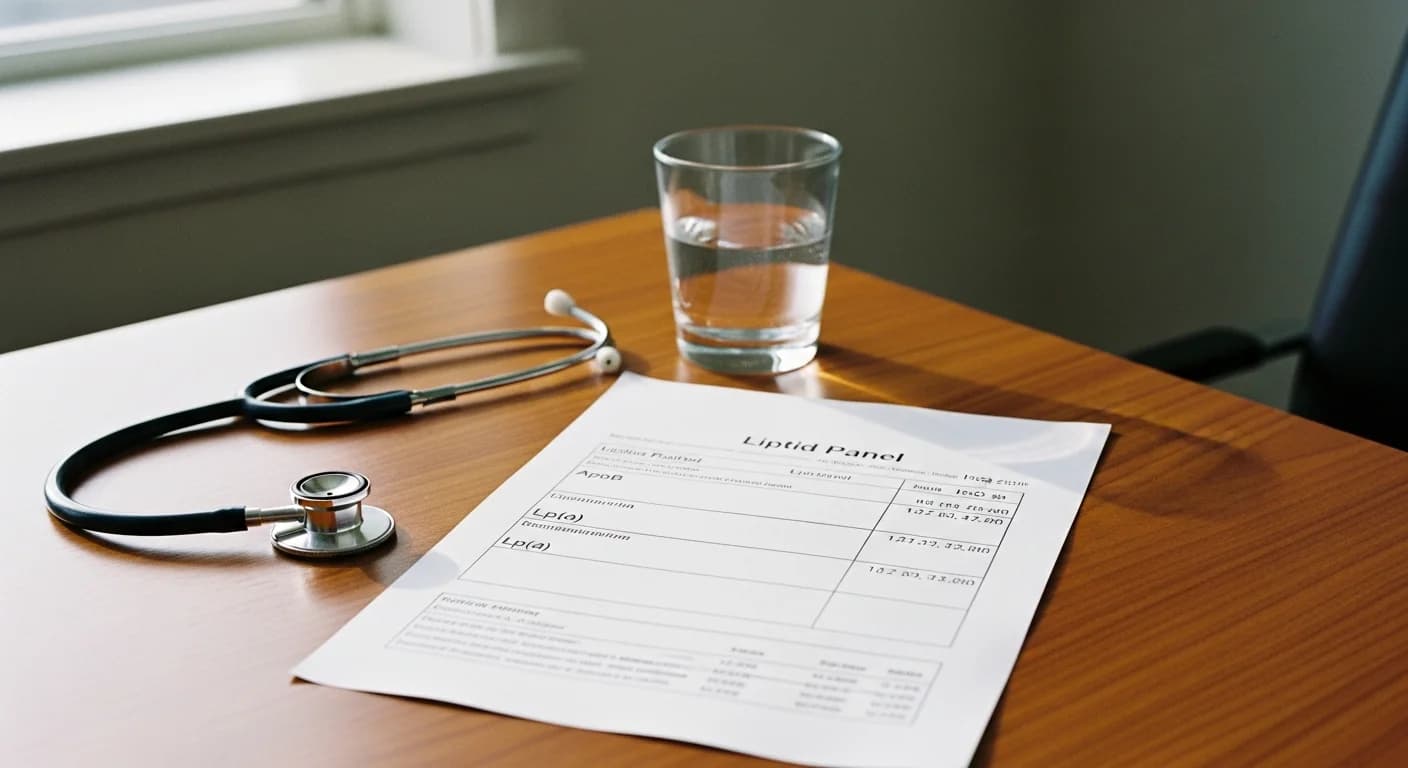

ApoB is a blood test that counts the particles that cause plaque in your arteries. LDL-C only estimates the weight of cholesterol they carry. About 1 in 3 people have a normal LDL but a high ApoB, which means a standard cholesterol report can miss serious heart risk.
Table of Contents
- Why Standard Lipid Panels Fall Short
- The Truck and Cargo Analogy
- The Discordance Gap: Where Heart Attacks Hide
- How We Lower ApoB: Functional and Pharmaceutical Tools
- Are You in the Discordance Gap?
- Common Questions
- Deep Questions
Why Standard Lipid Panels Fall Short
You go to your annual physical, get a basic cholesterol panel, and get a quick call back. "Your numbers look fine. Cut back on cheese. See you next year." You hang up relieved. You feel safe.
That moment is often where good preventive medicine fails without anyone noticing.
Most doctors still use LDL-C, which stands for low-density lipoprotein cholesterol. LDL-C measures the weight, or concentration, of cholesterol in your blood. It became standard in the 1970s because it was cheap and easy to estimate. It is also not the only risk your standard panel hides, since remnant cholesterol is right there in the same report and rarely gets calculated.
The problem is biology. The cells in your artery wall do not get damaged by the weight of cholesterol drifting by. They get damaged by the number of particles crashing into them, again and again, over years.
In Medicine 3.0, the model we follow at Fishtown Medicine, we measure ApoB, short for apolipoprotein B. ApoB counts the number of plaque-causing particles in your blood. Knowing your LDL without knowing your ApoB is like knowing the total weight of traffic on I-95 without knowing how many cars are on the road.
I have seen what happens when patients are told they are "safe" based only on LDL-C. I have cared for the heart attacks and strokes that should not have happened. That experience is why I do not rely on outdated metrics for the people I care for.
The Truck and Cargo Analogy
Atherosclerosis, the buildup of plaque inside artery walls, is driven by how often particles collide with the artery lining, rather than by how much cholesterol they happen to carry.
Picture your artery as the Schuylkill Expressway. Cholesterol is the cargo. The lipoprotein particles are the cars and trucks carrying it.
- LDL-C measures the total weight of the cargo.
- ApoB measures the number of vehicles.
A traffic jam in your arteries comes from the number of vehicles on the road, and the weight of the passengers has little to do with it. If you have 1,000 passengers in 1,000 small cars, the road is jammed. If those same 1,000 passengers ride in 20 buses, the road is clear.
Standard medicine measures the passengers, while we measure the cars. ApoB is the car count.
The Discordance Gap: Where Heart Attacks Hide
If LDL-C and ApoB always told the same story, the test you ordered would not matter. They do not always tell the same story. In an estimated 20 to 50% of people, the 2 values are discordant, meaning they disagree.
The dangerous version looks like this:
- Normal LDL-C, high ApoB. Your standard panel says "fine." Your particle count says "not fine." This pattern shows up most often in people with insulin resistance (when cells respond poorly to insulin), high triglycerides, or central body fat.
This describes a large slice of busy professionals across Philadelphia who eat on the run, sit through long meetings, and sleep less than they should. We use ApoB to find the people hiding in this gap.
You can read more about how this connects to overall metabolic patterns in our guide on metabolic health.
What if my fasting numbers are perfect and my particles are not?
This is the version that gets missed, and it deserves its own explanation, because the usual reasoning runs backward through it.
Small dense LDL is normally described as downstream of insulin resistance and high triglycerides. So when someone turns up with a high particle count, pattern B, and a pile of small dense particles, while their fasting triglycerides, fasting insulin, HOMA-IR, and A1c all come back excellent, the natural conclusion is that the pattern cannot be metabolic and has to be inherited.
That conclusion rests on a hidden assumption: that a fasting panel describes your metabolism. It describes your metabolism after 12 hours without food, which for most people is the least eventful stretch of the day.
The machinery that builds small dense LDL runs hardest in the hours after eating. A protein called cholesteryl ester transfer protein, or CETP, swaps triglyceride into LDL and HDL particles in exchange for cholesterol, and hepatic lipase then trims those triglyceride-loaded particles down into the small dense form. That transfer roughly doubles after a meal, and insulin is one of the things that switches CETP on. The pattern is assembled in the hours after eating, and a fasting draw arrives long after the work is finished.
That is why small dense particles can form in someone whose fasting triglycerides never leave the normal range. It is also why non-fasting triglycerides predict cardiovascular events at least as well as fasting ones, and why European guidance stopped requiring a fast for a routine lipid panel.
There is sometimes a clue on the fasting panel itself. A fasting glucose at the top of the normal range, paired with an A1c and an estimated average glucose that read higher than that fasting number alone would predict, means the average is being pulled up by hours the fasting draw never saw. The gap between those 2 numbers is postprandial territory.
Fishtown Medicine
A 90-minute conversation with Dr. Ash. A written plan you can follow.
What this means in practice: excellent fasting labs do not rule out a metabolic driver, they only fail to show one. Somebody who eats most weekday meals out can be pristine at 8am and spend several hours a day in a state no blood draw has ever sampled. The way to settle it is to measure that state rather than reason around it, which is what wearing a continuous glucose monitor through ordinary eating does, alongside a look at the composition of the fats in the diet.
How We Lower ApoB: Functional and Pharmaceutical Tools
Once we know your ApoB number, the plan is rarely "eat more oatmeal." We build a layered strategy that uses food, supplements, and medications based on how high the number is and what is driving it.
| Mechanism | Functional Tools | Pharmaceutical Tools |
|---|---|---|
| Pull more particles out of the blood | Soluble fiber (psyllium husk) binds bile acids in the gut, so the liver pulls more LDL and ApoB out of the blood to make new bile. | Statins block the livers main cholesterol-making enzyme. The liver responds by pulling more particles out of the blood. |
| Block absorption | Plant sterols compete with cholesterol for absorption in the gut. | Ezetimibe specifically blocks cholesterol absorption in the small intestine. |
| Boost LDL receptor activity | Berberine can mildly increase the LDL receptors that pull particles out of the blood. | PCSK9 inhibitors (a monthly injection) protect those receptors and can lower ApoB by more than half. |
| Slow particle production | Red yeast rice contains monacolin K, a natural statin-like compound. | Bempedoic acid acts on the same pathway as statins but only in the liver, which can avoid muscle side effects. |
For mild elevations or someone newly tuning their diet, we often start with food and fiber. For people with strong genetic patterns or existing plaque, we move quickly to medications, because biology will outpace lifestyle on its own.
Guidance from the Clinic

Patients often ask, "Why was this not part of my old labs?"
It usually takes about 17 years for strong evidence to become standard practice. ApoB is the better marker, but the broader system is slow to update. We do not wait for that to change. We give you the data and the agency to act on the best available science today.
I treat ApoB with the seriousness of a cancer screening result. We want it low. The targets I generally use:
- Low risk: under 80 mg/dL.
- Optimal: under 60 mg/dL.
- Reversal range (for people with known plaque): under 40 mg/dL.
Are You in the Discordance Gap?
Use this short list to see if your "normal" cholesterol may be hiding heart risk.
- Belly weight or a waist over 35 inches (women) or 40 inches (men)?
- Triglycerides over 100 mg/dL?
- Fasting insulin over 8 microIU/mL?
- Family history of heart attack or stroke before age 60?
- Diagnosed with pre-diabetes or metabolic syndrome?
- High-carb or high-saturated-fat eating pattern?
- Eating most weekday meals out or on the run, even if your fasting labs look good?
- Told your "ratios look fine" without ApoB ever being mentioned?
If you checked 2 or more boxes, your standard panel may be falsely reassuring. An ApoB test can show what is happening underneath.
If you checked none of them and your particle count is still high, read the section above on what happens after meals. An unremarkable fasting panel is the most common reason this pattern gets called inherited when it is not.
Actionable Steps in Philly
Your next move is simple. Stop guessing. Get the right number.
- Request the test: Ask for ApoB specifically at your next blood draw. Most labs can add it for around $15 to $20. If your current practice will not order it, we are happy to.
- Audit saturated fat: A diet heavy in butter, fatty meat, and tropical oils raises ApoB in many people. Lean toward olive oil, nuts, avocado, and fatty fish.
- Add soluble fiber: Beans, lentils, oats, and a serving of psyllium husk in the morning can drop ApoB by roughly 5 to 10% on their own.
- Walk after meals: A 10 to 15 minute walk after eating helps lower triglycerides, which often travel with high ApoB.
- Check your family history: Early heart disease in a parent or sibling is a strong reason to test ApoB and lipoprotein(a) at least once.
We use ApoB as our north star for heart health, because it counts the cars rather than the cargo.
If you are in the Philadelphia area and want to stop guessing about your cardiovascular risk, book a Warm Invitation Call and we will look at your data together.
Key Takeaways
- ApoB counts particles. LDL-C estimates weight. Particles cause plaque, so ApoB is the better signal.
- 20 to 50% of people are discordant. Their LDL looks fine, but their ApoB is high.
- Insulin resistance and central body fat are the most common reasons LDL underestimates risk.
- Lower targets matter. Under 80 mg/dL for low risk, under 60 mg/dL for optimal, under 40 mg/dL for plaque reversal.
- The test is cheap. Around $15 to $20 at most major labs.
Scientific References
- Sniderman AD, et al. Apolipoprotein B Particles and Cardiovascular Disease: A Narrative Review. JAMA Cardiol. 2019;4(12):1287-1295.
- Mach F, et al. 2019 ESC/EAS Guidelines for the management of dyslipidaemias. Eur Heart J. 2020;41(1):111-188.
- Marcovina S, et al. Effect of discordance between low-density lipoprotein cholesterol and particle number on coronary artery disease. Am J Cardiol. 2007.
- Ference BA, et al. Low-density lipoproteins cause atherosclerotic cardiovascular disease. Evidence from genetic, epidemiologic, and clinical studies. Eur Heart J. 2017;38(32):2459-2472.

Fishtown Medicine | Articles
Frequently Asked Questions
Common Questions
Deep-Dive Questions
Ready when you are
The chat is our AI assistant, answering from our published guides. To talk it through with Dr. Ash himself, start with the intake.