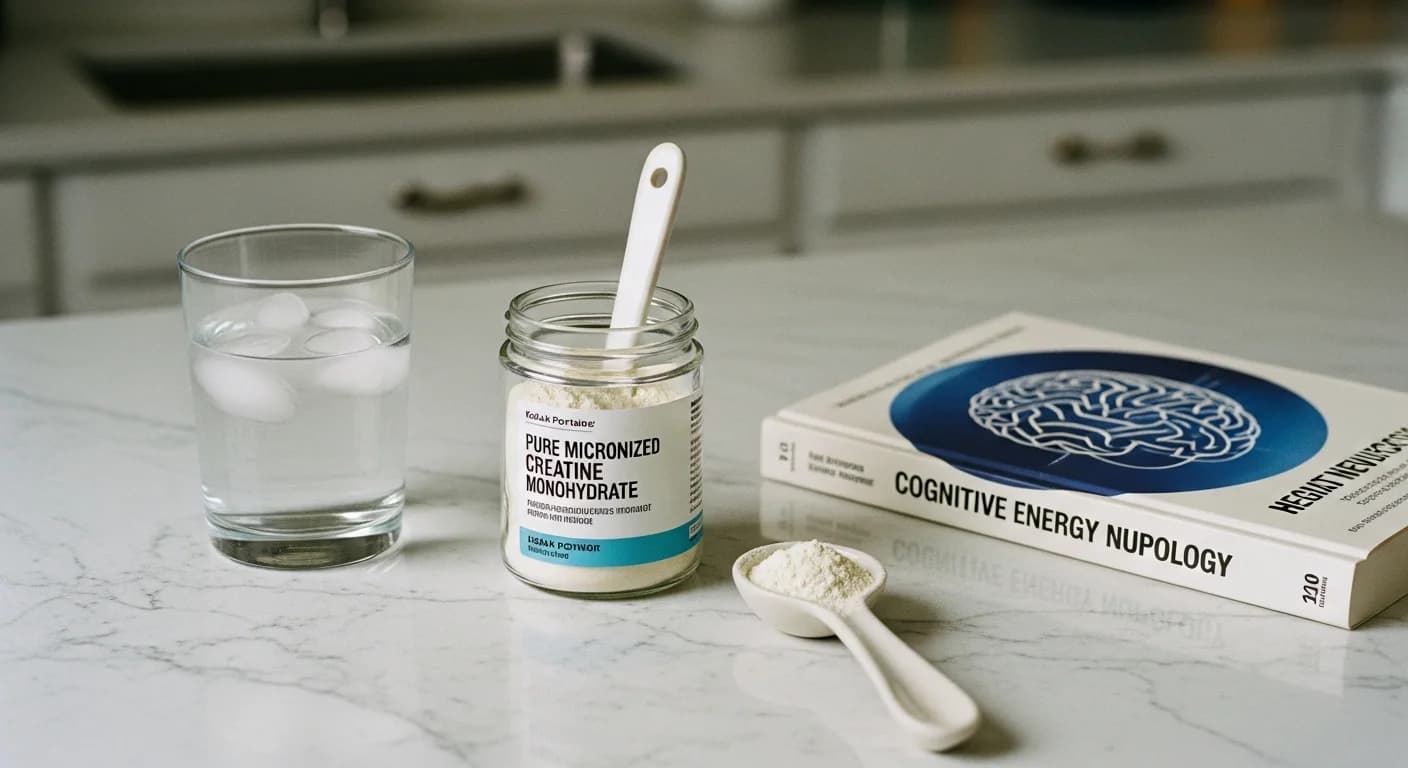

Creatine monohydrate is a natural compound your body uses to recycle energy (ATP) inside muscle and brain cells. A daily dose of 3 to 5 grams supports strength, power, and recovery, and a higher 10 to 20 gram dose may support thinking and resilience during sleep loss. It is one of the safest, most studied supplements available.
At Fishtown Medicine, I treat creatine as a foundational tool for patients who want better metabolic health, more stable daytime energy, and protection against age-related muscle loss. It is less about bulking up and more about giving cells the short-term energy reserve they need to do their jobs.
What creatine is and what it does
Creatine is a natural compound built from amino acids that your body uses to recycle ATP, the main energy currency of every cell. The body makes some on its own, and you get small amounts from red meat and fish.
It works by donating a phosphate group to recycle ADP back into ATP inside muscle and brain tissue, increasing the cells short-term energy reserve. This makes it useful for any process that burns through energy quickly: a heavy set of squats, a long shift, a night of poor sleep. Plant-based eaters tend to start with lower baseline creatine stores because most dietary creatine comes from meat and fish, which is one reason they often see a bigger response to supplementation.
Who this is for (and who it isn't)
Creatine tends to fit well for:
- People building strength and power. Anyone training for muscle size, power output, or sport performance. Grip strength and lean mass are 2 of the numbers we track on a performance physical, and creatine moves both.
- Healthy aging adults. Older adults trying to preserve strength and slow sarcopenia (age-related muscle loss). Paired with 2 to 3 weekly strength sessions, creatine improves strength, lean mass, and even bone density.
- Vegetarians and vegans. Plant-based eaters have lower baseline levels and often see the clearest response from a daily 3 to 5 gram dose.
- People with mental fatigue. Patients dealing with chronic fatigue, brain fog, or short sleep. Higher doses may protect thinking speed and accuracy during acute sleep loss.
It needs a conversation first, or isn't the right move, if:
- People with kidney disease (Stage 3 or higher). Safety is strong in healthy kidneys, but a nephrologist should weigh in first.
- People with bipolar disorder. Energy support could, in theory, interact with mood swings, although this is uncommon.
- Pregnancy or breastfeeding. Human data is limited, so confirm with your obstetrician before starting.
How we evaluate it: do you need it, is it safe, does the dose work, then cost
Every supplement we recommend runs the same 4 gates, in order, and most things never make it past the first one (the whole process is in how we choose supplements).
- Do you need it? No lab decides this. It attaches to a strength, muscle, or cognitive goal, and the evidence is strong enough that it is one of the few we bring up before being asked.
- Is it safe? We want a third-party-tested product with an NSF Certified for Sport or Informed Sport seal. The FDA does not pre-approve supplements, and cheap or imported creatine can contain contaminants.
- Does the dose work? The preferred form is creatine monohydrate. Skip the advanced forms like HCL, ethyl ester, or liquid creatine; the data consistently shows monohydrate is the most effective and the most cost-effective. Plain monohydrate without proprietary blends or unnecessary fillers is the standard.
- What does it cost? Among third-party-tested options, creatine monohydrate is one of the best supplement values you can buy. Buying in bulk (1 kilogram) brings the daily cost to about 25 to 40 cents.
- What we make on it: nothing. Our only charge is the flat membership fee, and nothing is ever added on top of it. We take nothing on supplements, labs, imaging, or medication, which means every discount we can negotiate reaches you at cost. There is no conflict of interest here to work around, so the 4 gates above are the only things deciding what you hear from us.
How to dose it, and when
Consistency matters far more than the time of day.
Standard dose (muscle and maintenance):
- 3 to 5 grams per day for most adults. Larger athletes (over 200 pounds) can use 5 to 10 grams.
- Optional loading: 20 grams per day, split into 4 five-gram doses, for 5 to 7 days to saturate muscle faster. Loading is not required. The standard daily dose fully saturates muscle tissue within about 30 days, with less risk of stomach upset.
Higher dose (cognitive and resilience):
The brain is harder to reach because the blood-brain barrier limits how much creatine gets in. To reach brain saturation, higher doses or a longer duration are needed. Consider this for shift workers, new parents, or anyone consistently sleeping under 6 hours; patients in concussion recovery; and anyone under heavy cognitive demand.
- 10 to 20 grams per day, split into morning and afternoon doses. Large single doses can cause stomach upset, so spread them out.
Timing notes:
- Mix 5 to 10 grams into hot coffee or tea. It dissolves quickly in hot liquid, and caffeine does not block creatine absorption (a common myth).
- For travel or jet lag: 10 grams when you land supports rehydration and cellular energy.
- After a poor night of sleep, alcohol, or illness: 10 grams in the morning for recovery support.
- Take creatine on rest days too. You are aiming for steady-state saturation rather than an acute pre-workout boost.
Brain effects, when they happen, often take 4 to 8 weeks of consistent dosing.
Fishtown Medicine
A 90-minute conversation with Dr. Ash. A written plan you can follow.
Flaws, side effects, and interactions
Creatine has an excellent safety record, with a few things to keep in mind:
- Water weight. Creatine pulls water into muscle cells. This can add 1 to 3 pounds of water weight in the first month, mostly inside muscle. It is water rather than fat, and most people find it helpful.
- Stomach upset. Large single doses (above 10 grams at once) can cause cramping or loose stools. Splitting the dose solves this.
- Kidney load. Safety is strong in healthy adults, but people on nephrotoxic medications (long-term high-dose NSAIDs, some antibiotics) should confirm with their prescriber. Creatine is not known to interact with antidepressants, statins, or thyroid medications.
- Bipolar disorder. There is a theoretical concern that energy support could interact with mood swings, though this is uncommon in practice.
- Hair loss. Likely not a concern. The fear comes from a single 2009 study showing a rise in DHT in rugby players; that result has never been reliably reproduced. Genetics drive hair loss far more than supplements.
- Doses above 25 grams per day can cause stomach upset, cramping, or loose stools and provide no extra benefit. For most healthy adults, the ceiling of useful daily intake is around 10 to 20 grams.
What we recommend, and what we don't
- We look for: plain creatine monohydrate with a third-party testing seal (NSF Certified for Sport or Informed Sport). Brands with a strong track record include Thorne Creatine Monohydrate (NSF Certified for Sport) and Thorne Travel Packs for convenience. Nutricost or BulkSupplements are good budget options for high-volume daily use.
- Worth considering alongside creatine: whey protein provides amino acids to build new muscle, while creatine helps the muscle you have generate more force and recover faster. The two are complementary.
- We skip: HCL, ethyl ester, liquid creatine, or proprietary blends marketed as next-generation, which cost more without working better. Steer clear of creatine drinks with added sugar, where the sugar itself drives the glucose impact.
Guidance from the Clinic
"In my practice, I often say creatine is a victim of bad marketing. If we discovered it today, we would call it a mitochondrial energy support nutrient and prescribe it for healthy aging. It is one of the lowest-risk, highest-yield tools I have for protecting muscle and brain function over time."
Dr. Ash
Actionable Steps
Build the creatine habit that sticks.
- Pick monohydrate. Choose a third-party tested creatine monohydrate. Skip the fancy next-gen forms; they are more expensive and not better.
- Anchor the habit. Stir 5 grams into your morning coffee or smoothie every day. Skip the loading phase if your stomach is sensitive.
- If you are sleep deprived or training hard, add a second 5-gram dose at lunch for cognitive support.
- Track the right signals. Note grip strength, sets at your usual weight, or a 1-to-10 mental energy score. Recheck at 4 and 12 weeks.
- Stay consistent on rest days. Steady-state saturation is the whole point; skipping days slows the process.
Key Takeaways
- Creatine monohydrate recycles ATP in muscle and brain cells, making it useful for strength, recovery, and cognitive resilience under stress or sleep loss.
- The standard dose is 3 to 5 grams daily for muscle; 10 to 20 grams daily for brain saturation. Loading is optional and not required.
- Plant-based eaters often see the biggest response, starting from lower baseline stores.
- Creatine has one of the strongest safety records in supplement research; the main caution is kidney disease (Stage 3 or higher), where a nephrologist should weigh in first.
- Choose plain creatine monohydrate with a third-party testing seal (NSF Certified for Sport or Informed Sport). Skip proprietary blends and next-gen forms.
A note on cost: any discount we negotiate on professional-grade supplements passes straight through to you, with no markup. Here is how we choose and source supplements.
Scientific References
- Kreider RB, et al. International Society of Sports Nutrition position stand: safety and efficacy of creatine supplementation in exercise, sport, and medicine. J Int Soc Sports Nutr. 2017.
- Rae C, et al. Oral creatine monohydrate supplementation improves brain performance: a double-blind, placebo-controlled, cross-over trial. Proc Biol Sci. 2003.
- Chilibeck PD, et al. Effect of creatine supplementation during resistance training on lean tissue mass and muscular strength in older adults: a meta-analysis. Open Access J Sports Med. 2017.
- Dolan E, et al. Beyond muscle: the effects of creatine supplementation on brain creatine, cognitive processing, and traumatic brain injury. Eur J Sport Sci. 2019.
- Kondo DG, et al. Creatine target engagement with brain bioenergetics: a dose-ranging phosphorus-31 magnetic resonance spectroscopy study of adolescent females with SSRI-resistant depression. Amino Acids. 2016.

Fishtown Medicine | Articles
Frequently Asked Questions
Common Questions
Deep-Dive Questions
Ready when you are
The chat is our AI assistant, answering from our published guides. To talk it through with Dr. Ash himself, start with the intake.