Fishtown Medicine Library
Heart Health & Risk
Protecting your most important engine.

High Triglycerides: What Your Number Means and What To Do
What 150, 500, and 1000 mg/dL triglycerides mean, and the diet, activity, and medication steps for each level. From Fishtown Medicine in Philadelphia.
Read Full Guide
Remnant Cholesterol: The Risk Hiding in Your Standard Panel
Remnant cholesterol is a causal heart risk you can calculate for free from a standard lipid panel, and it explains "normal LDL but still at risk." How to find it and what to do, from Fishtown Medicine in Philadelphia.

Adding Ezetimibe to a Low-Dose Statin Lowers ApoB More Than Three Statin Dose Doublings
Ezetimibe (Zetia) blocks intestinal NPC1L1 cholesterol absorption. See how it pairs with low-dose statins in the RACING and IMPROVE-IT trials to lower ApoB.

High Fibrinogen: What It Means for Your Heart
A high fibrinogen predicts heart risk but is not a treatment target. What the clotting-and-inflammation marker reflects, why genetics say it is a messenger not a cause, and how to respond, from Fishtown Medicine in Philadelphia.

GLP-1 Drugs and Heart Failure: What HFpEF Changes
GLP-1 drugs help one specific kind of heart failure, the obesity-driven HFpEF, and may not help another. What STEP-HFpEF and SUMMIT showed, why the type of heart failure matters, and how this differs from SGLT2 inhibitors.

Heart Disease in Women: Different, and Often Missed
Cardiovascular disease is the leading killer of women, yet under-recognized. The truth about women's heart symptoms, the risk factors unique to women, the menopause window, and why women are undertreated.

Lp-PLA2 (the PLAC Test): What It Means for Your Heart
A high Lp-PLA2, or PLAC test, carries a modest heart-risk signal but is not a treatment target. Why a drug built to lower it failed in two large trials, and what to do instead, from Fishtown Medicine in Philadelphia.

Repatha and Praluent Drop LDL 60%, Cut First Heart Attacks 36%, and Leave Brain and Blood Sugar Untouched
PCSK9 inhibitors (Repatha, Praluent) lower LDL by 55 to 60% and Lp(a) by 25 to 30% on top of a statin. What FOURIER-OLE, ODYSSEY, VESALIUS-CV (2026), and 5-year EBBINGHAUS brain testing prove for proactive prevention.

Autonomous Aldosterone Drives 11% to 22% of High Blood Pressure and Can Be Cured or Blocked
Primary aldosteronism drives 15.7% of Stage 1, 21.6% of Stage 2, and 22% of resistant high blood pressure in sodium-suppression studies (Brown 2020), yet fewer than 2% of eligible adults get tested. Why 70% have normal potassium, how to read renin and aldosterone without stopping meds, and why waking up renin (PRA >= 1.0 ng/mL/h) erases excess atrial fibrillation and stroke risk.

TMAO: What the Gut-Heart Marker Tells You
TMAO shows up on advanced cardiac panels and gets blamed on red meat and eggs. Here is what the gut-heart marker means, why fish complicates the story, and whether it is worth testing, from Fishtown Medicine in Philadelphia.

Your Watch Flagged AFib: What to Do Next
A smartwatch irregular-rhythm alert is a screening flag that needs medical confirmation. How wearables compare to a 14-day Zio patch or 6-lead Kardia EKG, what frequent PACs, short SVT runs, and "micro-AF" mean when AFib is not found, and how CHA2DS2-VASc, EAST-AFNET 4, LEGACY weight loss, and HOLIDAY alcohol abstinence work.

Should You Take a Daily Aspirin? CAC-Guided Primary Prevention
Routine daily aspirin causes net harm when your coronary calcium score is zero (MESA 5-year NNT 1,190 vs. NNH 567) but delivers net benefit at CAC >= 100 (NNT 140 vs. NNH 518) in adults 40-70 with low bleeding risk.

High Troponin and NT-proBNP: Reading Cardiac Markers
A high troponin on a longevity panel is not proof of a silent heart attack, and a normal NT-proBNP can mislead in obesity. Here is what these cardiac blood markers mean when you are not in the emergency room.

Do Statins Cause Diabetes?
Statins slightly raise diabetes risk, but the effect is small and concentrated in people already near diabetes, and the heart benefit outweighs it. What the Sattar, Preiss, and JUPITER analyses show, and what to do.

Vascepa (4 g/day EPA) Cuts Heart Events 25% in High-Risk Hypertriglyceridemia - But Raises AFib 49%
Icosapent ethyl (Vascepa) lowered cardiovascular events by 25% in REDUCE-IT (HR 0.75, NNT 21), while STRENGTH was stopped early for futility (HR 0.99). Compare mineral oil placebo biomarker shifts, JELIS/RESPECT-EPA, 2026 ACC/AHA Class 2b vs. ESC Class IIa guidelines, and the 49% atrial fibrillation risk.

Inclisiran (Leqvio) Drops LDL 50% With Two Shots a Year - While Repatha Holds the Proven Heart-Attack Edge
Inclisiran (Leqvio) is a twice-a-year injection that lowers LDL by 50%, ApoB by 42%, and Lp(a) by 20 to 25% out to 6.8 years (ORION-8). How it compares to Repatha and Praluent while ORION-4 outcome results finish for 2027.

Low-Dose Colchicine Cuts Repeat Heart Attacks 26% and Strokes 33% When Artery Inflammation Stays High
Low-dose colchicine (0.5 mg daily) targets the NLRP3 inflammasome in chronic coronary disease. Why COLCOT and LoDoCo2 succeeded, why the 2025 CLEAR SYNERGY acute-STEMI trial was neutral, and what 30,659-patient meta-analyses prove.

Lowering Lp(a): The First Drugs That Can
How pelacarsen, olpasiran, lepodisiran, and oral muvalaplin lower Lp(a) by 80 to 97%, why Lp(a)HORIZON reported a negative topline primary endpoint in September 2026, and how to cut your global heart risk by 50 to 65% today.

What Is a Preventive Cardiologist, and Do You Need One?
A preventive cardiologist works to stop heart disease before it starts. How that differs from a regular cardiologist, and when advanced primary care can lead the prevention.

Bempedoic Acid Cuts Heart Attack Risk by 23% Without Activating in Skeletal Muscle
Bempedoic acid (Nexletol) is a liver-activated prodrug (ACSVL1) that spares skeletal muscle. Full CLEAR Outcomes trial data, gout/OAT2 rules, and Nexlizet.

Low-Dose Combination Therapy and Non-Statin Options Reach ApoB Targets With Fewer Side Effects Than High-Dose Statins
Can't tolerate a statin, or need more lowering than one provides? Ezetimibe, bempedoic acid, PCSK9 inhibitors, and lifestyle all lower cardiovascular risk. The options compared, and how Fishtown Medicine uses them in Philadelphia.

Why Your HDL Stays Stuck
Triglycerides down, LDL down, A1C down, and HDL still stuck or even lower. Why HDL is the slowest lipid marker to respond, what moves it, and why the number matters less than the pattern around it.

What Happens When You Stop a Statin
Heart attacks can cluster in the weeks after someone stops a statin, even a short gap. Why statins do more than lower cholesterol, what the rebound is, and the durable fix.

Your Calcium Score Is Back. Now What?
How to manage a positive coronary calcium score (CAC 1-99, 100+, 300+, 1000+) under the 2026 ACC/AHA guideline, why statins and PCSK9 inhibitors raise CAC by densifying plaque (PARADIGM, Puri, ARCHITECT), when CAC >= 100 justifies daily aspirin, and why CAC = 0 misses 10% to 16% of soft plaque.

Low-Dose Statin Plus Ezetimibe Matches High-Dose Statin Protection With 41% Fewer Side-Effect Dropouts
Worried about statin side effects? See how low-dose statin plus ezetimibe (RACING trial), bempedoic acid (CLEAR Outcomes), and PCSK9 options lower ApoB.

Borderline Cholesterol: How ApoB, Lp(a), and Blood Pressure Change the Plan
A 47-year-old with "borderline" LDL, a father who had a heart attack at 60, and a blood pressure nobody was tracking. How ApoB, Lp(a), and home BP turned "recheck in a year" into a plan.

The Heart Attack We Caught Seven Years Early
A 39-year-old case: how ApoB, Lp(a), and LDL particle number revealed cardiovascular risk a standard cholesterol panel and a zero calcium score had missed.

Stroke Prevention: What the 2024 Guideline Changes
About 80% of strokes are preventable. What the 2024 AHA/ASA guideline updated, what to ask your doctor, and how we work it into primary care in Philadelphia.

The 'Widowmaker' Genetic Risk Factor
You can have normal LDL and still carry high genetic heart attack and aortic valve risk. See how Fishtown Medicine tests Lipoprotein(a) once in every adult and cuts global cardiovascular risk by 50 to 65% today.

Heart Attack Risk Follows ApoB Particle Count, Even When Standard LDL Cholesterol Looks Normal
Half of heart attacks happen in people with 'normal' LDL cholesterol. How ApoB counts every plaque-forming particle, why 593,354-person discordance studies back ApoB, and why low-dose combination therapy beats doubling statin doses.
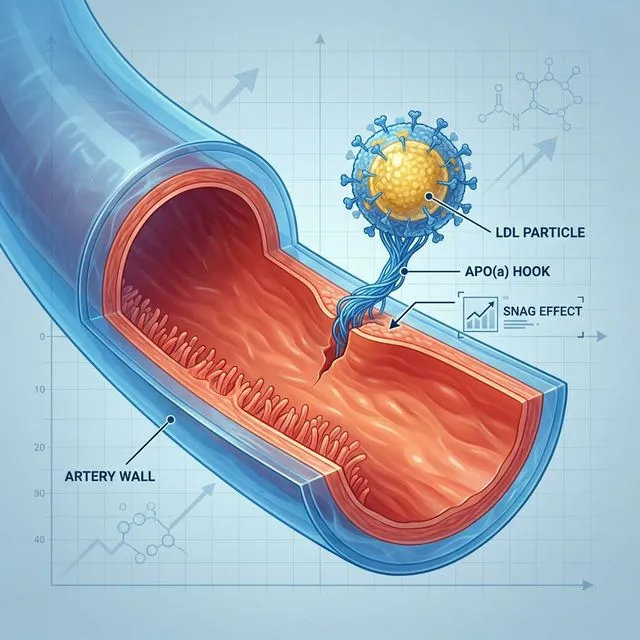
Lp(a): The Genetic Heart Risk
You can have perfect cholesterol and still be at risk. Learn the science of Lipoprotein(a), the genetic particle that standard blood tests miss.

ED: The Vascular Warning Sign
ED is often the earliest warning sign of cardiovascular risk. Learn how to treat the vascular root cause alongside the symptom.