

Lipoprotein(a), or Lp(a), is an inherited cholesterol particle (>= 50 mg/dL or >= 125 nmol/L in 1 in 5 adults) that drives heart attacks, strokes, and aortic valve narrowing. Four new Phase 3 drugs - pelacarsen, olpasiran, lepodisiran, and oral muvalaplin - lower Lp(a) by 80 to 97%. However, in September 2026, the first Phase 3 outcomes trial (Lp(a)HORIZON with pelacarsen, ~80% reduction) missed its primary 4-point MACE endpoint, shifting attention to deeper 94 to 97% siRNA reducers like olpasiran (OCEAN(a)-Outcomes, due late 2026) and lepodisiran (ACCLAIM-Lp(a), due 2029). Today, driving ApoB below 50 mg/dL, keeping blood pressure under 120/80, and keeping hs-CRP under 1.0 mg/L cuts heart and vessel events by 50 to 65% even while Lp(a) stays high.
TL;DR:
- What
Lp(a)is: Lipoprotein(a) (>= 50 mg/dLor>= 125 nmol/L) is a genetically fixed particle carried by roughly 1 in 5 adults that increases the risk of heart attacks, ischemic stroke, and aortic valve stenosis.1- The September 2026
Lp(a)HORIZONturning point: Pelacarsen (an injectable antisense drug that lowersLp(a)~80%) failed to meet its primary 4-point MACE endpoint in September 2026 (Lp(a)HORIZON,n = 8,323).23 That surprise result proves that lowering the lab number is not by default the same as preventing heart attacks - and puts the spotlight onolpasiran(OCEAN(a)-Outcomes, due late 2026) andlepodisiran(ACCLAIM-Lp(a), due 2029), which silenceLp(a)deeper (94 to 97%) and test heart-artery-focused endpoints.345- What works right now (
50 to 65%risk drop): InEPIC-Norfolk(n = 17,087),UK Biobank(n = 385,917), andFOURIER/ODYSSEY, high-Lp(a)patients who driveApoB < 50 mg/dL, keep blood pressure< 120/80 mmHg, and keephs-CRP < 1.0 mg/Lcut heart and vessel events by50 to 65%. At the same time,PCSK9inhibitors (evolocumab,alirocumab) lowerLp(a)19 to 30%and cut MACE by23%(NNT = 40).6789- Aspirin and niacin truths: Low-dose aspirin (
81 mg) cuts events by56 to 76%in carriers of theLPA rs3798220-Cgenetic variant (WHSandASPREEtrials). In contrast, pooled cohorts (n = 23,662) show no blanket benefit from Lp(a) level alone (HR 1.01) without genotype or heart-artery calcium (CAC >= 100) selection.101112 Never take niacin forLp(a): it failed inHPS2-THRIVE(n = 25,673), raises diabetes (+32%) and bleeding (+38%), and generates the vessel-toxic metabolite4PY.1314
Why has Lp(a) been so hard to treat - and what can you change today?
For decades, medicine could measure Lp(a) (>= 50 mg/dL or >= 125 nmol/L) but had no targeted drug to lower it safely. While targeted Phase 3 RNA and oral drugs now cut Lp(a) by 80 to 97%, your most powerful proven move today is crushing the changeable risks around it: driving ApoB below 50 mg/dL, holding blood pressure under 120/80 mmHg, and keeping hs-CRP below 1.0 mg/L.167
Lipoprotein(a) is an LDL-like particle wrapped in a sticky protein tail called apolipoprotein(a). Because 80 to 90% of your Lp(a) level is locked in by your LPA gene at birth, diet and exercise barely move the number.1 Statins do not lower Lp(a) (they can nudge it up by 5 to 15%), and niacin was abandoned after two massive outcome trials (AIM-HIGH and HPS2-THRIVE, n = 29,087 combined) proved it did not prevent heart attacks while causing diabetes, bleeding, and 4PY-driven vessel swelling.1314
Yet having an unchangeable Lp(a) number does not mean your heart attack risk is fixed. Across six randomized statin trials (Bhatia et al., Circulation 2025), EPIC-Norfolk (Verbeek 2018. Kraaijenhof 2025, n = 17,087), and the UK Biobank (Wang et al., 2025, n = 385,917), Lp(a) acts as a risk multiplier on top of ApoB, blood pressure, and vessel swelling (hs-CRP):671516
- When
LDL-C(ApoB),hs-CRP, andLp(a)are all high together, heart and vessel risk jumps2.41-fold(HR 2.41).6 - When high-
Lp(a)adults (>= 125 nmol/L) keep their changeable heart and vessel health high (Life's Simple 7 >= 10) and driveApoBandLDL-Cdown aggressively, their excess heart and vessel event rate drops by50 to 65%(HR 0.35).71617 - In the
FOURIER(n = 25,096) andODYSSEY OUTCOMES(n = 18,924) trials, adding aPCSK9inhibitor (evolocumaboralirocumab) to a statin loweredLDL-Cby50 to 60%and trimmedLp(a)by19 to 30%, cutting major adverse heart and vessel events by23%(NNT = 40over 3 years) in patients with high baselineLp(a).89
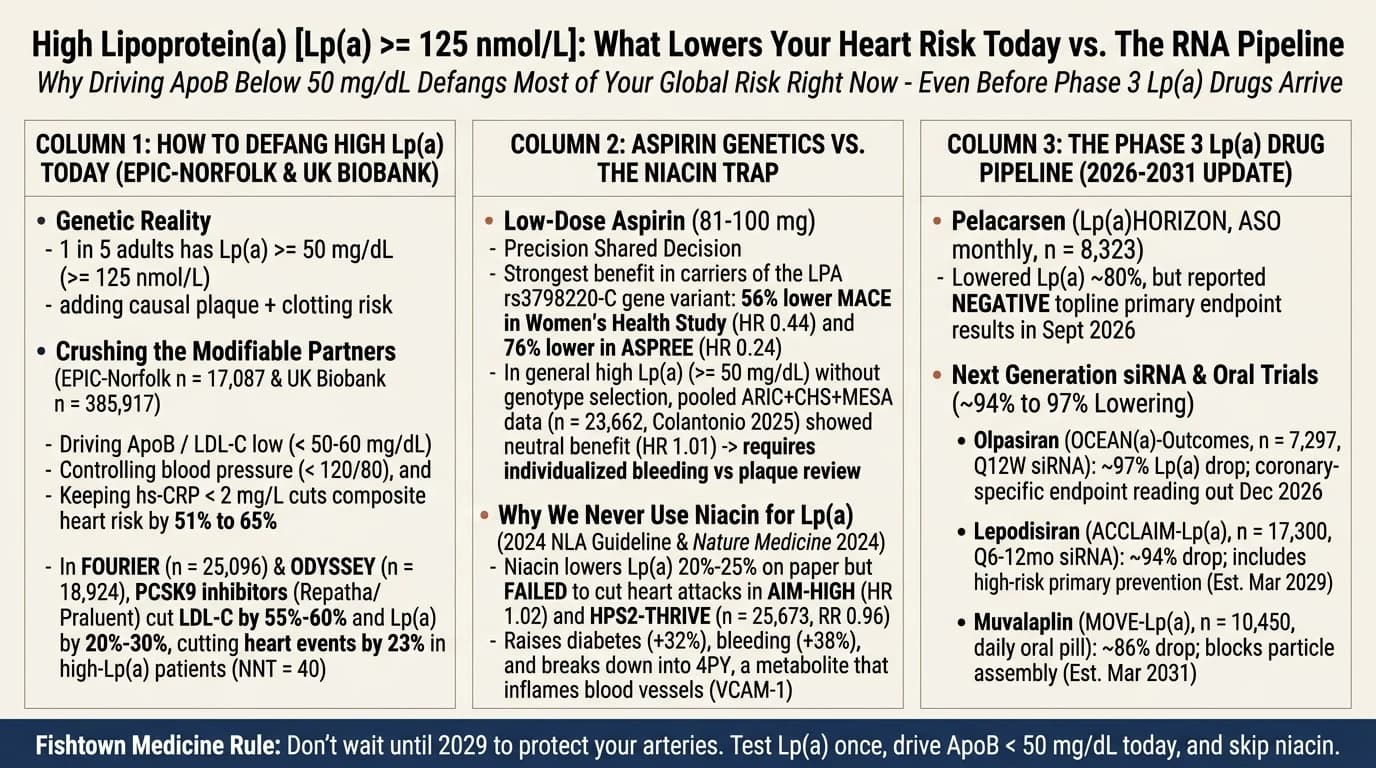
How do the four new Phase 3 Lp(a) drugs work - and what happened in Lp(a)HORIZON?
Four targeted drugs have reached Phase 3 trials: three injectable gene-silencers (pelacarsen, olpasiran, lepodisiran) that block the liver from building apolipoprotein(a) (80 to 97% reduction), and one daily oral pill (muvalaplin) that blocks the particle from assembling (~86% reduction). In September 2026, pelacarsen's Lp(a)HORIZON trial missed its primary 4-point MACE endpoint, making the deeper 94 to 97% siRNA trials the decisive test for the class.234518
Instead of trying to clear finished Lp(a) particles from the bloodstream, the new therapies stop Lp(a) production inside the liver cell (hepatocyte):
| Drug (Sponsor) | Mechanism & Route | Dosing Schedule | Lp(a) Reduction | Phase 3 Outcomes Trial (n) & Population | Primary Readout Status |
|---|---|---|---|---|---|
| Pelacarsen (Novartis / Ionis) | Antisense oligonucleotide (ASO) degrading LPA mRNA (SubQ injection) | 80 mg once monthly | ~80% | Lp(a)HORIZON (n = 8,323): Prior MI, stroke, or PAD + Lp(a) >= 70 mg/dL | Sept 2026: Did NOT meet primary 4-point MACE endpoint.23 |
| Olpasiran (Amgen) | Small interfering RNA (siRNA) via RISC complex (SubQ injection) | 225 mg every 12 weeks (quarterly) | ~94 to 97% | OCEAN(a)-Outcomes (n = 7,297): Prior CAD + Lp(a) >= 200 nmol/L (~80-90 mg/dL) | Expected ~December 2026 (plus OCEAN(a)-PreEvent in ~11,000 first-event patients due ~2031).4 |
| Lepodisiran (Eli Lilly) | Ultra-long-acting GalNAc-siRNA (SubQ injection) | 400 mg every 6 to 12 months | ~94% over days 60-180 | ACCLAIM-Lp(a) (n = 17,300): Established ASCVD or high-risk primary prevention + Lp(a) >= 175 nmol/L | Estimated March 2029.5 |
| Muvalaplin (Eli Lilly) | Small-molecule oral blocker preventing apo(a) from binding apoB-100 | 60-240 mg daily oral pill | ~85.8% (intact Lp(a) assay) | MOVE-Lp(a) (n = 10,450): Prior ASCVD or high-risk primary prevention + Lp(a) >= 175 nmol/L | Estimated March 2031.18 |
Why did Lp(a)HORIZON (pelacarsen) miss its primary endpoint in September 2026 - and could olpasiran or lepodisiran still succeed?
In September 2026, Novartis announced that Lp(a)HORIZON (n = 8,323) did not achieve a clear win on its primary 4-point MACE composite (heart and vessel death, non-fatal MI, non-fatal stroke, or urgent heart-artery revascularization).23 That result is a sobering reminder of why we never treat an unapproved drug as a guaranteed cure before outcome trials finish.
At the same time, lipidologists point to three biological differences that explain why OCEAN(a)-Outcomes (olpasiran, expected late 2026) and ACCLAIM-Lp(a) (lepodisiran) could still succeed:345
- Deeper
Lp(a)suppression (94-97%vs~80%): Mendelian randomization estimates suggest you need an absoluteLp(a)drop of50 to 100 mg/dL(~125 to 250 nmol/L) to match the~22%relative risk reduction of a38.7 mg/dL(1 mmol/L)LDL-Cdrop.1 In someone starting at80 mg/dL, an80%drop leaves residualLp(a)around16 mg/dL. In contrast, a95 to 97%siRNA reduction drivesLp(a)nearly to zero (< 3-5 mg/dL).34 - Higher baseline entry threshold (
>= 200 nmol/L):OCEAN(a)-Outcomesenrolled patients withLp(a) >= 200 nmol/L(~80-90 mg/dL), guaranteeing a larger absolute particle reduction thanLp(a)HORIZON's>= 70 mg/dLcutoff.34 - heart-artery-focused primary endpoint:
Lp(a)HORIZONincluded non-fatal stroke in its 4-point primary composite (where non-atherosclerotic strokes can dilute a lipid signal). In contrast,OCEAN(a)-Outcomesuses a pure 3-point heart-artery endpoint (heart-artery heart disease death, myocardial infarction, or urgent heart-artery revascularization).34
A critical lab caveat on oral muvalaplin
Muvalaplin (KRAKEN Phase 2 trial, Nicholls et al., JAMA 2025) is the first daily oral pill for Lp(a).18 Because it works by binding free apo(a) tails so they cannot attach to apoB-100, standard commercial lab tests that measure total apo(a) protein count those harmless drug-bound apo(a) fragments and underestimate the true drop (~70% on standard assays vs 85.8% on an intact Lp(a) particle assay).18
Should you take low-dose aspirin (81 mg) or niacin if your Lp(a) is high?
Never take niacin for high Lp(a) - it failed to reduce events in 29,000+ patients and generates a toxic vessel metabolite (4PY).1314 Low-dose aspirin (81 mg) is not a blanket rule for everyone with Lp(a) >= 50 mg/dL, but it strongly reduces events (56 to 76% reduction) in carriers of the LPA rs3798220-C genetic variant and is favored when high Lp(a) coexists with heart-artery plaque (CAC >= 100) and low bleeding risk.10111219
1. The Low-Dose Aspirin (81 mg) Nuance: Genotype vs. Mass Level
Because apolipoprotein(a) mimics plasminogen and slows clot breakdown, doctors long wondered whether daily aspirin (81 to 100 mg) could defuse Lp(a) thrombosis risk. The evidence splits sharply depending on how you select the patient:
- Strong protection in
LPA rs3798220-Cvariant carriers (HR 0.24to0.44): In post-hoc genetic analyses of two randomized placebo-controlled aspirin trials - the Women's Health Study (Chasman et al., 2009,n = 25,131) andASPREE(Lacaze et al., JACC 2022,n = 12,815older adults) - carriers of thers3798220-Cvariant randomized to low-dose aspirin had a56%reduction in heart and vessel events inWHS(HR 0.44) and a76%reduction in MACE inASPREE(HR 0.24,95% CI 0.07-0.82) without significant excess major bleeding.1011 - Mixed results when using
Lp(a) >= 50 mg/dLmass level alone: While a single-cohort propensity analysis inMESA(Bhatia et al., JAHA 2024,n = 2,183) suggested a46%lower CHD rate (HR 0.54) with aspirin in adults withLp(a) > 50 mg/dL,20 a much larger 2025 pooled analysis ofARIC,CHS, andMESA(Colantonio et al., Eur J Prev Cardiol 2025,n = 23,662) found no overall reduction in CVD (HR 1.12) or CHD events (HR 1.01) from aspirin based onLp(a) >= 50 mg/dLalone.12 A 2026 meta-analysis (Lopes et al., EJPC 2026,n = 6,628) confirmed that significant MACE reduction was proven inrs3798220-Ccarriers (HR 0.37) instead of unselected mass-high cohorts (HR 0.62, non-significant).21 - How we decide in the clinic: Following the
2024 NLA Updateand2026 ACC/AHAguidance, we do not put every 35-year-old withLp(a) = 60 mg/dLand zero plaque on aspirin by default.19 Instead, we favor81 mgdaily aspirin when highLp(a)is paired with heart-artery plaque on imaging (CAC >= 100, non-calcified plaque on CCTA, orCAC > 0withLp(a) >= 125 nmol/L) or confirmedrs3798220-Ccarrier status, provided bleeding risk is low.1119
2. Why Niacin (Vitamin B3) Is Off the table for Lp(a)
High-dose niacin (1.5 to 2 g/day) lowers Lp(a) on a lab report by 20 to 25%,22 which still tempts some supplement protocols. Do not use it:
- Zero heart and vessel benefit in 29,087 patients: Both
AIM-HIGH(n = 3,414,HR 1.02) andHPS2-THRIVE(NEJM 2014,n = 25,673,RR 0.96,p = 0.29) showed zero reduction in heart attacks or strokes when extended-release niacin was added to statin therapy.13 - Serious clinical harms: In
HPS2-THRIVE, niacin sharply increased new-onset diabetes by+32%(RR 1.32), diabetic complications (+55%), serious bleeding (+38%, including intracranial and GI hemorrhage), serious infections (+22%), and gout.13 - The
4PYvessel toxin discovery (Ferrell et al., Nature Medicine 2024): Excess niacin is broken down into a terminal metabolite called4PY(N1-methyl-4-pyridone-3-carboxamide), which directly triggersVCAM-1vessel swelling on artery walls and on its own predicts heart attacks and strokes.14 That explains the niacin paradox: the toxic4PYswelling cancels out the20%Lp(a)drop.
Guidance from the Clinic

Actionable Steps: Your If -> Then High-Lp(a) Playbook
Use these four If -> Then triggers if your Lp(a) is >= 50 mg/dL (>= 125 nmol/L):
- If your
Lp(a)is>= 125 nmol/L(>= 50 mg/dL) -> drive yourApoBbelow50 mg/dLandhs-CRPbelow1.0 mg/L: Low-dose rosuvastatin (5 to 10 mg) plus ezetimibe (10 mg) typically dropsApoBby50 to 60%. ifApoBremains above50 mg/dLor plaque is present, adding aPCSK9inhibitor (evolocumaboralirocumab) dropsApoBanother50%while trimmingLp(a)by19 to 30%(NNT = 40inFOURIER).689 - If you are over age 40 with high
Lp(a)-> image your heart-artery arteries (CCTAorCAC): BecauseLp(a)accelerates non-calcified soft plaque before calcium appears, a standard heart-artery CT Angiogram (CCTA) or heart-artery Calcium Score (CAC) tells us whether your arteries are clear or actively building plaque.19 - If your scan shows heart-artery plaque (
CAC >= 100or soft plaque onCCTA) or you carry theLPA rs3798220-Cvariant -> discuss81 mgdaily aspirin: With low bleeding risk, low-dose aspirin offsetsLp(a)'s clot-stabilizing tail where genotype (HR 0.24-0.44) or visible atheroma confirms high absolute risk.101119 - If someone recommends high-dose niacin (
Vitamin B3) forLp(a)-> stop it immediately: Niacin failed in 29,087 trial patients, raises diabetes (+32%) and bleeding (+38%), and produces the4PYmetabolite that inflames blood vessels (VCAM-1).1314
Related at Fishtown Medicine
- Lp(a): The Genetic Risk Most Panels Miss - what
Lp(a)is, theI-676traffic model, and family cascade testing - ApoB and Heart Health - the cholesterol particle target (
< 50 mg/dL) to drive down alongsideLp(a) - Beyond Statins: PCSK9 Inhibitors, Ezetimibe & Bempedoic Acid - how
PCSK9inhibitors lowerApoB50-60%andLp(a)20-30% - heart-artery Calcium Score (
CAC) vs.CCTA- checking whetherLp(a)has laid down soft or calcified plaque - Heart Imaging Guide (
CAC,CCTA,Cleerly) - choosing the right scan whenLp(a)is high - Lp(a) and Cholesterol - why a normal standard lipid panel hides high
Lp(a)
Scientific References
- Kronenberg F, Mora S, Stroes ESG, et al. Lipoprotein(a) in atherosclerotic cardiovascular disease and aortic stenosis: a European Atherosclerosis Society consensus statement. Eur Heart J. 2022;43(39):3925-3946. PMID:
36036785. - Sabouret P, et al. Lipoprotein(a)-targeted therapies after Lp(a)HORIZON: lessons from the first Phase 3 outcomes readout. Am J Med. 2026. PMID:
42880684. - Parcha V, Bittner VA. Lipoprotein(a)-Lowering Therapies in Clinical Trials: From Antisense Oligonucleotides to siRNAs and Oral Small Molecules. Curr Atheroscler Rep. 2026. DOI:
10.1007/s11883-026-01474-4. - O'Donoghue ML, Rosenson RS, Gencer B, et al. Small Interfering RNA to Reduce Lipoprotein(a) in Cardiovascular Disease (OCEAN[a]-DOSE). N Engl J Med. 2022;387(20):1855-1864. DOI:
10.1056/NEJMoa2211023. - Nissen SE, Ni W, Shen X, et al. Lepodisiran - A Long-Duration Small Interfering RNA Targeting Lipoprotein(a). N Engl J Med. 2025;392(17):1673-1683. DOI:
10.1056/NEJMoa2415818. - Kraaijenhof JM, et al. Twenty-Year Cardiovascular Risk Associated With Combined Elevation of LDL Cholesterol, High-Sensitivity C-Reactive Protein, and Lipoprotein(a) in EPIC-Norfolk. Eur Heart J. 2025. PMID:
40167249. - Wang M, et al. Joint associations of lipoprotein(a) and low-density lipoprotein cholesterol with incident coronary artery disease in 385,917 UK Biobank participants. Int J Epidemiol. 2025. PMID:
40064167. - O'Donoghue ML, Fazio S, Giugliano RP, et al. Lipoprotein(a), PCSK9 Inhibition, and Cardiovascular Risk: Insights From the FOURIER Trial. Circulation. 2019;139(12):1483-1492. PMID:
30586750. - Schwartz GG, Ballantyne CM, Barter PJ, et al. Effect of Alirocumab on Lipoprotein(a) and Cardiovascular Risk After Acute Coronary Syndrome (ODYSSEY OUTCOMES). J Am Coll Cardiol. 2021;78(5):421-433. PMID:
34325831. - Chasman DI, Shiffman D, Zee RYL, et al. Polymorphism in the apolipoprotein(a) gene, plasma lipoprotein(a), cardiovascular disease, and low-dose aspirin therapy in the Women's Health Study. Atherosclerosis. 2009;203(2):371-376. PMID:
18775538. - Lacaze P, Bakshi A, Riaz M, et al. Aspirin for Primary Prevention of Cardiovascular Events in Relation to Lipoprotein(a) Genotypes (ASPREE). J Am Coll Cardiol. 2022;80(14):1287-1298. PMID:
36175048. - Colantonio LD, et al. Aspirin use and cardiovascular events among adults with high lipoprotein(a): a pooled analysis of ARIC, CHS, and MESA. Eur J Prev Cardiol. 2025. PMID:
40874494. - HPS2-THRIVE Collaborative Group; Landray MJ, Haynes R, Hopewell JC, et al. Effects of Extended-Release Niacin with Laropiprant in High-Risk Patients. N Engl J Med. 2014;371(3):203-212. DOI:
10.1056/NEJMoa1300955. - Ferrell M, Wang Z, Anderson JT, et al. A terminal metabolite of niacin promotes vascular inflammation and contributes to cardiovascular disease risk. Nat Med. 2024;30(2):424-434. DOI:
10.1038/s41591-023-02793-8. - Bhatia HS, et al. Independent and Additive Cardiovascular Risk of Lipoprotein(a) and LDL Cholesterol Across Six Randomized Statin Trials. Circulation. 2025. PMC:
PMC11771346. - Verbeek R, Hoogeveen RM, Langsted A, et al. Cardiovascular disease risk associated with high lipoprotein(a) attenuates at low low-density lipoprotein cholesterol levels in a primary prevention setting. Eur Heart J. 2018;39(27):2589-2596. PMID:
29931232. - Razavi AC, et al. Ideal Cardiovascular Health Attenuates Lipoprotein(a)-Associated Atherosclerotic Cardiovascular Disease Risk. Diabetes Obes Metab. 2025. DOI:
10.1111/dom.16469. - Nicholls SJ, Ni W, Rhodes GM, et al. Oral Muvalaplin for Lowering of Lipoprotein(a): A Randomized Clinical Trial (KRAKEN). JAMA. 2025;333(3):222-231. DOI:
10.1001/jama.2024.24017. - Koschinsky ML, Bajaj A, Boffa MB, et al. A focused update to the 2019 NLA scientific statement on use of lipoprotein(a) in clinical practice. J Clin Lipidol. 2024;18(3):e308-e319. PMID:
38565461. - Bhatia HS, Trainor P, Carlisle S, et al. Aspirin and Cardiovascular Risk in Individuals With high Lipoprotein(a): The Multi-Ethnic Study of Atherosclerosis. J Am Heart Assoc. 2024;13(3):e033562. PMID:
38293935. - Lopes RD, et al. Aspirin for Primary Cardiovascular Prevention in high Lipoprotein(a) and LPA Risk Genotypes: A Systematic Review and Meta-Analysis. Eur J Prev Cardiol. 2026. PMID:
42138694. - Sahebkar A, Reiner Ž, Simental-Mendía LE, Ferretti G, Cicero AFG. Effect of extended-release niacin on plasma lipoprotein(a) levels: A systematic review and meta-analysis of randomized placebo-controlled trials. Metabolism. 2016;65(11):1664-1678. PMID:
27733255.

Frequently Asked Questions
Common Questions
Deep-Dive Questions
Ready when you are
The chat is our AI assistant, answering from our published guides. To talk it through with Dr. Ash himself, start with the intake.