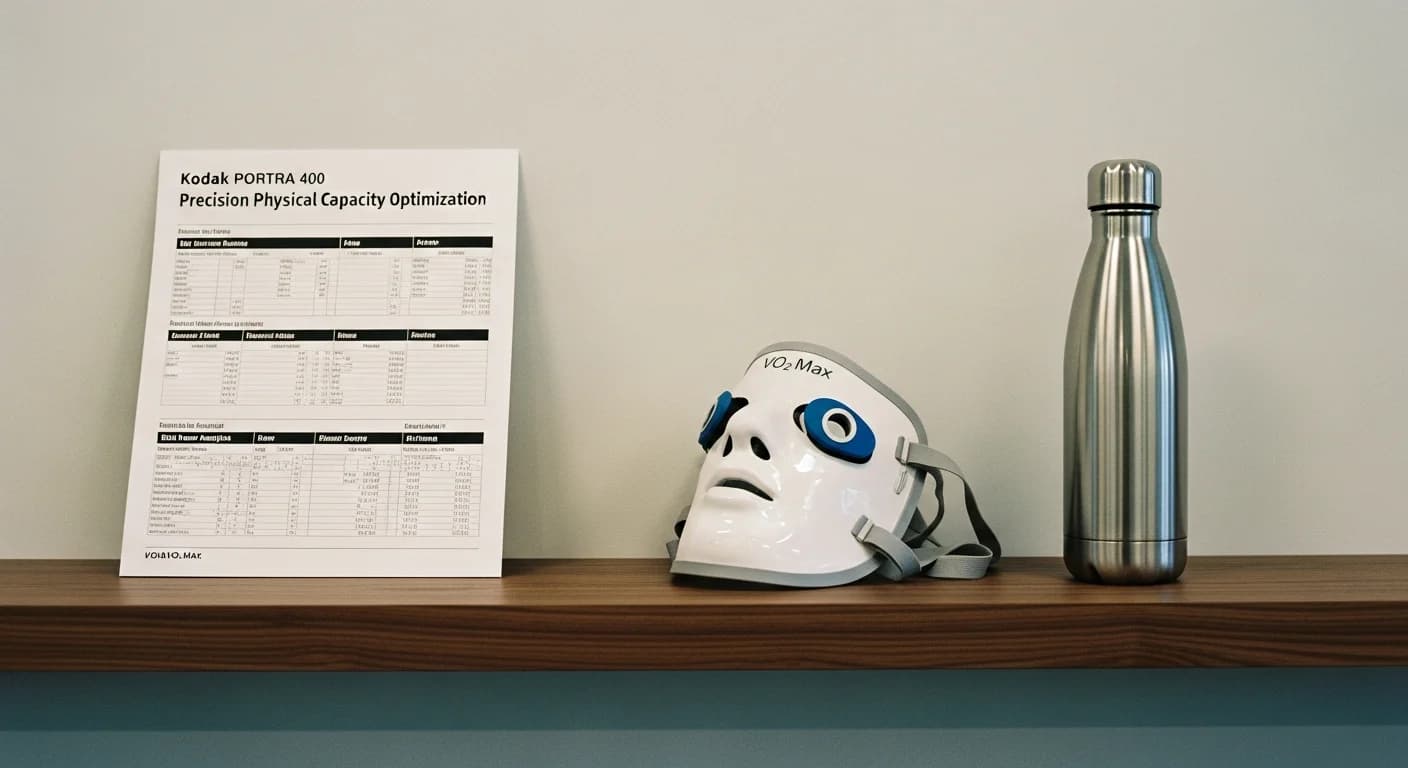

A standard physical looks for disease. It tells you very little about how well you are aging. 4 functional measures predict that better: VO2 max (your aerobic fitness), grip strength, mobility (getting off the floor, balancing on one leg, walking speed), and body composition. Each is cheap to measure, easy to track over time, and trainable at any age. The same exam fits a 35-year-old runner and a deconditioned 60-year-old; only the numbers move.
Table of Contents
- Why your annual physical misses how you're aging
- The performance physical: 4 measures that predict how you'll age
- VO2 max: your aerobic engine
- Grip strength: the 2-minute test that predicts a lot
- Can you get off the floor? The mobility battery
- Body composition: the muscle you bank for later
- Your smartwatch and VO2 max: track the trend over time
- What this costs, and what's worth paying for
- Common Questions
- Deep Questions
Why your annual physical misses how you're aging
Your yearly physical is built to catch disease and satisfy a billing code. Blood pressure, cholesterol, a basic metabolic panel, maybe an EKG. That work matters, and we do all of it. But it mostly answers whether you have a disease today. It says little about how well your body is working, or where it is heading over the next 30 years.
Longevity medicine adds a second exam. Call it the performance physical. Instead of screening only for illness, it measures capacity and trajectory: how much your heart and lungs can do, how strong you are, how well you move, and what your body is made of. Each of these has been studied against the outcomes that matter most, like death, disability, and losing your independence. And unlike your age or your genes, every one of them improves with training.
A lot of patients land in my office after years of being told their labs are normal while they slowly lose a step. Normal labs are not the finish line. How you function is.
The performance physical: 4 measures that predict how you'll age
4 functional measures carry most of the signal. They are quick, most of them need almost no equipment, and you can track each one against yourself over time.
| Measure | What it predicts | How we check it |
|---|---|---|
| VO2 max | Cardiorespiratory fitness; one of the strongest predictors of lifespan and brain health | Wearable estimate for the trend; a lab CPET when the result will change the plan |
| Grip strength | Whole-body strength, frailty risk, recovery from illness | Hand dynamometer, both hands, about 2 minutes |
| Mobility | Whether strength and fitness translate into everyday independence | Sit-to-rise, a 10-second one-leg stand, comfortable walking speed |
| Body composition | Muscle you can defend with age, and the fat wrapped around your organs | DEXA scan, plus a look at protein intake |
Here is the idea that ties them together. The work that keeps a competitive athlete in the game at 40 is the same work that keeps a sedentary person independent at 80. Same assessments, same levers, different starting dose. The performance physical fits a marathoner and a deconditioned 60-year-old equally well. Only the numbers move.
Two of these, VO2 max and muscle, are the headline predictors of how long and how well you live, and I go deep on training them in VO2 max, muscle mass, and the centenarian decathlon. The other two, grip and mobility, are the fastest and cheapest early-warning checks you can run. Together they give you a baseline a standard physical misses.
VO2 max: your aerobic engine
VO2 max is the most oxygen your body can take in and use during hard effort. It reflects the heart, lungs, blood, and muscle all working together, which is part of why it predicts death better than almost anything else in the chart.
In a study of 122,007 patients undergoing treadmill testing, Mandsager and colleagues found fitness inversely tied to mortality with no upper limit of benefit. People in the elite-fitness group had roughly an 80% lower risk of death than the least-fit group. That gap rivaled or exceeded the risk carried by smoking, diabetes, and coronary disease. Few things we can measure move the needle that far.
The part most people miss is that VO2 max is not something you inherit and keep. It responds to training at any age, which makes it a target we can treat, the same way we handle blood pressure: measure it, prescribe a dose of training, measure again, adjust. I walk through the Zone 2 and Zone 5 prescription on the VO2 max training page, and when a patient wants a precise baseline, we coordinate a formal VO2 max test in Philadelphia.
Grip strength: the 2-minute test that predicts a lot
Grip strength is the cheapest powerful test you own. A hand dynamometer takes about 2 minutes, and the number it gives you stands in for whole-body strength, neuromuscular health, and how well you would weather a serious illness.
The data here is hard to argue with. In the PURE study, which followed nearly 140,000 adults across 17 countries, each 5 kg drop in grip strength was associated with about a 16% higher risk of death. Newer NHANES analyses point the same way, with the weakest adults facing roughly double the mortality risk of the strongest.
Grip is more than a readout; it moves when you train it. Resistance training is the active ingredient, and the dynamometer lets us prove the program is working from one visit to the next. I cover how we use it as a quick function check in grip strength as a longevity marker.
Can you get off the floor? The mobility battery
Strength and fitness only help if they translate into moving through your day. Three quick mobility checks tell you whether they do, and you can run all of them in under 10 minutes with no equipment. These are the tests almost no standard physical includes, and the outcomes data behind them is striking.
Sit-to-rise. You sit down on the floor and stand back up, scoring out of 10 based on how much support you need from a hand, a knee, or a forearm. Brito and colleagues found that adults aged 51 to 80 who scored below 8 had 2 to 5 times the mortality risk over the following 6 years, and each 1-point improvement was linked to a 21% lower risk of death. It looks like a party trick. It is one of the better functional screens we have.
The 10-second one-leg stand. Stand on one leg for 10 seconds. A 2022 cohort study in the British Journal of Sports Medicine found that people who could not hold the stance had about an 84% higher risk of death over a median of roughly 7 years, independent of age, sex, body weight, and existing conditions. Balance is not a vanity metric; it is a window into your nervous system and your fall risk.
Walking speed. Comfortable gait speed is one of the most studied predictors of aging outcomes. Walking slower than 0.8 meters per second flags elevated risk of disability, hospitalization, and earlier death, while a pace above 1.0 meters per second is a marker of healthy aging. We can measure it in a hallway in under a minute.
In Philadelphia, the everyday version of these tests is everywhere: carrying groceries up a narrow Fishtown rowhome staircase, the climb up from the El at Girard, getting down to play on the floor with a grandkid and back up again. The floor battery just measures, on purpose, what your neighborhood already asks of you.
A practical note: if you are older, deconditioned, or have a history of falls, do the balance and floor tests near a wall or a sturdy chair, or with someone spotting you. The point is to measure your starting line safely, with enough support that a test cannot become a fall.
Body composition: the muscle you bank for later
Fishtown Medicine
A 90-minute conversation with Dr. Ash. A written plan you can follow.
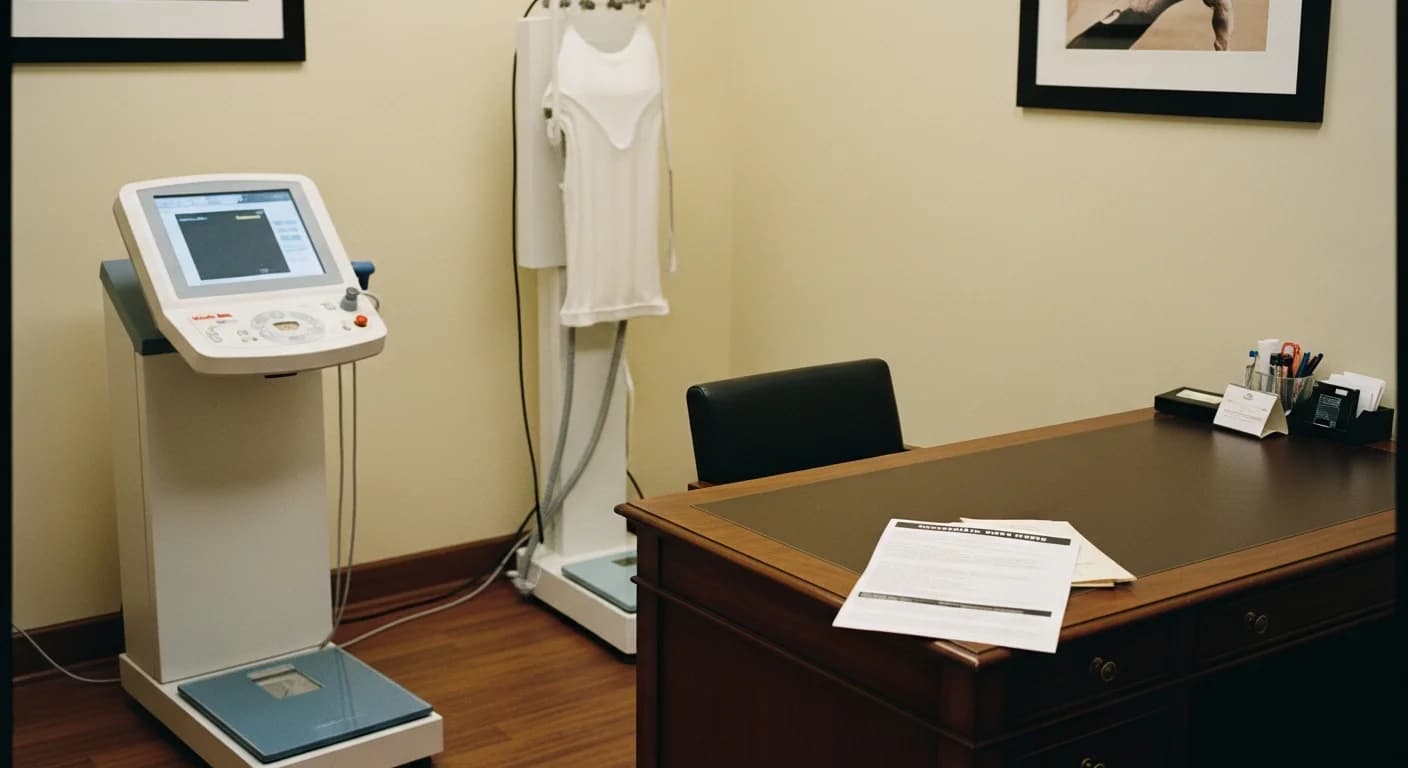
The scale cannot tell you the two things that matter most: how much muscle you carry, and how much fat is wrapped around your organs. A DEXA scan can. We track appendicular lean mass (the muscle on your arms and legs) and visceral fat, and we watch both over time. You can read more about why we favor this over weight on the body composition page, and we coordinate scans through our DEXA service in Philadelphia.
Muscle is the tissue you spend decades either building or slowly losing. Strength fails without fuel, so we anchor nutrition on protein, around 1.6 grams per kilogram of body weight for anyone building or defending muscle. Protein works best next to training, not instead of it. Train first, then feed the training.
How much training. A 2026 analysis in the British Journal of Sports Medicine followed 147,000 adults for up to 30 years and found a sweet spot: 90 to 120 minutes of strength training per week was associated with a 13% lower risk of death overall, a 19% lower risk of cardiovascular death, and a 27% lower risk of neurological death. The benefit flattened above 120 minutes. So if a patient asks how much lifting is enough, 90 minutes a week is a defensible floor, and the dynamometer and DEXA tell you whether it is working.
This matters more, not less, for patients on GLP-1 medications. Rapid weight loss strips muscle along with fat, so the target is not the number on the scale; it is protecting functional tissue. We track lean mass with body composition rather than weight alone, and we pair the medication with resistance training and enough protein to defend muscle quality.
Your smartwatch and VO2 max: track the trend over time
Your watch already estimates your VO2 max, and patients ask me constantly whether to trust it. Here is the answer.
A 2025 validation study in PLOS One put the Apple Watch up against the gold-standard lab test in 30 adults. On average, the watch underestimated VO2 max by about 6 mL/kg/min, with a mean absolute percentage error of 13.3%. A 2025 systematic review in Frontiers found that Garmin estimates from a short submaximal run often land within 10% of lab values, but accuracy varies by brand, by context, and by how fit you are.
So the single reading on your wrist can be off, sometimes by a lot. What these devices do well is track the same person over time. The trend matters more than the number on any given day. Use the wearable to see whether you are climbing or sliding month over month, and order a formal test only when the result will change what you do. That turns wrist data from a vanity score into a useful signal, as long as you let the trend guide the decision.
This is where I land on a lot of longevity tech. Some of it is woo-woo, and some of it is careful, evidence-based work. My job is to bring in the part that gives you results and to be clear about the part that does not.
What this costs, and what's worth paying for
The most predictive tests here cost almost nothing. Sit-to-rise, the one-leg stand, and walking speed are free. A hand dynamometer runs about 30 dollars. You do not need a 150,000-dollar recovery chamber or a boutique biological-age kit to know how you are aging; you need a few simple measurements and the discipline to repeat them.
Worth paying for, when the result will change your plan: a formal VO2 max test to set a precise baseline and find your training zones, and a DEXA scan to see muscle and visceral fat the scale hides. Because we practice evidence-based medicine, much of the surrounding workup, like advanced labs and imaging, is often covered by your insurance rather than paid out of pocket beyond your membership. The performance physical fits inside the same preventive approach we bring to cardiology and metabolic health: stop guessing and start measuring.
Guidance from the Clinic

Actionable Steps in Philly
Build your baseline once, then run it every year.
- Know your VO2 max: track the trend on your watch, and get a formal test when you want a precise number and your training zones.
- Test your grip: a 30-dollar hand dynamometer, both hands, about 2 minutes. Flag the lowest range for your age.
- Run the floor battery: sit-to-rise, a 10-second one-leg stand, and your comfortable walking speed. Do the balance work near a wall if you are deconditioned.
- Get a DEXA scan: muscle and visceral fat the bathroom scale cannot show. Repeat every 6 to 12 months if you are changing your body composition.
- Train the gap: 90 to 120 minutes of strength work per week, Zone 2 cardio, and protein around 1.6 g/kg to defend muscle.
We fold your Apple Watch, Whoop, or Oura data into the plan, so we can see how your training time is distributed and where to push next.
Key Takeaways
- A standard physical screens for disease. A performance physical measures how well you are aging. They answer different questions, and you want both.
- Four measures carry most of the signal: VO2 max, grip strength, mobility, and body composition. Each is measurable, trackable, and trainable.
- The cheapest tests predict a lot. Sit-to-rise, a 10-second one-leg stand, and walking speed are free and tied to hard outcomes.
- Track the trend over time. Wearable VO2 max can be off on any given day, but the direction over months is useful.
- The same exam fits everyone. Marathoner or deconditioned 60-year-old, only the numbers move.
Scientific References
- Mandsager K, et al. Association of Cardiorespiratory Fitness With Long-term Mortality Among Adults Undergoing Exercise Treadmill Testing. JAMA Network Open. 2018;1(6):e183605.
- Leong DP, et al. Prognostic value of grip strength: findings from the Prospective Urban Rural Epidemiology (PURE) study. The Lancet. 2015;386(9990):266-273.
- Brito LBB, et al. Ability to sit and rise from the floor as a predictor of all-cause mortality. European Journal of Preventive Cardiology. 2014;21(7):892-898.
- Araujo CG, et al. Successful 10-second one-legged stance performance predicts survival in middle-aged and older individuals. British Journal of Sports Medicine. 2022;56(17):975-980.
- Studenski S, et al. Gait speed and survival in older adults. JAMA. 2011;305(1):50-58.
- Zhang Y, Lee DH, et al. Long-term resistance training with all-cause and cause-specific mortality: dose-response and joint associations with aerobic activity. British Journal of Sports Medicine. 2026.
- Lambe R, et al. Investigating the accuracy of Apple Watch VO2 max measurements: a validation study. PLOS One. 2025;20(5):e0323741.
- Železnik Mežan L. Accuracy of wearables for determining the maximal oxygen uptake and lactate threshold: a qualitative systematic review. Frontiers in Sports and Active Living. 2025;7:1707991.

Fishtown Medicine | Articles
Frequently Asked Questions
Common Questions
Deep-Dive Questions
Ready when you are
The chat is our AI assistant, answering from our published guides. To talk it through with Dr. Ash himself, start with the intake.