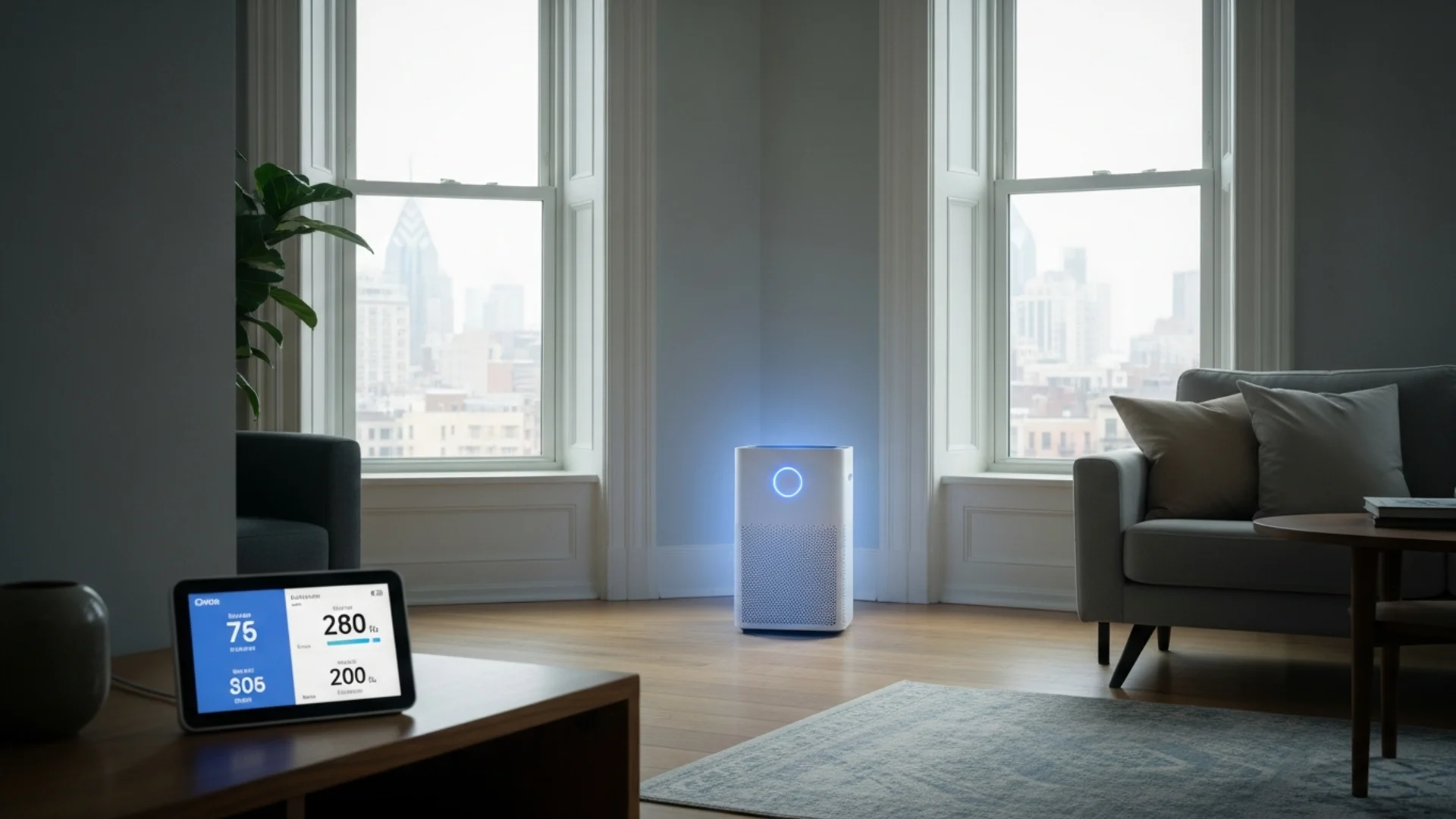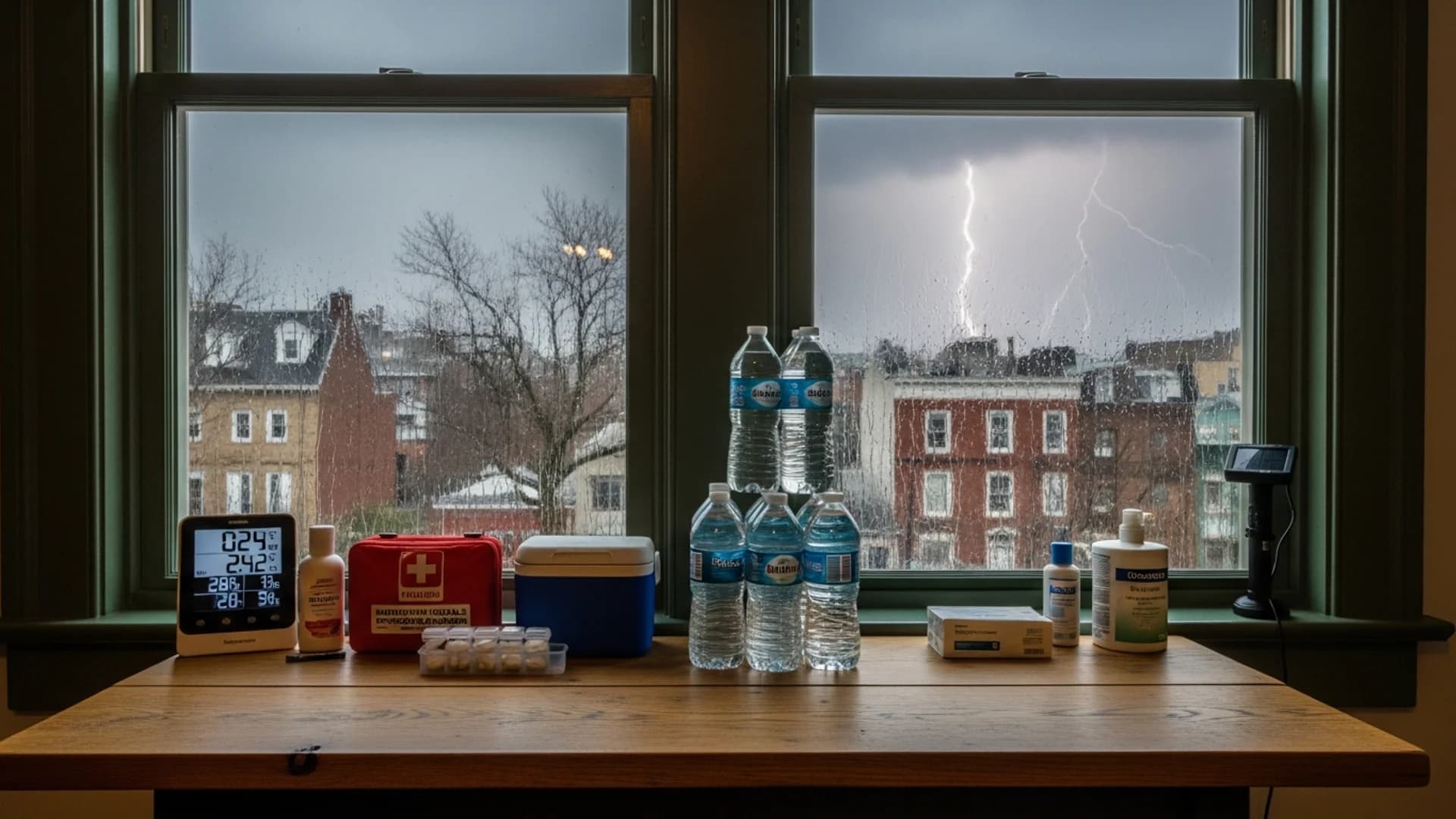

Severe weather is mostly a question of preparation, not heroics. The National Weather Service issues a small set of alerts that materially change health risk: heat advisories and excessive heat warnings, wind chill / cold weather advisories and extreme cold warnings, severe thunderstorm and tornado warnings, flash flood warnings, and winter storm warnings. The medications that change the math most are diuretics, beta blockers, anticholinergics, GLP-1s, lithium, and any drug with a sedating or hypotensive effect. The conditions that change it most are kidney disease, heart failure, COPD, pregnancy, and older age. The single highest-leverage move is to have a written plan that exists before the alert: who you check on, where you go, what you take with you. The sections below give you the specific moves for each alert.
Philadelphia gets a wider weather spectrum than most outsiders expect. Heat waves stack up in July and August across an urban heat island of asphalt and row-home brick. Ida-scale flooding hit the Schuylkill and Manayunk floodplain in 2021 and will again. Wind chill warnings can hit in January and February. Severe thunderstorms cross every summer, with tornado warnings occasional but not theoretical.
The clinical pattern across all of it is the same. The patients who do well had a plan written down. The patients who end up in the emergency department often had every piece of the plan in their head but had not assembled it before the alert hit.
Who is at higher risk across weather extremes
Some groups feel weather more than others. The list largely matches the air-quality risk groups, with a few additions specific to temperature and storms.
- Adults over 65. Lower physiologic reserve, often more medications, and reduced sensation of thirst and temperature.
- Infants and young children. Higher surface area to body mass ratio; they heat and cool faster than adults.
- People with cardiovascular disease, heart failure, or recent stents. Heat raises cardiac demand; cold triggers vasoconstriction and platelet activation.
- People with chronic kidney disease. Heat and dehydration are common triggers for acute-on-chronic kidney injury.
- Asthma and COPD. Cold air and storms (thunderstorm asthma) trigger flares.
- People on diuretics, beta blockers, anticholinergics, GLP-1 medications, lithium, antipsychotics, or any sedating drug. All of these change how the body handles heat, hydration, or fall risk.
- People who are pregnant. Heat tolerance is reduced; flash flooding adds mobility considerations.
- Outdoor workers and athletes. Construction, landscaping, delivery, food service patios; long runs along the Schuylkill in August.
- People without reliable air conditioning, heating, or transportation. Cooling centers and warming centers exist citywide for a reason.
If you are in any of these groups, the action step at any tier starts one level earlier than for everyone else.
What these hospital admissions look like
A composite from years of hospital medicine, because the pattern repeats every heat event.
Here is the pattern I have watched play out many times. Someone in their 60s or 70s takes a diuretic for blood pressure or heart failure, and a heat-index day rolls in. They keep taking the medication, which is the right thing to do, but the extra water their body needs in that heat never comes. They arrive in the emergency department 2 or 3 days later, lightheaded and confused, with kidney numbers doubled from their baseline. It tends to show up in more than one place at once: the heart, with new chest pain or an irregular heartbeat; the kidneys, where dehydration lays a fresh injury on top of long-standing kidney disease; and the brain, where the family notices their mom or dad is not acting like themselves. What stays with me is that none of this had to become an emergency. The warning was in the forecast days earlier, before anyone connected it to the person taking that daily pill.
I want you to hold on to one idea here, because it is the part most people miss. The people in those hospital beds did not think of themselves as vulnerable that week, and they were. How much heat your body can safely handle is not a fixed number; it moves with your age, your medications, how hard you have been training, and what the heat index does that afternoon. So if you are fit and active, an advisory day is a day to ease off rather than push through. And if you take any of the medications above, the plan is simple: keep taking them, drink more water than usual, and check in with us if something worries you instead of adjusting a dose on your own. That way we catch the small problem before it becomes the one that puts you in the hospital.
Heat is one lens of the Environment pillar. The same thinking applies to air, pollen, and UV.
Heat Advisory
NWS issues a Heat Advisory when the heat index (apparent temperature combining heat and humidity) is forecast to reach roughly 100 to 104 degrees for two or more hours. In Philadelphia, this often coincides with the urban heat island making downtown row-home blocks feel 10 to 15 degrees hotter than the regional forecast.
- Everyone: Move heavy outdoor exertion to early morning or evening. Hydrate proactively, not reactively (water plus electrolytes if sweating heavily). Light-colored, loose-fitting clothing.
- Sensitive groups: Stay in air conditioning during the heat of the day. If your home does not have AC, plan ahead to a city cooling center (free, at most libraries and rec centers during heat events).
- Medication review: Anyone on diuretics, beta blockers, anticholinergics, GLP-1 medications, lithium, or antipsychotics should not silently adjust their own dose during heat. Check in if you are concerned, particularly if you are losing weight on a GLP-1 and adding heat-related fluid loss.
- Athletes: Reduce session length, increase rest intervals, and weigh in before and after long efforts. A drop of more than 2 percent body weight is meaningful dehydration.
- Check on neighbors: Particularly older adults living alone. This is the single highest-leverage move in a heat event.
Excessive Heat Warning
Issued for forecast heat index of 105 degrees or higher for two or more hours, or 110-plus for any duration. This is the dangerous tier. Some NWS offices now issue this same tier as an Extreme Heat Warning - different name, same threshold, same guidance below.
- Everyone: Avoid outdoor exertion during the heat of the day. If you must be outside, plan it for sunrise hours or after dark.
- Run the air conditioning even if you usually do not. Fans alone are not protective above 95 degrees of ambient air; they can accelerate fluid loss without cooling you.
- Recognize heat illness early. Heat exhaustion: heavy sweating, weakness, headache, lightheadedness, nausea, muscle cramps. Move to AC, rehydrate, cool the skin with damp cloths. Heat stroke: confusion, altered consciousness, hot dry skin, body temperature above 104. This is a medical emergency. Call 911. Begin active cooling (ice packs to neck, groin, axillae) while waiting.
- Sensitive groups: Cooling centers and family members. During a hot stretch you can call the city Heatline (215-765-9040) to talk a symptom through with a nurse. Do not power through. Heat stroke mortality in older adults is significant.
- At home: Close blinds, cluster activity in one cool room, take cool showers. If you lose power, leave for a cooling center; sheltering in a sealed home without AC is more dangerous than the trip.
- Cardiovascular caution: Heat events increase emergency department visits for heart attacks, strokes, and arrhythmias. New chest pain, breathlessness, palpitations, or syncope during a heat event are not "just the heat." Get evaluated.
Cold Weather Advisory
NWS issues a Cold Weather Advisory (the modern replacement for the older Wind Chill Advisory) when wind chill values are forecast in the 0 to minus 14 degree range. In Philadelphia, January and February cold snaps and early-morning windy days are the usual triggers.
- Everyone: Layer in three stages (wicking base, insulating middle, wind-blocking outer). Cover face, hands, and ears. Limit time outdoors.
- Asthma and COPD: Cold dry air is a powerful airway trigger. Pre-treat with rescue medication 15 to 30 minutes before extended outdoor time. Cover the mouth and nose with a scarf or buff to warm and humidify the air.
- Cardiovascular disease: Shoveling, brisk walking in cold, or hurrying outdoors raises cardiac demand sharply. Take it slowly, pause if you feel chest tightness, and warm up gradually.
- Ice falls: Most cold-weather emergency visits in Philadelphia are not from cold itself but from falls on ice. Microspikes or YakTrax for boots cost 20 dollars and are worth it.
- People experiencing homelessness: If you encounter someone outside in distress, call the 24/7 homeless outreach line at 215-232-1984. The city's outreach team, run by Project HOME, will go to them. If the person is unresponsive or in immediate danger, call 911.
Extreme Cold Warning
Issued when wind chill values are forecast at minus 15 degrees or colder. Less common in Philadelphia than further north, but happens during major Arctic blasts.
- Everyone: Limit outdoor exposure to brief, essential trips. Hypothermia and frostbite times shorten dramatically; at wind chill of minus 20, frostbite on exposed skin can occur in roughly 30 minutes, and faster with wind.
- Pets, pipes, and people: Bring pets in, drip faucets to prevent pipe bursts, and check on older neighbors. Hypothermia in older adults can develop unnoticed indoors when heating fails. If a home has lost heat, warming centers, utility-bill help, and free heater repair are there for this.
- Recognize hypothermia and frostbite. Hypothermia: shivering (early), confusion, drowsiness, slurred speech. Frostbite: numbness, white or grayish skin, hard or waxy texture. Warm gradually in lukewarm water, not direct heat; do not rub frostbitten skin. Severe hypothermia (no shivering, altered consciousness) is a 911 call.
- Heart failure and COPD patients: Cold drives both. Have rescue medications and a plan; thresholds for getting evaluated should be lower during an extreme cold warning.
Severe Thunderstorm Warning
Issued when a thunderstorm with damaging winds (58 mph-plus) or large hail (1 inch-plus) is occurring or imminent. The summer pattern in Philadelphia is afternoon cells crossing from the west.
- Indoor shelter: Get inside immediately. Avoid windows. Lightning kills 20 to 30 Americans a year; severe wind takes more. The "30/30 rule" still applies: if thunder follows lightning within 30 seconds, you are within strike range, and stay indoors 30 minutes after the last thunder.
- Outdoor activities (Eagles tailgates, Phillies games, marathons, kids' sports): Move inside, into a vehicle, or into a substantial building. Open shelters and dugouts do not count.
- Asthma: Thunderstorm asthma is a documented phenomenon. The combination of pollen rupture, rapid pressure changes, and dust can trigger flares hours before or during a storm. Pre-treat if you have a flare-prone pattern.
- Power outages: Charge devices, have flashlights, do not run generators or grills indoors or in attached garages (CO poisoning is a leading cause of post-storm death). Refrigerator and freezer guidance: a closed fridge keeps food safe for about 4 hours, a closed freezer 24 to 48 hours.
Tornado Warning
Longevity Medicine
A personalized longevity strategy starts with knowing your real baselines.
A tornado has been sighted or indicated by radar. Uncommon in Philadelphia but not theoretical; small tornadoes have touched down in the metro area.
- Shelter immediately. Lowest interior room, away from windows. Basements, interior bathrooms, and closets. Cover with mattresses or heavy blankets if possible.
- Mobile homes and cars: Leave for sturdier shelter if there is any safe option. If trapped in a vehicle and a sturdy building is not reachable, lie flat in a low area away from trees and power lines.
- After: Watch for downed power lines, gas leaks, structural instability. Photograph damage for insurance.
- Asthma and respiratory patients: Dust and debris in the air after a tornado are a serious flare trigger. Mask up before going outside to assess.
Flash Flood Warning
Issued when flooding is imminent or occurring. Philadelphia's vulnerable zones include the Vine Street Expressway tunnel, the Schuylkill banks (Manayunk, Conshohocken corridor), low-lying neighborhoods near the rivers, and many basement-finished row homes citywide. Ida in September 2021 was the recent reference point.
- Turn around, do not drown. Two feet of moving water can carry a car. Do not drive through standing water of unknown depth; flooded streets are the leading cause of flood deaths.
- At home: Move people, pets, and valuables to higher floors. Unplug electronics in the basement. If water rises rapidly, get out before the basement stairs become a hazard.
- After: Floodwater is contaminated (sewage, gasoline, debris). Avoid skin contact when possible. Tetanus boosters should be current. Mold remediation starts within 24 to 48 hours of dry-out.
- Medications and medical equipment: If you rely on home dialysis, oxygen, CPAP, or infusion pumps, have a 7-day backup plan and know your nearest dialysis center, oxygen vendor, or hospital before the alert hits.
Winter Storm Warning
Issued for significant snow accumulation (typically 6 inches or more in 24 hours in this area), or for an ice storm with at least a quarter inch of ice. Often combined with cold weather alerts.
- Pre-storm: Stock the basics (water, shelf-stable food, flashlights, batteries, medications for 7 days, baby formula and pet food if applicable). Charge devices and battery banks. Park strategically to avoid being blocked in.
- During: Stay off the roads if possible. Salt and ice on the Schuylkill Trail and sidewalks make falls common; wait 24 to 48 hours after city treatment for any non-essential walk.
- Shoveling: Snow shoveling is a classic heart attack trigger. Push, do not lift; take frequent breaks; warm up first. If you have known coronary disease, delegate or use a snow blower.
- Power outages and generators: Generators belong outside, away from windows. CO poisoning during winter storms is a recurring tragedy. CO detectors save lives in this scenario.
- Vulnerable neighbors: Heat, food, and a check-in are the high-leverage things during a winter storm with power loss. If older neighbors live alone, this is the moment to knock. For anyone without heat, warming centers and the city's utility and repair help open during a Code Blue.
Air Quality Alert
NWS sometimes issues Air Quality Alerts during heat events, ozone-action days, or wildfire smoke episodes. The clinical actions overlap heavily with the heat or smoke guidance.
- The combined risk is more than the sum. Heat plus ozone, or heat plus PM2.5, hits cardiovascular and respiratory systems together.
- Run indoor air filtration during smoke days. A HEPA in the bedroom, MERV 13 in the HVAC, windows closed, HVAC on recirculate.
- See the Philadelphia AQI guide for the tier-by-tier action steps for the air-quality side.
Guidance from the clinic

Actionable Steps
Set this up before the next major event.
- Build the household plan. Where do you go if you lose power for more than 24 hours. Who do you check on, and how. What is your nearest cooling center and warming center.
- Stock the basics. 7 days of medications, water (one gallon per person per day for 3 days), shelf-stable food, flashlights, battery banks, a working CO detector, and a tetanus booster within the last 10 years if you might encounter floodwater.
- Know your highest-risk medications. Diuretics, beta blockers, anticholinergics, GLP-1 medications, lithium, and antipsychotics all change the calculus in heat. Ask us at your next visit how yours specifically change during severe weather.
- Subscribe to NWS alerts and the city's notification system. ReadyPhiladelphia for citywide alerts; the NWS Philadelphia/Mount Holly office for forecast and alert updates.
Key Takeaways
- The alerts that matter most for health in Philadelphia are Heat Advisory and Excessive Heat Warning, Cold Weather Advisory and Extreme Cold Warning, Severe Thunderstorm and Tornado Warnings, Flash Flood Warning, and Winter Storm Warning.
- Medications that change the math most: diuretics, beta blockers, anticholinergics, GLP-1 medications, lithium, antipsychotics, and any sedating drug.
- Conditions that change it most: cardiovascular disease, heart failure, kidney disease, asthma and COPD, pregnancy, and older age.
- The single highest-leverage move is a written household plan that exists before the alert hits.
- During combined alerts (heat plus air quality, cold plus power loss), the risk is more than the sum of either alone.
Scientific References
- Bouchama, A., & Knochel, J. P. (2002). Heat stroke. New England Journal of Medicine, 346(25), 1978-1988.
- Basu, R. (2009). High ambient temperature and mortality: a review of epidemiologic studies from 2001 to 2008. Environmental Health, 8, 40.
- Anderson, B. G., & Bell, M. L. (2009). Weather-related mortality: how heat, cold, and heat waves affect mortality in the United States. Epidemiology, 20(2), 205-213.
- D'Amato, G., Vitale, C., Rosario, N., et al. (2019). Climate change, allergy and asthma, and the role of tropical forests. World Allergy Organization Journal, 12(2), 100011.
- Watts, N., Amann, M., Arnell, N., et al. (2021). The 2020 report of The Lancet Countdown on health and climate change. The Lancet, 397(10269), 129-170.
- National Weather Service. (2024). NWS Watch, Warning, Advisory Display - definitions and thresholds. National Oceanic and Atmospheric Administration.
Related at Fishtown Medicine
- Philadelphia AQI: what to do - the practical playbook for air quality days in Philly
- Pollen in Philadelphia - the tree/grass/weed calendar and when to pre-treat
- Microplastics in Philadelphia - the five highest-leverage moves to lower your exposure
- UV Index in Philadelphia - the daily UV calculus for skin and eye protection
- Philadelphia Environmental Health (overview) - the city-wide environmental health framework
- Philadelphia city health resources - cooling and warming centers, the outreach line, utility help, and home repair, with the phone numbers
- The Philly Flood Survival Kit - what to have packed before the water comes up
- The Philly Glovebox Kit - what belongs in the car for a winter breakdown
- February in Philly - the cold-snap month, and what else to plan around

Frequently Asked Questions
Common Questions
Deep-Dive Questions
Ready when you are
The chat is our AI assistant, answering from our published guides. To talk it through with Dr. Ash himself, start with the intake.