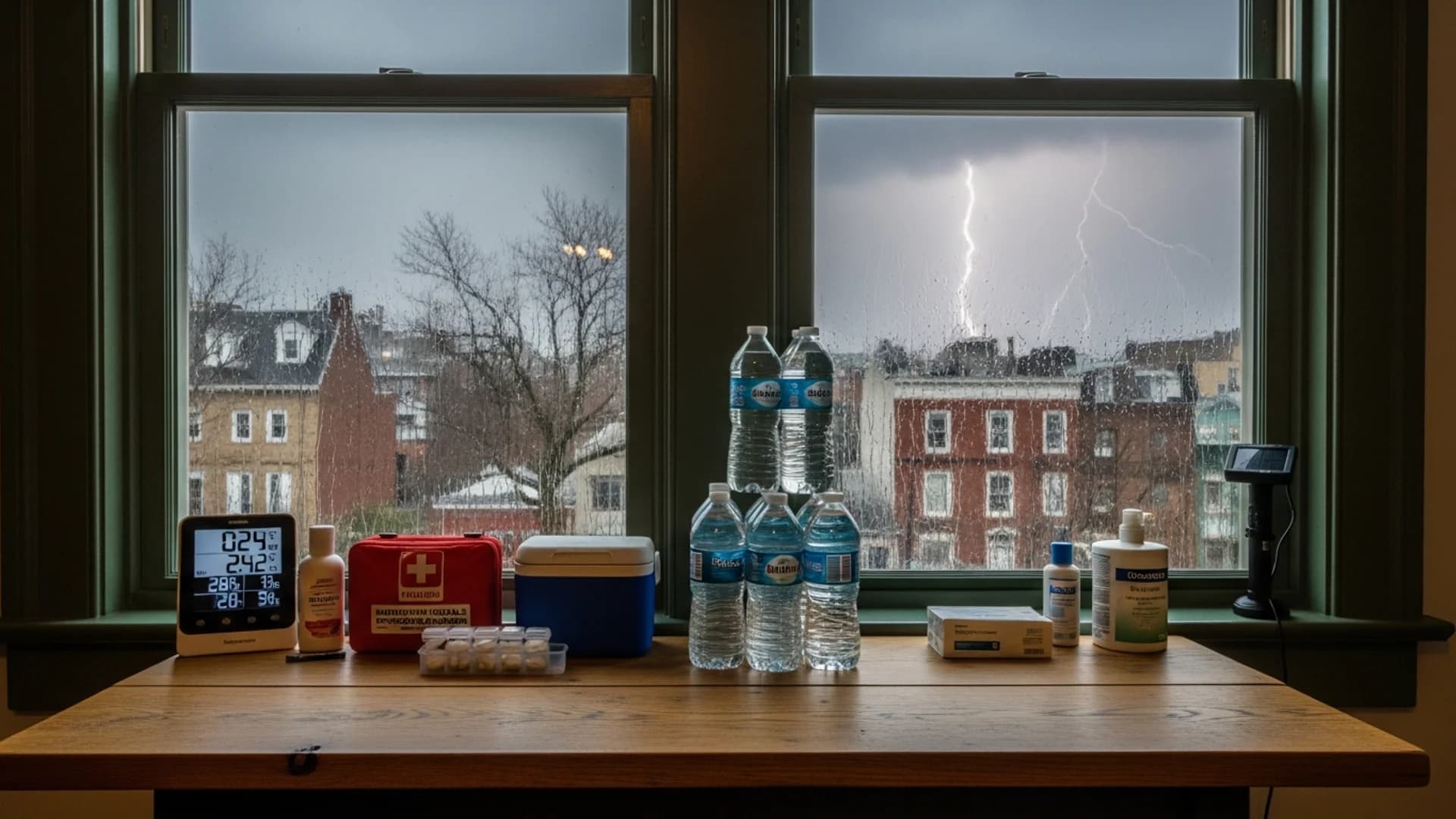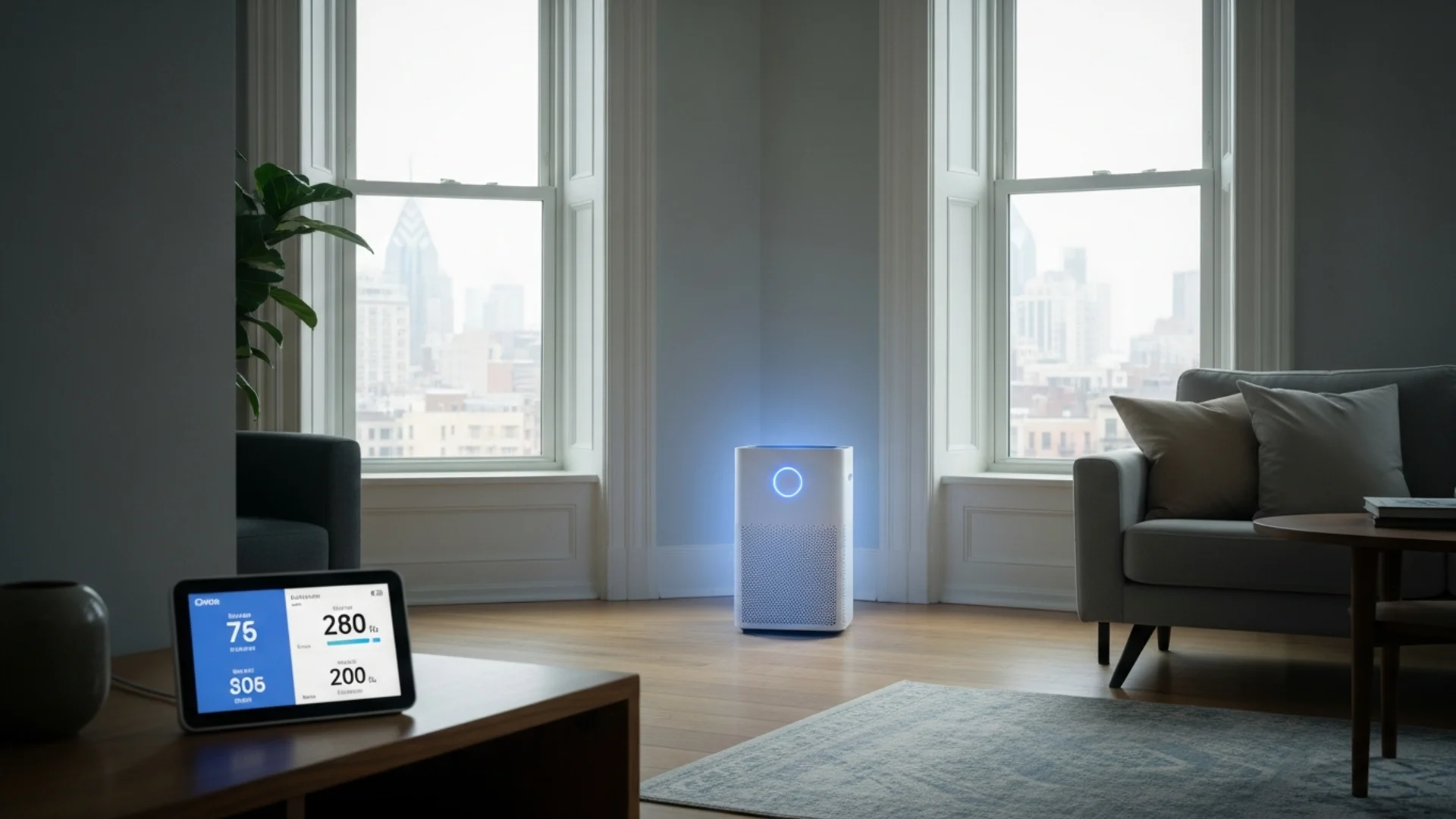

The Air Quality Index (AQI) summarizes how much harmful pollution is in the air you are breathing, on a 0 to 500 scale. PM2.5, the fine particulate matter from traffic, industry, and wildfire smoke, does most of the damage; every 10 microgram-per-cubic-meter increase in long-term PM2.5 is associated with about a 6 percent rise in cardiovascular mortality. Effects show up even in the moderate tier for sensitive groups (asthma, COPD, cardiovascular disease, pregnancy, children, older adults). The two highest-leverage moves are filtering the air indoors at home and timing outdoor activity by the live forecast.
If you live in Philadelphia, you already know the air does not behave the same way every week. Most of the year it is fine. Then a few stretches come along, summer ozone alerts, the Canadian wildfire smoke that settled over the city in June 2023, the occasional inversion that traps exhaust along the I-95 corridor, and the air starts to affect your health directly.
This is a practical guide for those weeks. Skim the "Who is at higher risk" section once. Then bookmark the action sections so when the AQI moves, you know what to do.
What the AQI measures
The Air Quality Index is a single number from 0 to 500 that summarizes the worst of 5 pollutants in your local air: ground-level ozone, PM2.5 (fine particulate matter), PM10 (coarser particulate matter), carbon monoxide, sulfur dioxide, and nitrogen dioxide. Whichever pollutant is the worst at the moment drives the AQI value.
PM2.5 is the one to know. It is particulate matter smaller than 2.5 microns (about 1/30th the width of a human hair). Particles this small bypass the upper airway, deposit deep in the lung parenchyma, and a fraction crosses into the bloodstream. From there it drives systemic inflammation, accelerates the same atherosclerosis process that ApoB drives, raises blood pressure, increases insulin resistance, and has been linked to faster cognitive decline. In wildfire smoke, in dense traffic, and during summer inversions, PM2.5 is usually the pollutant the AQI is tracking.
Ozone is the second one to watch, particularly on hot Philadelphia summer afternoons. It is a powerful airway irritant and the reason you sometimes hear a "code orange ozone action day" advisory on a clear blue summer day.
Who is at higher risk
Air pollution does not affect everyone the same way. The same AQI value that is a non-issue for a healthy 35-year-old is meaningful for several groups we see regularly in the practice.
- People with asthma, COPD, or chronic bronchitis. Airway inflammation amplifies the irritant effect; flares and ER visits go up sharply with AQI.
- Adults with cardiovascular disease, elevated ApoB or Lp(a), or known plaque. PM2.5 accelerates the same pathway you are trying to slow.
- People who are pregnant. Higher PM2.5 exposure is associated with low birth weight and preterm birth.
- Children. Their lungs are still developing, and pound-for-pound they breathe more air than adults, so dose per body mass is higher.
- Adults over 65. Background lung function and cardiovascular reserve are lower, so the same exposure does more.
- Endurance athletes during training. Higher minute ventilation means more total dose; an hour on the Schuylkill Trail at a moderate AQI delivers more particulate than a sedentary day at a slightly higher AQI.
- Outdoor workers. Construction, landscaping, delivery, food service curbside pickup. Time exposed is the variable.
If you are in any of these groups, the tier where action starts is one step lower than for everyone else.
What the bad-air admissions look like
From years of hospital medicine, here is what I have watched happen. When Philadelphia gets a stretch of poor air, a smoke event or a stagnant ozone week in July, the admissions follow within days, and the chart never names the air. It names the diagnosis instead: asthma exacerbation, COPD flare, heart failure decompensation, chest pain. I think of the patient whose asthma had been quiet for years and then suddenly needed steroids, and the patient with known heart disease whose chest tightness started 2 days into a smoke event. The air was the trigger in every one of those, but the air is not what ends up in the chart.
Here is what I want you to take from that: we all fall somewhere on that vulnerability curve. The pollutant level that reaches you depends on your lungs, your heart, your training load, and your hours outside. A healthy 35-year-old running hard on the Schuylkill on an orange day is taking a meaningful dose. The tiers below are about knowing where your own line is and acting one step before you reach it.
Air is one lens of the Environment pillar. The same thinking applies to heat, pollen, and UV.
Good (AQI 0-50)
Air quality is satisfactory and poses little or no risk. Carry on.
- Healthy adults and kids: anything outdoors is on the table. This is the window to schedule longer training, the Wissahickon hike, the weekend long ride on the Schuylkill River Trail.
- Sensitive groups: also fine. Asthma patients should still carry a rescue inhaler as usual.
- At home: consider opening windows, particularly after a stretch of poor air days, to flush indoor pollutants out.
Moderate (AQI 51-100)
Air quality is acceptable for most. A small number of unusually sensitive people may notice symptoms.
- Healthy adults and kids: continue normal outdoor activity. If you train hard outdoors, choose the earlier or cooler part of the day, when ozone is usually lower.
- Asthma, COPD, or cardiovascular disease: consider reducing prolonged or intense outdoor exertion. Have your rescue inhaler with you. If you notice cough, chest tightness, or wheeze, step inside.
- Older adults and young children: fine for normal activity. Pay attention if asthma is in the picture.
- At home: the move is to start running your HEPA filter if you have one, and to keep windows closed during the warmest hours when ozone tends to peak.
Unhealthy for Sensitive Groups (AQI 101-150)
The general public is unlikely to be affected. People in the sensitive groups described above may experience health effects.
- Healthy adults: continue activity, but lower the intensity of long outdoor sessions. A 60-minute run becomes a 30-minute run. An outdoor pickup game is fine.
- Asthma, COPD, cardiovascular disease, pregnancy, kids under 12, adults over 65: move prolonged or intense exertion indoors. Walks and errands outdoors are still fine. Consider a well-fitted N95 for any extended time outside; a surgical or cloth mask does not block PM2.5.
- Asthmatics specifically: pre-treat with your prescribed controller. Keep rescue medication immediately accessible.
- At home: HEPA filter on the highest setting you can tolerate, windows closed, set HVAC to recirculate rather than draw in outside air.
- Schools and youth sports: outdoor recess is borderline. Consider moving practices indoors for kids with asthma.
Unhealthy (AQI 151-200)
The general public will start to experience effects. Sensitive groups will experience more serious effects.
- Everyone: limit prolonged or intense outdoor exertion. Reschedule the long run or the cycling group ride. Light walks are still reasonable.
- Wear a well-fitted N95 for any extended outdoor time (commuting on foot, walking the dog, errands). Adjust for kids old enough to wear one comfortably.
- Sensitive groups: stay indoors as much as possible. Have rescue medications and a written action plan in reach.
- At home: HEPA filter on high, windows sealed, HVAC on recirculate, MERV 13 or better filter installed.
- Schools: outdoor recess and practice should move inside.
- Older adults: check in with neighbors who live alone and have heart or lung disease.
Very Unhealthy (AQI 201-300)
A health alert. Everyone may experience more serious health effects.
- Avoid all outdoor exertion. Even healthy adults should stay inside as much as possible.
- N95 even for brief errands (walking to the car, taking the dog out). The exposure adds up fast.
- Asthma and COPD patients: pre-treat assertively. If symptoms develop, do not wait. Use rescue medication early. If symptoms persist despite rescue dosing, seek care.
- Cardiovascular patients: chest pain, new shortness of breath, or palpitations during a high-PM event warrant prompt evaluation rather than a wait-and-see approach.
- At home: set up one filtered room. Put a HEPA on high in the room where you spend most of your time, and keep that room's door closed so the filtered air stays concentrated.
- Caregivers: check on older neighbors and family members in person if possible. Heat and high PM2.5 events often overlap in Philadelphia summers and the combination is more dangerous than either alone. If someone needs a cool place or help at home, our Philadelphia city health resources guide keeps the cooling centers, the outreach line, and utility help in one place.
Hazardous (AQI 301-plus)
A health warning of emergency conditions. The entire population is more likely to be affected.
- Shelter in place. Outdoor exposure should be limited to emergencies.
- N95 even for the briefest outdoor time. Lower-grade masks are not enough.
- Seal your home as much as possible. Door sweeps, draft seals, painter's tape on leaky windows. Run HEPA filters in every room you use.
- Asthma, COPD, heart failure, pregnancy, kids, older adults: make sure medications are stocked, have a clear plan, and know your nearest urgent care and emergency department.
- Watch carbon monoxide if you are running generators or burning fuel indoors during a power outage. This combination kills people every wildfire season elsewhere.
- Schools and workplaces: typically close at this tier; if they have not, that is a serious mismatch with public health guidance.
Longevity Medicine
A personalized longevity strategy starts with knowing your real baselines.
Pollen and allergens: the other half of the picture
The AQI does not include pollen, but if you have allergies or asthma, the two move on the same airway. A high-pollen day stacks on top of a moderate-AQI day and feels worse than either alone. They inflame the same nasal lining and lower airway, activate the same mast cells, and drive the same downstream effects on the heart and on sleep. People sensitive to one are almost always more reactive to the other.
For the deeper read on pollen specifically, see the Philadelphia pollen guide, which covers the local tree / grass / weed calendar, how the Pollen Watch tiers map to action, and the case for starting meds 2 to 3 weeks before your worst window.
The Philadelphia mid-Atlantic pollen calendar in brief:
- Tree pollen peaks February through May. The biggest single window of the year for allergy-driven misery in Philly. Oak, maple, birch, sycamore, ash all overlap.
- Grass pollen peaks May through August.
- Weed pollen (ragweed primarily) peaks September through November. The fall wave most people forget about until it arrives.
The single most important indoor move is the same one we cover above for PM2.5: a MERV 13 HVAC filter. Most pollen grains are 10-100 µm, so MERV 13 captures them efficiently. The same filter that catches the particulate also catches the allergen. The dedicated pollen guide goes deeper on outdoor timing, "shower at night" mechanics, and when to involve an allergist.
Indoor air: the move that beats every mask
Here is the sentence I most want you to remember: you spend roughly 90 percent of your time indoors, so the quality of your indoor air matters more than the AQI on any given day.
Three concrete moves, in order of leverage:
- Upgrade your HVAC filter to MERV 13. This is the single highest-leverage indoor air move. Filters in the MERV 13 range capture the fine particulate (PM2.5) that does the most cardiovascular and respiratory damage, plus airborne bacteria and the particles that carry viruses. A roughly 20-dollar quarterly change improves the air in your entire home in the background, not one room at a time. Confirm your system can handle the higher filter resistance before swapping.
- Add a HEPA filter in the bedroom. A true HEPA unit sized to the room covers the place you spend the most concentrated time. The number to look at is the CADR, the rate at which the unit delivers filtered air, matched to your room's square footage. Run it on a moderate setting continuously rather than blasting it on high for an hour, since steady filtration over the whole day does more than a short burst.
- Time your window opening. Open windows during low-AQI mornings to flush. Keep them closed during summer ozone peaks (typically afternoon) and during smoke events.
If you can afford only one move, do the MERV 13 HVAC upgrade. It covers the whole home for a fraction of the cost of a portable filter. For the units worth buying, see our clinical toolkit picks for both the HVAC filter and the bedroom HEPA.
The fourth move, once you have the filtration in place, is reducing your settled dust load. Household dust is a cocktail of fine particulate, dead skin, pet dander, pollen, and microplastics; every time you walk across a carpet or shake out bedding, a fraction of it re-aerosolizes back into the air your filter just cleared. The practical version: damp-dust surfaces with a microfiber cloth rather than a feather duster (which only redistributes it); vacuum with a bagged sealed-system unit on a regular cadence; wash bedding weekly; and use mattress and pillow covers if you have known dust mite sensitivity. Hard floors are easier to keep free of dust than carpet, where feasible.
A short word on wildfire smoke days in Philly
The Canadian wildfire smoke event of June 2023 pushed Philadelphia into the unhealthy and very unhealthy tiers for several days in a row. Climate-driven fire seasons in Canada and the Mid-Atlantic are now part of the local picture, and Philadelphia has to plan for them the way the western US long has.
The patterns we have seen:
- Smoke days hit PM2.5 specifically. Ozone is usually fine on those days, so the AQI you want to watch is the one tracking PM2.5.
- Symptoms show up in patients who were "fine" the day before. Asthma flares, cardiovascular events, and headaches climb during a smoke event and keep climbing in the days after it clears.
- Indoor air without filtration tracks outdoor air within hours. A house without a HEPA or MERV 13 has nearly the same PM2.5 as outside by the second day of a smoke event.
- Plan upstream. When the weekly forecast shows a smoke event coming, swap the HVAC filter, dust off the HEPA, and stock asthma rescue and prescribed controllers before day one.
Guidance from the clinic

Actionable Steps
Three concrete moves to set up this week.
- Bookmark a live AQI source. AirNow.gov for the EPA reading, or your weather app if it reports Air Quality Index based on EPA pollutants. We surface the current Philadelphia AQI on our homepage when it is elevated.
- Set up indoor air. MERV 13 in the HVAC (whole-home, replace quarterly), then a HEPA filter in the bedroom on continuous moderate.
- Buy N95 masks and a rescue plan. 5 or 10 N95 masks in a drawer. If you or anyone in your home has asthma, have the rescue inhaler stocked and the action plan written down.
Key Takeaways
- The AQI summarizes outdoor pollution on a 0 to 500 scale, with PM2.5 doing most of the damage in Philadelphia.
- Sensitive groups (asthma, cardiovascular disease, pregnancy, kids, older adults, endurance athletes) start to feel effects at the "moderate" tier.
- Indoor air filtration is the single highest-leverage move because most of your exposure is indoors. MERV 13 HVAC filter first (whole-home, cheapest per square foot); HEPA in the bedroom as the high-value add-on.
- N95 is the right mask above AQI 100 for sensitive groups and above 150 for everyone; cloth and surgical masks do not block PM2.5.
- Wildfire smoke events in Philadelphia have become an annual reality; pre-treat asthma, run filters, and seal the home before day one.
Scientific References
- Pope, C. A., 3rd, Burnett, R. T., Thun, M. J., et al. (2002). Lung cancer, cardiopulmonary mortality, and long-term exposure to fine particulate air pollution. JAMA, 287(9), 1132-1141.
- Brook, R. D., Rajagopalan, S., Pope, C. A., 3rd, et al. (2010). Particulate matter air pollution and cardiovascular disease: An update to the scientific statement from the American Heart Association. Circulation, 121(21), 2331-2378.
- Chen, H., Kwong, J. C., Copes, R., et al. (2017). Living near major roads and the incidence of dementia, Parkinson's disease, and multiple sclerosis: a population-based cohort study. The Lancet, 389(10070), 718-726.
- Liu, J. C., Wilson, A., Mickley, L. J., et al. (2017). Wildfire-specific fine particulate matter and risk of hospital admissions in urban and rural counties. Epidemiology, 28(1), 77-85.
- Schraufnagel, D. E., Balmes, J. R., Cowl, C. T., et al. (2019). Air pollution and noncommunicable diseases: A review by the Forum of International Respiratory Societies. Chest, 155(2), 417-438.
- US Environmental Protection Agency. (2018). Technical Assistance Document for the Reporting of Daily Air Quality - the Air Quality Index (AQI). EPA-454/B-18-007.
Related at Fishtown Medicine
-
What Sets Your Asthma Off - when the air is the trigger and the asthma is the thing being triggered
-
Pollen in Philadelphia - the tree/grass/weed calendar and when to pre-treat
-
Microplastics in Philadelphia - the five highest-leverage moves to lower your exposure
-
UV Index in Philadelphia - the daily UV calculus for skin and eye protection
-
Severe Weather in Philadelphia - heat, cold, and storm preparedness for chronic disease patients
-
Philadelphia city health resources - cooling and warming centers, the outreach line, utility help, and home repair, with the phone numbers
-
Philadelphia Environmental Health (overview) - the city-wide environmental health framework
-
The Philly Throat - why the same allergies feel worse in this city than they did where you grew up
-
August in Philly - the month ozone peaks here, and what else the calendar brings

Frequently Asked Questions
Common Questions
Deep-Dive Questions
Ready when you are
The chat is our AI assistant, answering from our published guides. To talk it through with Dr. Ash himself, start with the intake.