
The Professional-Neighborly Playbook
Read Time: 35 Minutes
Target Audience: Lawyers, Accountants, Consultants, Tech Workers
Location Context: Center City, Navy Yard, Home Offices
In our practice, we see a specific archetype we call the "Sandwich Generation." You are managing a demanding career, raising young children, and often coordinating care for aging parents. You are the operational hub for everyone else's life. The system encourages you to put yourself last.
Most of our patients rely on Standard medicine, which is inherently reactive. You visit the doctor when something breaks. Meanwhile, the silent stressors of your lifestyle (prolonged sedentary desk time, decision fatigue, chronic low level stress) are slowly eroding your metabolic foundation. The Professional-Neighborly Playbook is the alternative: automate the basics, fight the desk physiology, and protect the energy you need for 6 PM with your family.
You don't need "more to do." You need efficient, high yield strategies that fit into a calendar that is already full. You are a "Desk Athlete," and you deserve to train like one.
Guidance from the Clinic
"In our experience, burnout isn't usually a deficit of will; it's a deficit of fuel. When we stabilize your blood sugar and re-engage your metabolism during the workday, the mental fog lifts. We aren't just preventing disease; we're buying you better energy for 6 PM."
Pillar 1: The Desk Athlete (Ergonomics & Movement)
Prolonged stillness shuts down metabolic pathways. This is not just about "bad habits." It is physiology. When you sit for 60 plus minutes, activity of lipoprotein lipase (LPL), the enzyme responsible for breaking down fats in the bloodstream, drops by approximately 90 percent. Your glutes disengage (a phenomenon often called "Glute Amnesia"), and hip flexors shorten mechanically. You become metabolically stagnant.
1. The "Exercise Snack"
- The Roadmap: Keep a kettlebell (12 kg or 16 kg) or a resistance band under your desk.
- The Habit: Every time you finish a call or send an email, do 10 swings or 10 band pull-aparts.
- Why: This helps clear blood sugar spikes immediately. It keeps your metabolism "simmering" rather than cold.
- Tradeoff: Your coworkers might look at you funny (if you are in the office). The cognitive boost is worth it.
2. The 50/10 Rule
- The Roadmap: Work for 50 minutes. Stand or move for 10.
- Why: It resets your posture and your focus.
- The Gear: A standing desk is a useful tool, but we caution against standing all day, as that can contribute to venous insufficiency. Oscillation is key.
3. "Rucking" Developments
- The Roadmap: Put 20 lbs in a backpack (or buy a GoRuck). Wear it while you walk the dog or take a call.
- Mechanism: It turns a casual walk into Zone 2 cardio without the impact of running. It also builds postural strength by mechanically pulling the shoulders back.
- Tradeoff: You will sweat more than a standard walk.
{{NEWSLETTER}}
Pillar 2: Nutritional Automation (Fuel)
Decision Fatigue is real. "What's for dinner?" is often the most stressful question of the day.
1. The "Uniform" Meal Plan
- The Roadmap: Eat the exact same Breakfast and Lunch, Monday through Friday. Rotate the menu every 1 to 2 weeks.
- Why: This removes 10 distinct decisions a week. It creates a baseline where you hit your protein and fiber metrics most of the time. Save the variety for dinner and weekends.
- Example:
- Breakfast: Greek Yogurt plus Berries plus Walnuts. (2 minutes preparation).
- Lunch: Sweetgreen Custom Salad (saved in app). (0 minutes decision time).
2. The "Center City" Sweep
- Context: You are in the office. You have 15 minutes. Here is how we navigate Philly options.
- Sweetgreen: The Order: Kale or Spinach Base plus Salmon or Chicken plus Sweet Potato plus Olive Oil Dressing. We generally avoid the bread to prevent the afternoon insulin crash.
- Real Food Eatery: The Order: Chicken Thighs plus Roasted Broccoli plus Sweet Potato wedges. (Provides a "home cooked" macronutrient profile).
- Honeygrow: The Order: Stir fry (Rice noodles are acceptable if you worked out) or Salad base. Ask for sauce on the side, this is where the hidden sugar lives.
- Dig (Rittenhouse): The Order: Charred Chicken plus Roasted Carrots plus Brown Rice. Excellent macronutrient balance.
- Cava: The Order: Greens plus Grains bowl. Heavy on the Harissa Chicken.
- Tradeoff: It costs $15 to $18. We view this as an investment in your afternoon productivity.
Pillar 3: The "Weekend Warrior" Protection
You sit Monday through Friday. You play intense pickleball, basketball, or CrossFit on Saturday. This is a common setup for injury, specifically Achilles ruptures. Your tendons stiffen from the sedentary week, and are then subjected to high dynamic loads.
1. Daily Mobility "Hygiene"
- The Roadmap: The "Couch Stretch" (Hip Flexors) and "Pigeon Pose" (Glutes).
- Frequency: 5 minutes every night.
- Why: It attempts to undo the "sitting shape" imposed by the chair. It is a primary defense against mechanical back pain.
2. Zone 2 Cardio
- The Roadmap: Aim for 150 minutes of "conversational pace" cardio per week.
- Why: This builds your "Mitochondrial Engine." It is the foundation of longevity. Unlike high intensity intervals (HIIT), Zone 2 is stress reducing rather than stress adding.
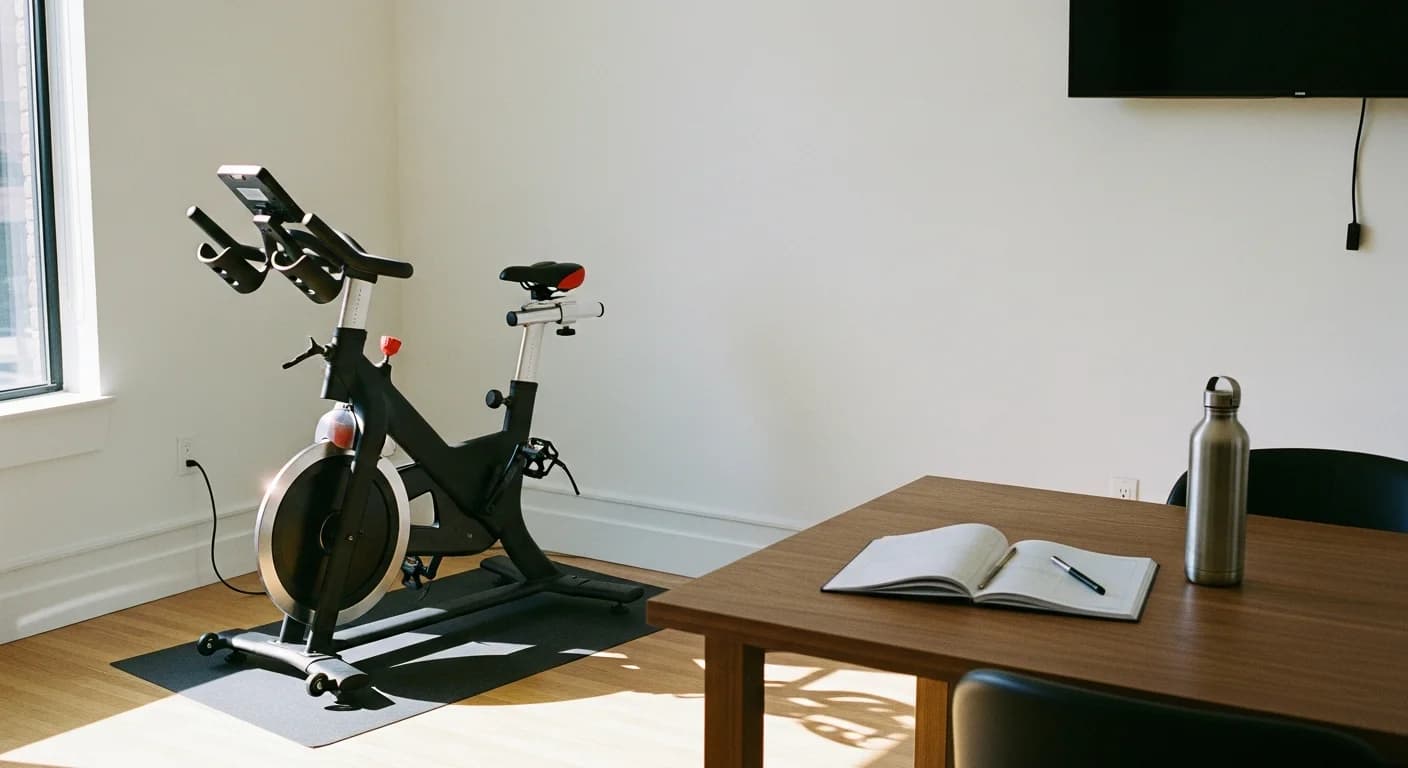
- How: Incline walking, Rucking, or a stationary bike while reading emails.
The Philadelphia Context
1. Efficient Gyms (Get in, Get out)
- Barry's (Rittenhouse): Highly efficient use of 50 minutes. Cardio plus Strength. Loud, dark, and allows you to turn your brain off.
- Solidcore: Extreme core stability. Excellent for counteracting "desk posture."
- Unite Fitness: A Philly original. Great functional cross-training.
- Rumble Boxing: High intensity, but offers significant stress relief.
2. Commuting as Activity
- SEPTA: If you take the train, take the stairs. Walk to the further stop. Small inputs compound.
- Indego: Biking to work converts "commute time" into "cardio time." (See our Environmental Guide for routes).
The Toolkit (Cheat Sheets)
The "Zoom Marathon" Strategy
You have 6 hours of back-to-back calls. Here is how we survive it.
- Hydration: 32 oz water bottle on the desk. Finish 2 by noon.
- Blue Light: Use "f.lux" or "Night Shift" on your monitor to reduce eye strain.
- The "Gaze": Every 20 minutes, look at something 20 feet away for 20 seconds. (The 20-20-20 rule). This helps mitigate myopia progression and tension headaches.
The "Travel" Kit (Consultants / Road Warriors)
- Deep Dive: See the full Air Travel Strategy for the detailed supplement stack and radiation mitigation strategy.
- Gear: See our full Clinical Toolkit for our specific recommendations.
- Resistance Bands: Weigh nothing. Do 100 band pull-aparts in the hotel room to reset posture.
- Lacrosse Ball: Use it to roll out your feet (plantar fascia) and glutes after a 6 hour flight.
- Compression Socks: If the flight is more than 3 hours, we consider these mandatory to reduce DVT risk and maintain energy.
- Magnesium Glycinate: 400 mg. Hotel sleep quality is notoriously poor; this may support relaxation.
- Electrolytes (LMNT): Air travel is dehydrating. One packet per flight hour helps maintain fluid balance.
- Psyllium Husk Capsules: Disrupted schedules often lead to GI slowing. 5 capsules with water helps maintain regularity.
- Eye Mask & Ear Plugs: Control your environment. Darkness is non-negotiable for recovery.
Actionable Steps for Desk Athletes
- Buy a kettlebell or band today: Set the rule that every 50 minutes of focused work earns 10 reps. Track for one week.
- Set the breakfast and lunch uniform: Eat the exact same thing Monday through Friday for two weeks. Track energy and afternoon performance.
- Daily 5 minute mobility: Couch stretch and pigeon pose every night. Non-negotiable.
- Schedule a Warm Invitation Call: 20 minutes, no pressure, to map the highest yield interventions for your specific desk physiology.
Common Questions
What is a "Desk Athlete"?
A Desk Athlete is a professional whose job demands cognitive performance for 8 to 12 hours a day in a sedentary position. The biological stresses are not the same as a manual laborer, but they are real: prolonged sitting reduces lipoprotein lipase activity by approximately 90 percent, glutes disengage, hip flexors shorten, and metabolism becomes stagnant. Treating yourself like an athlete, with structured training, recovery, and nutrition, is the most efficient way to protect long term function.
Is sitting really "the new smoking"?
The phrase is overstated, but the underlying concern is real. Prolonged sedentary time is independently associated with cardiovascular disease, metabolic disease, and all cause mortality, even in people who exercise regularly. The fix is movement frequency throughout the day, not just one hard workout. Standing desks, exercise snacks, and walking meetings all help.
What is Zone 2 cardio and why does everyone talk about it?
Zone 2 is a moderate intensity, "conversational pace" effort, typically 60 to 70 percent of maximum heart rate. It is the intensity at which your body burns fat as primary fuel and builds mitochondrial density. It is the foundation of cardiovascular longevity. The reason it gets attention is that most people skip it, going either too easy (a stroll) or too hard (HIIT) and missing the most metabolically valuable zone. 150 minutes per week is the target.
How do I know if I am in Zone 2?
The simplest test is the talk test: you should be able to hold a conversation but not sing comfortably. Heart rate based: roughly 60 to 70 percent of (220 minus age). Wearable based: use the device's heart rate zones, which are usually well calibrated. For more precision, a lactate threshold test or VO2 max test gives you exact targets.
What is the "Couch Stretch" and why should I do it?
The Couch Stretch is a hip flexor stretch where you place your back foot up against a wall or couch with your knee on the ground and your front foot flat. You drive your hips forward, stretching the front of the hip and quad. Most desk workers have shortened hip flexors from sitting, which contributes to lower back pain and altered movement patterns. 5 minutes per side per night is the dose.
Should I get a standing desk?
Yes, with caveats. Standing all day is not the answer; it can cause venous insufficiency and back pain of its own. The right setup is a sit-stand desk that lets you alternate every 30 to 60 minutes. The goal is movement frequency, not a single static position.
What is "rucking"?
Rucking is walking with weight in a backpack. 20 to 35 lbs, depending on your size and conditioning. The added load turns a casual walk into Zone 2 cardio without the joint impact of running. It also builds postural strength by mechanically pulling the shoulders back. It is one of the most efficient forms of training for desk workers because it requires no special equipment beyond a backpack and weight.
How do I avoid the 2 PM crash?
The 2 PM crash is largely a consequence of a high carbohydrate lunch. Carbs trigger insulin, which facilitates tryptophan crossing the blood brain barrier, where it converts to serotonin and ultimately melatonin. The result is sleepiness in the early afternoon. The fix is to shift lunch to protein and fat with vegetables, saving carbs for the evening or post workout.
Do I really need to take supplements?
Most desk workers benefit from a small, targeted supplement stack: vitamin D (most are deficient), omega-3 (most do not eat enough fatty fish), magnesium glycinate (most are mildly deficient and it improves sleep), and creatine (cognitive and muscle support). Beyond that, supplements are situational. We do not run patients through 30 supplement protocols.
How do I balance work travel with training?
Plan for it. Resistance bands and a lacrosse ball travel anywhere. Hotel gyms work for the basics. Walking meetings count. The goal during heavy travel weeks is maintenance, not gains. We design 20 minute "minimum effective dose" workouts for clients who travel more than 50 percent.
What about ADHD and stimulants in desk work?
We treat ADHD in primary care for adults with a clear history and validated diagnosis. We prescribe stimulants and non stimulant alternatives when indicated. We require regular monitoring including blood pressure, sleep, and mood. Stimulants are tools, not a substitute for sleep, exercise, and structure.
How does the membership work for busy professionals?
The membership runs alongside your existing insurance. Most care happens by message, phone, or video, so you do not need to take time off work for routine visits. We schedule appointments around your calendar. Many of our professional members tell us this is the first time in years they have actually used their primary care because the friction is so much lower.
Deep Questions
How does Fishtown Medicine personalize the desk athlete strategy?
We start with a baseline assessment: body composition (DEXA when indicated), advanced labs (fasting insulin, ApoB, hs-CRP), wearable data (sleep, HRV, activity patterns), and a structured intake history. The personalized plan addresses your specific bottlenecks. For a desk worker with low energy, we focus on sleep architecture, fasting insulin, and Zone 2 capacity. For one with chronic back pain, we focus on mobility, strength, and gait. For one with weight gain, we focus on nutrition and metabolic flexibility.
What is the role of body composition versus weight on the scale?
Body composition (specifically muscle mass and visceral fat) predicts long term health outcomes much better than weight or BMI alone. We use DEXA scans (the gold standard) when accessible, and bioimpedance scales as a daily proxy. Many desk workers gain visceral fat without gaining weight (a phenomenon sometimes called TOFI: Thin Outside, Fat Inside) because they are losing muscle and gaining fat in equal amounts. Treating the scale alone misses this picture entirely.
How do you handle the "gradual decline" pattern in 35 to 45 year old professionals?
The most common pattern is a slow drift: 5 lbs of weight gain per year, 2 hours less sleep, half a drink more per night, half a workout fewer per week. Each step is small, but ten years compound into a meaningfully different physiology. We catch the drift in real time with regular labs, wearable data, and structured check-ins. We adjust before the drift becomes a problem. The single highest yield intervention is often "stop the drift" rather than "make a heroic change."
What is the role of resistance training for desk workers?
Resistance training is non-negotiable. Muscle mass is one of the strongest predictors of long term health, and it does not maintain itself in a sedentary lifestyle. Two to three sessions per week of compound lifts (squats, deadlifts, presses, pulls) is the minimum effective dose. Many of our desk worker members have never lifted before; we connect them with trainers who can teach the basics safely.
How do you handle the alcohol pattern in professional culture?
Most professional cultures (law, finance, consulting, sales) involve regular alcohol exposure: client dinners, networking events, after work drinks, weekend social events. We do not lecture. We talk about the actual physiology: alcohol's effect on sleep, HRV, body composition, cancer risk. We use wearable data to make the trade off concrete. Many patients reduce alcohol significantly when they see what it does to their HRV the next morning.
What is the connection between sleep and professional performance?
Sleep is not a luxury. It is the foundation of cognitive performance. Six hours of sleep produces measurable cognitive impairment equivalent to mild alcohol intoxication. Five hours is worse. Most desk workers underestimate how much performance they are leaving on the table by short sleeping. We use Oura, Whoop, or Apple Watch to track sleep architecture and identify the specific levers (caffeine timing, alcohol, screen time, room temperature, stress) that move the needle.
How does Fishtown Medicine support working parents?
The Sandwich Generation (raising young children, demanding career, often coordinating aging parents) is the most stressed group we see. We treat the parent as a patient first, with attention to sleep, mood, blood pressure, and burnout. We coordinate care for spouses and partners when desired. We act as the medical quarterback for aging parents when needed. The goal is to protect the bandwidth of the parent so they can show up for the kids, the job, and themselves.
What is the role of mental health in desk work?
Anxiety, depression, ADHD, and burnout are highly prevalent in professional settings, and most of it is untreated or under treated. We screen with validated tools, prescribe medications when indicated, and refer to therapists with whom we have working relationships. We treat the medical drivers of mood (thyroid, B12, sleep, alcohol) alongside the psychiatric ones. We do not pretend medication alone is the answer, and we do not refuse medication when it clearly is.
How does Fishtown Medicine handle the "I am too busy" patient?
The patients who tell us they are "too busy" are the ones who need the most efficient care. We design the membership for that reality: messaging instead of in-person visits when possible, video instead of clinic visits, home visits when necessary, and a comprehensive care plan that minimizes friction. Many of our most successful patients are the ones who said they did not have time for primary care.
What is the prognosis for a desk worker who starts this work at 35 versus 45?
Earlier is better. Starting at 35 with mildly elevated insulin and gradual deconditioning, you can often fully reverse the trajectory. Starting at 45 with established metabolic syndrome and 10 years of muscle loss, you can still meaningfully improve, but the work is harder and the ceiling is lower. The math favors early intervention.
What is the Warm Invitation Call?
It is a 20 minute video conversation, free, with no commitment. You tell us about your job, your lifestyle, your concerns, and your goals. We tell you whether the model fits and what the highest yield interventions for your specific situation are. If we are not a fit, we will say so.
Conclusion
You manage projects, budgets, and teams. You generally manage everything except your own biology. We believe this is a structural vulnerability.
Your health is the infrastructure that supports your family, your career, and your future. Taking time for it is not selfish; it is structural engineering for your life's stability.
Fishtown Medicine is your Structural Engineer. We monitor the foundation. You build the skyscraper.
Schedule Your Warm Invitation Call. Let's figure this out together.
Scientific References
- Hamilton, M. T., Hamilton, D. G., & Zderic, T. W. (2007). Role of low energy expenditure and sitting in obesity, metabolic syndrome, type 2 diabetes, and cardiovascular disease. Diabetes, 56(11), 2655-2667.
- Dunstan, D. W., et al. (2012). Breaking up prolonged sitting reduces postprandial glucose and insulin responses. Diabetes Care, 35(5), 976-983.
- San-Millán, I., & Brooks, G. A. (2018). Assessment of Metabolic Flexibility by Means of Measuring Blood Lactate, Fat, and Carbohydrate Oxidation Responses to Exercise in Professional Endurance Athletes and Less-Fit Individuals. Sports Medicine, 48(2), 467-479.
- Tremblay, M. S., et al. (2010). Physiological and health implications of a sedentary lifestyle. Applied Physiology, Nutrition, and Metabolism, 35(6), 725-740.

Medical Disclaimer: This resource provides Clinical context for educational purposes. In the world of Precision Medicine, there is no "one size fits all", the right supplement treatment plan must be matched to your unique lab work, physiology, and performance goals. Consult Dr. Ash to determine if this approach is right for you, especially if you have chronic health conditions or are taking prescription medications.