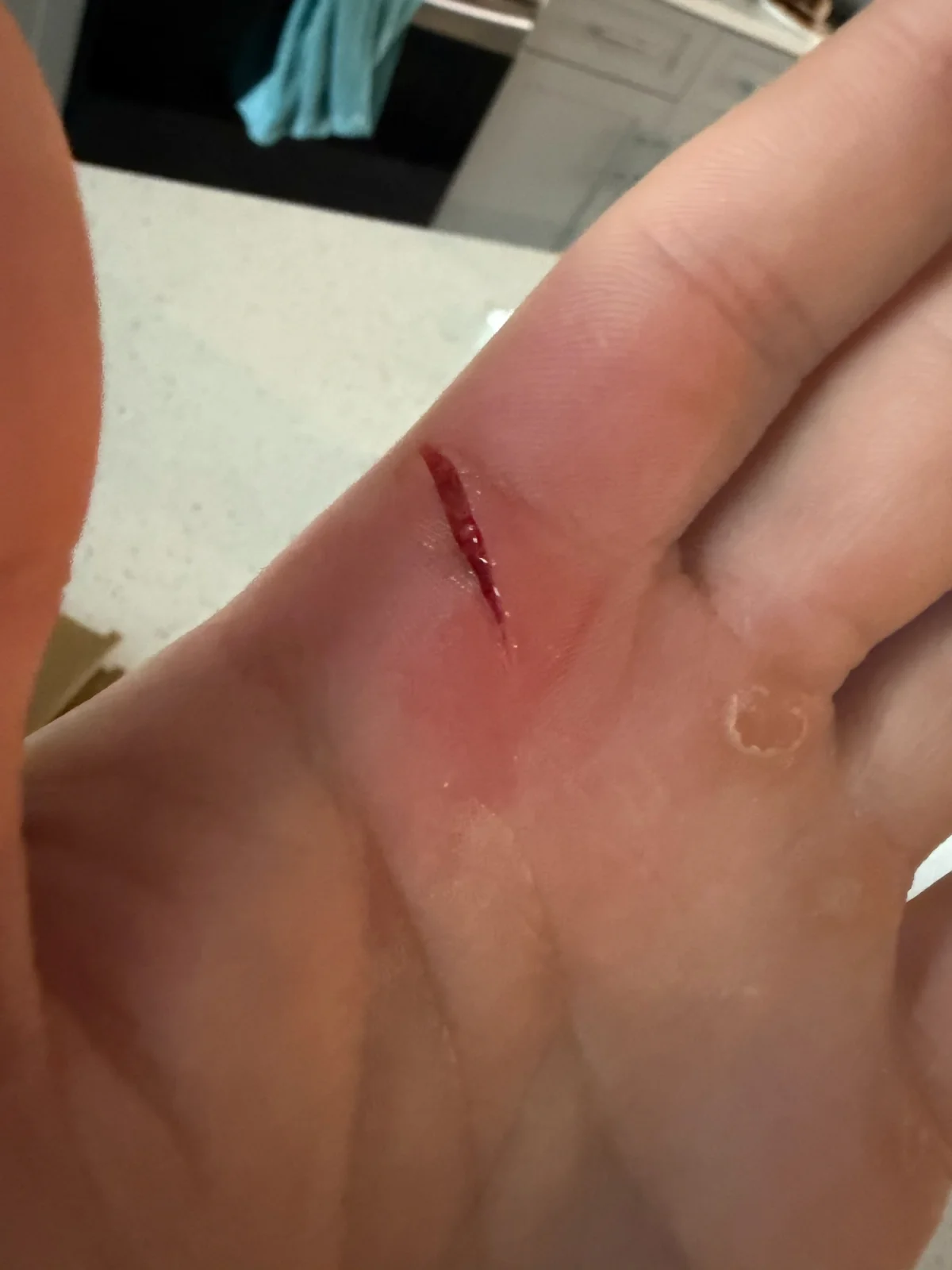

A simple cut at home usually does not need stitches if three things check out: bleeding stops with 10 minutes of direct pressure, you have no numbness past the cut, and you can fully bend and straighten the finger. If all three pass, the right care is soap and water, plain Vaseline, and a regular bandage. Skip Neosporin. Skip liquid bandage like New-Skin on a raw, still-bleeding wound.
The phone rang on a Tuesday night. Jordan had just moved to Fishtown from Charlotte. She had cut her finger in the kitchen, walked to the pharmacy for supplies, and was now back on the couch with the cut still bleeding. Before she sat down in an urgent care lobby in a neighborhood she barely knew, she sent a photo and called the practice.
The photo she sent showed a roughly 1.5 cm straight cut on the palm-side of the index finger, near the big knuckle. The edges were close together, with no glass or dirt in the wound, and it was oozing from the surface capillaries rather than spurting.
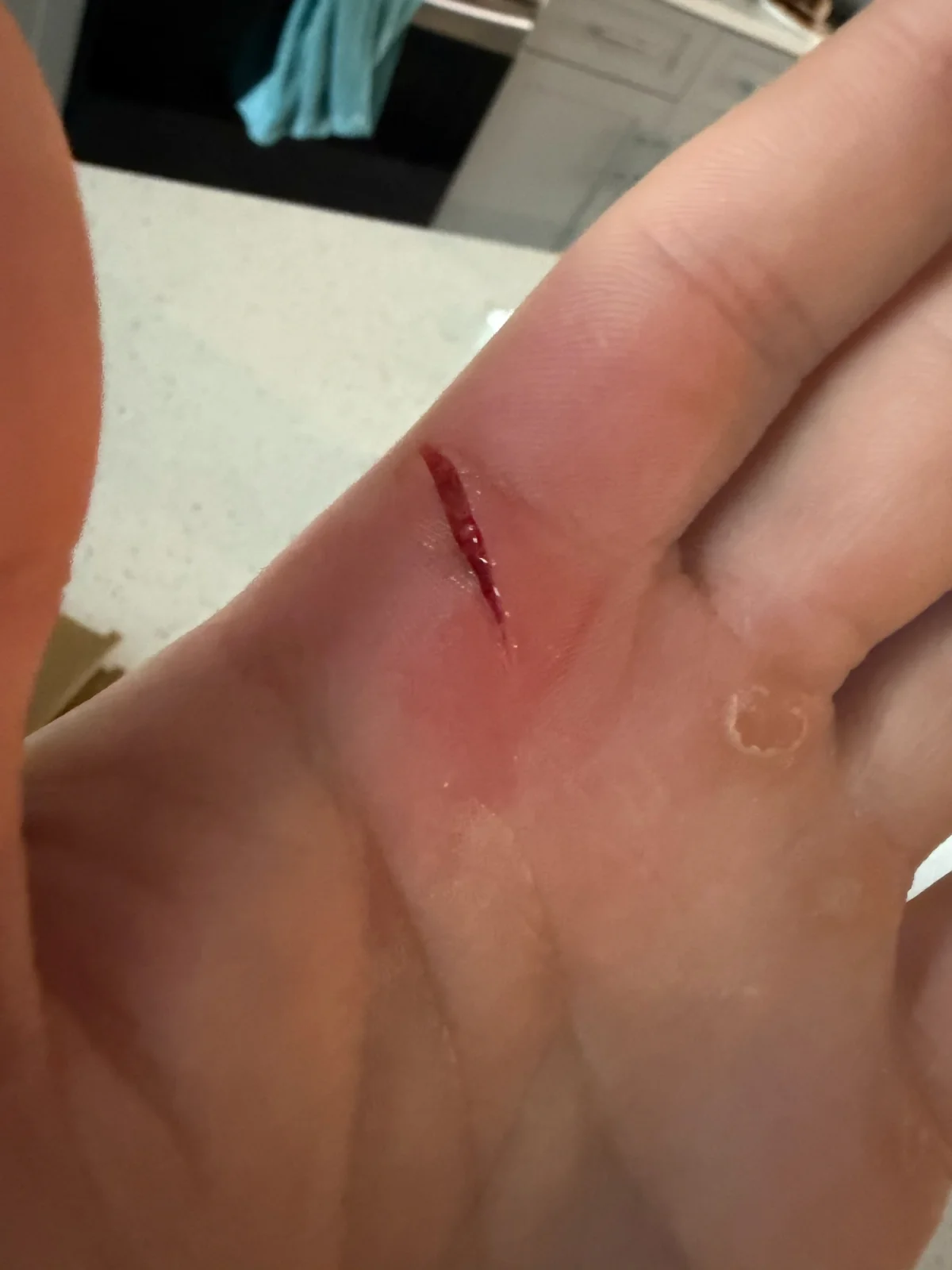

This guide walks through the same triage I ran on the phone with Jordan, plus the home care plan we sent her by text.
What Is a "Simple" Cut Versus One That Needs Stitches?
A simple cut at home is one that the skin can heal on its own once you give it the right environment. A cut that needs stitches is one where the skin cannot pull itself back together, or where there is damage to a structure underneath that the eye cannot fully see.
The visible signs of a cut that probably needs stitches:
- Gaping edges. When you relax the hand, the skin does not come back together. You can see fat (yellow) or muscle.
- Length over about 1 to 2 cm on the hand or face, or any cut on the joint of a finger where movement keeps pulling it open.
- Bleeding that does not slow after 10 to 15 minutes of firm pressure.
- A wound from a dirty or contaminated source (rusty metal, animal bite, glass shards left behind, a serrated tool).
- Loss of sensation in the fingertip past the cut.
- Loss of motion, meaning you cannot fully bend or straighten the finger past the cut.
If any of those are true, this is not the article to follow. Skip to the When to Escalate section.
How Do I Triage a Cut at Home in 60 Seconds?
You triage a cut at home with three questions. They map to the three things your hand can lose under a cut: the nerve, the tendon, and the blood supply. This is the script I run on every photo or call.
Question 1: Is there numbness past the cut?
Lightly touch the fingertip past the cut and compare it to the same spot on the other hand. If it feels noticeably duller, or if you cannot tell the difference between a sharp pen tip and a soft eraser, the digital nerve may be cut. Numbness in a finger is a red flag because the nerve is small, runs close to the skin on the palm side, and does not heal well without help.
Question 2: Can you fully bend and straighten the finger?
Make a full fist, then open the hand all the way. Bend just the fingertip joint. Push the fingertip down against a flat surface. If any of those motions feels weak, locked, or like the tendon is "skipping," a flexor or extensor tendon may be involved. Hand tendons heal best when repaired in the first week or two by a hand specialist.
Question 3: Can you stop the bleeding with 10 minutes of firm, direct pressure?
Hold a fresh cloth or gauze on the cut, press down firmly without lifting, and raise the hand above the heart. Hold for a full 10 minutes. Lifting every 30 seconds to peek resets the clot, so do not check until the timer goes off. If the cut still bleeds steadily through gauze after a continuous 10 minutes, the wound is deeper than it looks or there is a small artery involved. Both are reasons to be seen.
If all three pass, the home plan below is the right next step. If even one fails, see a clinician within a few hours, before the wound closure window narrows.
What Is the Right Home Care Plan for a Simple Cut?
The right home care plan for a simple cut is short and boring on purpose. The skin is very good at closing a cut like this when you do not get in its way. The four steps:
- Stop the bleeding first. Press firmly on the cut with a fresh cloth or gauze for a full 10 minutes, keep the hand above the heart, and do not peek.
- Rinse with soap and water. Lukewarm tap water under low pressure is fine, and so is mild hand soap. Skip hydrogen peroxide and rubbing alcohol; both kill the skin cells you need for healing.
- Apply a thin film of plain petrolatum. Vaseline or Aquaphor. Petrolatum keeps the wound moist, which speeds healing and prevents the scab from cracking with every finger bend.
- Cover with a standard adhesive bandage. Change once a day, or sooner if it gets wet or dirty.
For a cut on the side or palm of a finger that opens when you bend it, a butterfly closure (Steri-Strip) or a "knuckle" style bandage with side pull helps hold the edges together. Place the butterfly across the cut, not along it. Leave for 5 to 7 days unless it falls off on its own.
Tetanus matters. If the last tetanus shot was more than 10 years ago, schedule a booster within a few days. For a dirty or deep wound, that window shortens to 5 years.
Guidance from the Clinic
Should I Use Neosporin on a Cut?
For most simple cuts at home, Neosporin is not the right tool, for two reasons.
One: the neomycin allergy issue. Neomycin is one of the three active ingredients in Neosporin (the others are bacitracin and polymyxin). The American Contact Dermatitis Society named neomycin its "Allergen of the Year" in 2010. A 2025 systematic review and meta-analysis in Contact Dermatitis put the pooled prevalence of neomycin contact allergy in adult dermatitis patients at 3.2%, rising to 6.4% in North America. That allergic rash, called contact dermatitis, looks like a wound infection: red, itchy, sometimes weeping. So a product you applied to "prevent infection" can produce a rash that mimics one.
Two: plain petrolatum works just as well. The often-cited Smack trial in JAMA (1996) randomized 922 ambulatory surgery patients to either bacitracin ointment or plain white petrolatum on minor wounds. Infection rates were similarly low in both groups (2.0% with petrolatum, 0.9% with bacitracin). Zero patients in the petrolatum group developed allergic contact dermatitis, compared with 0.9% in the bacitracin group. The takeaway: petrolatum gives you the same wound-healing benefit without the allergy risk.
The right call on a simple, low-risk cut at home: plain Vaseline or Aquaphor. Save antibiotic ointments for wounds that are dirty, animal-related, or in patients with diabetes or immunosuppression, and even then, ask a clinician first.
Is New-Skin Liquid Bandage Good for a Fresh Cut?
New-Skin liquid bandage is not the right product for a fresh, still-bleeding cut. It belongs in a different part of the cabinet.
Get Real Answers
Tired of being told your labs are 'normal'? Dr. Ash digs deeper.
New-Skin is benzethonium chloride 0.2% in a solution of nitrocellulose, ethyl alcohol, and acetate. Two problems for a raw wound:
- The vehicle stings hard on open tissue. The alcohol and acetate solvent are the part that "dries" the film. On intact or healed skin, fine. On a fresh laceration with active bleeding, painful and irritating.
- The film does not hold the edges together. Liquid bandages create a thin protective film over a wound. They do not pull the skin edges together like a butterfly closure or a true tissue adhesive (cyanoacrylate, marketed as Dermabond in clinics). On a cut that wants to gape open with every finger bend, the film is a poor mechanical match.
Where New-Skin shines: closed and partially healed wounds, hangnails, paper cuts, blister covers, and skin that has already stopped bleeding and just needs a flexible seal. For Jordan's kitchen cut, we used a regular bandage and a butterfly closure instead.
When Do I Need to Go to Urgent Care or the ER?
You need urgent or emergency care for a cut when it falls into one of these groups. The hierarchy I run through with patients:
Go to the emergency department (call 911 if severe):
- Bleeding that pulses or spurts with each heartbeat (arterial bleed).
- Bleeding that will not stop after 15 minutes of firm direct pressure with the limb raised.
- A deeply contaminated wound from a high-force injury: a saw, a power tool, a glass smash, a motor vehicle cut.
- Suspected exposed bone, joint capsule, or tendon (you see white, glistening tissue at the base of the wound).
- A bite wound to the face or hand from a human or animal with significant tissue damage.
Go to urgent care within 6 to 12 hours:
- Cut on the hand or face that gapes open when relaxed.
- Loss of sensation or motion past the cut, but stable bleeding.
- A puncture wound (a nail, a piece of glass, a knife tip) where the depth is unclear.
- An animal or human bite to the hand, even if it looks shallow. Hand bites have a high infection rate and almost always need antibiotics.
- A cut more than 12 hours old that you now realize needs closing. The closure window on hand wounds is roughly 12 hours, and on the face about 24 hours. Past that window, most clinicians let the wound heal on its own (called secondary intention) because closing late traps bacteria.
Stay home and watch:
- A shallow, non-gaping cut with no dirt in it, on a spot away from a joint or fingertip (forearm, lower leg) that stops bleeding with pressure and passes the three-question triage.
In Philly, two good urgent care options that handle wound closure well are Penn Medicine Urgent Care and Jefferson Urgent Care. Skip the ED for a simple cut. The wait is longer, the cost is much higher, and the wound care is the same.
How Fishtown Medicine Approaches Cuts at Home
At Fishtown Medicine, a cut at home is the kind of moment where a relationship-based practice earns its keep. The traditional path is to hunt through urgent care websites at 9 PM, choose one based on Yelp reviews, sit in a waiting room for 90 minutes, and pay a $250 facility fee for a butterfly closure you could have applied at home.
The Fishtown Medicine path:
- Text Dr. Ash a photo of the cut. Most members get a response inside 15 minutes during waking hours.
- Quick triage by video or phone. We run the three questions, look at the photo, and decide together whether this is a home plan or an in-person visit.
- If home plan, you get a personalized text with the steps, the products to buy (and which ones to skip), and the warning signs that would change the plan.
- If in-person care, the practice coordinates the right urgent care or specialist, or arranges a home visit if the situation fits.
- Follow-up text 24 to 48 hours later to check that the wound is closing well, with another photo if you want.
The medicine here is the same as anywhere; what is different is the access. A 2-minute photo triage prevents most unnecessary urgent care visits, and the visits that do happen are at the right level of care.
Actionable Steps in Philly
A simple kit and protocol you can have ready before you ever cut yourself.
- Stock the right wound kit at home: gauze pads, plain Vaseline or Aquaphor, regular fabric adhesive bandages, butterfly closures (Steri-Strips), and a small bottle of saline for rinsing. Available at NovaStar Pharmacy on Frankford Ave or any CVS.
- Skip the Neosporin unless a clinician tells you otherwise. Plain petrolatum is the better default.
- Check your tetanus status: if your last tetanus shot was more than 10 years ago, get one at your next visit. If you cut yourself on something dirty and you are past 5 years, book a booster within a few days.
- Save Fishtown Medicine in your phone as a contact. A 2-minute text triage on a cut beats a 4-hour urgent care wait.
- Take a photo before you bandage. Even if you handle the cut yourself, a clear photo lets a clinician weigh in later if anything changes.
The Bottom Line
Cuts at home are one of the most over-treated and under-triaged problems in primary care. What usually serves people best is the most boring plan: a gentle rinse, a thin layer of plain petrolatum, a regular bandage, and a calm 10-minute look at the three triage questions. The two products people turn to on instinct, Neosporin and New-Skin liquid bandage, are usually the wrong tool for a fresh, bleeding wound. Where people go wrong is defaulting to urgent care for a cut that could heal at home with a text-based triage from a doctor who knows them.
Key Takeaways
- Triage every cut with the same three questions: bleeding, sensation, motion. If all three pass, the home plan is enough.
- Direct pressure for a full 10 minutes with the hand above the heart stops most bleeding. Do not peek.
- Plain petrolatum (Vaseline or Aquaphor) beats antibiotic ointment for simple cuts, with less risk of contact allergy.
- Skip New-Skin on a fresh wound. Use it on healed or closed skin, not raw tissue.
- The hand wound closure window is about 12 hours. If you might need stitches, do not wait overnight.
Related at Fishtown Medicine
- Respiratory Congestion - the same-day workup for sinus and respiratory symptoms
- Cold Sores - HSV outbreaks, triggers, and suppressive options
- Sick After Flu Shot - what's expected versus what's not, after vaccination
- Swollen Lymph Nodes - when to watch and when to work it up
- Tattoo & Piercing Infection - the same-day care path for skin infections
- Lightheadedness & Dizziness - the orthostatic, cardiac, and neurologic causes worth distinguishing
- High Blood Pressure at Home - the at-home BP workup that tells us more than office readings
- Nausea - the clinical workup for persistent or unexplained nausea
- Bloating & Digestive Discomfort - the structured GI workup for bloating that won't quit
- The Follow-Up Visit After an ER Trip - what to do with the discharge paperwork once the stitches are in

Scientific References
- Smack DP, Harrington AC, Dunn C, et al. (1996). "Infection and allergy incidence in ambulatory surgery patients using white petrolatum vs bacitracin ointment. A randomized controlled trial." JAMA, 276(12), 972-977. PMID: 8805732.
- Jensen CT, Sommerlund M, Mortz CG, et al. (2025). "Prevalence of Contact Allergy to Neomycin in Dermatitis Patients: A Systematic Review and Meta-Analysis." Contact Dermatitis. PMID: 40107276. (Pooled adult prevalence 3.2%; 6.4% in North America.)
- Quinn JV, Polevoi SK, Kohn MA. (2014). "Traumatic lacerations: what are the risks for infection and has the 'golden period' of laceration care disappeared?" Emergency Medicine Journal, 31(2), 96-100.
- Centers for Disease Control and Prevention. "Tetanus: For Clinicians." Most recent ACIP recommendations on tetanus-containing vaccine intervals.
Dr. Ash is a board-certified internal medicine physician at Fishtown Medicine in Philadelphia. The practice handles acute issues like cuts, infections, and same-day questions by direct text and video, so members rarely need to face urgent care alone.
Frequently Asked Questions
Common Questions
Deep-Dive Questions
Ready when you are
The chat is our AI assistant, answering from our published guides. To talk it through with Dr. Ash himself, start with the intake.