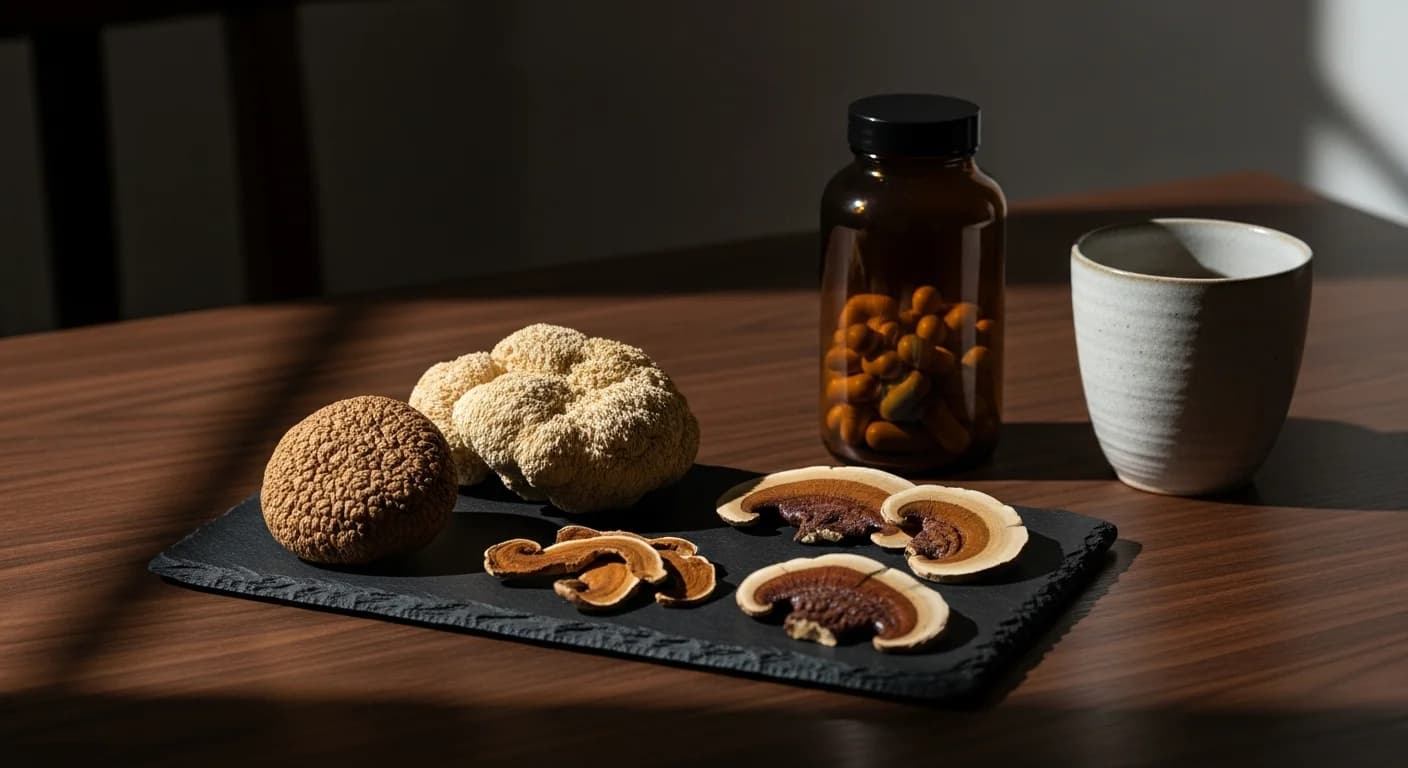

Most medicinal mushroom claims run far ahead of the evidence. The strongest data comes from PSK (a polysaccharide from turkey tail mushroom), which is an approved adjuvant cancer therapy in Japan with decades of randomized data. Cordyceps for endurance, lion's mane for cognition, and reishi for sleep all show promise but the trials are small. The bigger problem is product quality: in one analysis, only 26% of tested reishi products contained authentic reishi. This guide walks through what is validated, what is promising, and how to avoid the most common mistakes.
A patient brought in a paper bag with 4 mushroom products last month: lion's mane for focus, reishi for sleep, cordyceps for energy, and a "10-mushroom blend" for general health. The combined cost came to about $230 per month. We went through the labels together. Two of the four did not list a beta-glucan content, which is the closest thing we have to a quality marker, and one was mostly mycelium-on-grain, meaning most of the powder is starch rather than mushroom. She had been taking them for 8 months with no measurable effect, and no one had checked her vitamin D level. That is the gap this guide tries to close.
What medicinal mushrooms are and what they do
The evidence for medicinal mushrooms ranges from "approved drug in Japan with thousands of patients" at the top end to "promising in mice" at the bottom end, with most consumer claims somewhere in between. A short summary, from strongest evidence to weakest:
- Turkey tail (PSK / PSP): An approved adjuvant cancer therapy in Japan, backed by decades of randomized trial data that other studies reproduce.
- Cordyceps (sinensis / militaris): Modest endurance and aerobic capacity benefit in well-designed trials at the right dose.
- Reishi (Ganoderma lucidum): Some signal for sleep modulation and immune (NK cell) activation, though the trials are small.
- Lion's mane (Hericium erinaceus): Mixed cognitive results in small, short trials, with a plausible mechanism but inconsistent outcomes.
- Chaga, maitake, shiitake: Mostly cell-culture, animal, or very small human studies, which is not enough to recommend specific clinical claims.
- "Immune-boosting" combination blends: The marketing claim outruns the data by a wide margin in almost every product we see.
Turkey tail (Trametes versicolor, formerly Coriolus versicolor) is the most evidence-backed medicinal mushroom in the world. The active compound, polysaccharide K (PSK, also called krestin), is an approved prescription adjuvant therapy in Japan, where it has been used in combination with chemotherapy since the 1970s. PSK and its sister compound PSP work through immune modulation rather than direct anti-cancer activity. They appear to repair some of the immune damage caused by chemotherapy and to stimulate NK cell and T cell activity.
Cordyceps (Cordyceps sinensis and the lab-grown Cordyceps militaris) has the most consistent human exercise-performance data. The benefit is modest but measurable, and it depends on dose and duration. Cordyceps appears to improve oxygen utilization and possibly mitochondrial function, with effects that take weeks to develop.
Reishi (Ganoderma lucidum) has a modest clinical signal in sleep and immune modulation. Beta-glucans from reishi appear to stimulate natural killer cells, macrophages, and T cells in healthy adults at appropriate doses.
Lion's mane (Hericium erinaceus) has the most popular consumer story (focus, memory, "neurogenesis") and the least consistent clinical evidence. The mechanism research is interesting; the clinical trials are small and mixed.
Who this is for (and who it isn't)
Medicinal mushrooms are not a universal recommendation. They fit specific clinical contexts, and that is the right way to approach them.
People for whom a targeted mushroom trial is reasonable:
- Cancer patients in active oncology care. PSK from turkey tail is the one mushroom-derived compound worth raising by name, in coordination with the treating oncologist, as an adjuvant alongside chemotherapy or surgery, rather than as a primary cancer treatment.
- Endurance athletes with an established training base. Cordyceps at 2 to 3 g/day for 8 to 12 weeks is a reasonable trial for cyclists, runners, and rowers who already have sleep and nutrition dialed in.
- Adults with sleep difficulty. Reishi may help with sleep onset when underlying sleep apnea has been ruled out and basic sleep hygiene is in place.
- Adults curious about cognitive support. Lion's mane is a reasonable 8 to 12 week experiment at a documented dose with realistic expectations. It is not a substitute for sleep, blood sugar control, or hormone optimization.
It is not the right first move, or it needs a conversation first, if:
- You are on blood thinners (warfarin, DOACs, high-dose aspirin). Reishi and some other mushrooms have antiplatelet activity, which may increase bleeding risk.
- You are on immunosuppressive therapy (transplant medications, biologics for autoimmune disease). Immune-stimulating mushrooms may counteract the intended effect.
- You are pregnant or breastfeeding. Safety data are limited; the default position is to avoid.
- You have severe hepatic or renal impairment. Limited safety data at impaired clearance.
- You have a mushroom allergy or sensitivity.
Tell your clinician about any mushroom supplement you take, particularly before surgery or starting new medications.
How we evaluate it: do you need it, is it safe, does the dose work, then cost
Every supplement we recommend runs the same 4 gates, in order, and most things never make it past the first one (the whole process is in how we choose supplements).
- Do you need it? No lab makes this decision. If we use them it is against a stated goal with a review date, rather than as a permanent addition.
- Is it safe? Mushrooms accumulate heavy metals from their growing substrate. Without third-party testing by an ISO 17025 lab, contamination is possible. We also look for the species name on the label and a certificate of analysis (COA) available from the manufacturer.
- Does the dose work? The active compounds (beta-glucans, triterpenes) need hot-water extraction (decoction) to be bioavailable. Whole-mushroom powders in capsules are often poorly absorbed. Fruiting body extracts typically show 20% to 50% beta-glucan content; grain-based mycelium products often show 5% or less. We want the fruiting body specified rather than "mycelium on grain" or "full-spectrum," and a listed beta-glucan content of 20% or higher.
- What does it cost? A $40-per-month supplement that maybe helps is not equal to a $200-per-month stack of unproven blends. Among products that meet the safety and quality bar, we take the best value.
- What we make on it: nothing. Our only charge is the flat membership fee, and nothing is ever added on top of it. We take nothing on supplements, labs, imaging, or medication, which means every discount we can negotiate reaches you at cost. There is no conflict of interest here to work around, so the 4 gates above are the only things deciding what you hear from us.
How to dose it, and when
Dose depends on which mushroom and which goal. Most consumer doses are below the amounts used in trials, which is one of the main reasons patients report no benefit.
- Cordyceps for endurance: 2 to 3 grams per day of standardized extract for 6 to 12 weeks. Shorter trials (1 to 2 weeks) and lower doses (500 mg to 1,500 mg) typically show no significant effect. Combine with structured exercise, since the supplement supports your training rather than replacing it.
- Reishi for sleep: Doses studied range widely, from 200 mg to over 11,000 mg per day, for 1 to 24 weeks. Most consumer products come in at the low end. Best evidence is for trouble falling asleep, with no underlying sleep apnea, on a foundation of good sleep hygiene.
- Lion's mane for cognition: 8 to 12 weeks at a documented dose (preparations vary; look for erinacine A content if cognition is the goal). Results are inconsistent across trials, so set a measurable endpoint before you start.
- PSK (turkey tail) in oncology: This is a purified, standardized extract used as an adjuvant alongside chemotherapy or surgery, rather than a consumer capsule. Dose and protocol are directed by the treating oncologist.
Fishtown Medicine
A 90-minute conversation with Dr. Ash. A written plan you can follow.
Run an 8 to 12 week trial with a measurable endpoint (lab marker, performance test, sleep score, validated questionnaire). Stop if nothing changes.
Flaws, side effects, and interactions
No supplement category has more distance between the marketing and the evidence than medicinal mushrooms. The plain read:
- Product authenticity is the biggest problem. Only about 26% of tested reishi products in a USP analysis contained authentic reishi. The rest were mostly grain starch. A product that does not contain the mushroom on the label cannot produce the studied effect.
- Mycelium-on-grain products. Many cheap products are grown by inoculating mycelium on sterilized grain (rice, oats), then drying and powdering the whole substrate. The result is mostly starch with very little mushroom tissue.
- Ineffective extraction. Many active compounds need hot water extraction to be bioavailable. Whole-mushroom powders in capsules are often poorly absorbed.
- Blood thinning. Reishi and some other mushrooms have mild antiplatelet activity. Combination with warfarin, DOACs, or daily aspirin may increase bleeding risk.
- Immune interactions. Mushroom polysaccharides may counteract immunosuppressive medications used after transplant or for autoimmune disease.
- GI side effects. The main side effects in trials are occasional GI upset and rare skin rashes, most common with lion's mane.
- Chemotherapy interactions. Patients in active cancer treatment should coordinate any mushroom use with the treating oncologist, since some compounds may interact with chemotherapy in unpredictable ways.
What we recommend, and what we don't
- We look for: Species name on the label (like Trametes versicolor, Ganoderma lucidum, Hericium erinaceus); fruiting body specified (not "mycelium on grain" or "full-spectrum"); beta-glucan content listed at 20% or higher; third-party tested by an ISO 17025 lab with a COA available; hot-water or dual extraction (hot water plus alcohol for triterpenes); transparent sourcing.
- Worth considering: PSK if there is an oncology indication and the oncologist agrees. Cordyceps for an endurance athlete with the training base in place. Reishi for sleep when the foundations are already covered. A measured lion's mane trial for a patient with realistic expectations.
- We avoid: "10-mushroom blends" and general immune-boosting products where the marketing claim outruns the data. Mycelium-on-grain products with no listed beta-glucan content. Any mushroom supplement without a third-party COA. Stacking multiple mushroom products simultaneously without a clear hypothesis for each.
Guidance from the Clinic
"When a patient asks me about a mushroom product, I don't start with 'does it work.' I start with 'is the product authentic.' If 75% of reishi capsules on the market don't contain reishi, then the question of whether reishi works is irrelevant to the bottle in their hand. Get the product right first, then match the mushroom to the goal."
Dr. Ash
Actionable Steps
A practical framework before buying any mushroom product.
- Match the goal to the evidence. Cancer adjuvant (PSK / turkey tail) is the strongest. Endurance (cordyceps), sleep (reishi), and cognition (lion's mane) are weaker. "General immune boost" is mostly marketing.
- Verify the product is authentic. Species name, fruiting body, beta-glucan content at 20% or higher, third-party COA, hot-water extraction.
- Get the dose right. Most consumer doses are below trial doses. Cordyceps studies use 2 to 3 g/day; reishi studies often use 1 to 3 g/day of standardized extract.
- Run an 8 to 12 week trial with a measurable endpoint. Lab marker, performance test, sleep score, or validated questionnaire. Stop if nothing changes.
- Tell your clinician. Particularly before surgery, cancer treatment, or starting new medications.
Key Takeaways
- PSK (turkey tail) is the most evidence-backed medicinal mushroom, used as an approved adjuvant cancer therapy in Japan with decades of randomized trial data.
- Cordyceps modestly improves endurance metrics at 2 to 3 g/day over 6 to 12 weeks; shorter trials and lower doses typically show no effect.
- Reishi has some sleep and immune signal; doses studied range from 200 mg to over 11,000 mg per day.
- Lion's mane is promising for cognition but trial results are small and mixed; it is a reasonable 8 to 12 week experiment with realistic expectations.
- Only about 26% of tested reishi products in one USP analysis contained authentic reishi. Product quality is the biggest unsolved problem in the category.
A note on cost: any discount we negotiate on professional-grade supplements passes straight through to you, with no markup. Here is how we choose and source supplements.
Scientific References and Sources
- Memorial Sloan Kettering Cancer Center. "Coriolus versicolor." Integrative Medicine reference, accessed 2026.
- National Cancer Institute. "Medicinal Mushrooms (PDQ) - Health Professional Version." PDQ Cancer Information Summaries, NCBI Bookshelf.
- Chen S, Li Z, Krochmal R, et al. (2010). "Effect of Cs-4 (Cordyceps sinensis) on exercise performance in healthy older subjects: a double-blind, placebo-controlled trial." Journal of Alternative and Complementary Medicine.
- Hirsch KR, Smith-Ryan AE, Roelofs EJ, et al. (2016). "Cordyceps militaris improves tolerance to high intensity exercise after acute and chronic supplementation." Journal of Dietary Supplements.
- Mori K, Inatomi S, Ouchi K, et al. (2019). "Improvement of cognitive functions by oral intake of Hericium erinaceus." Biomedical Research.
- Alzheimer's Drug Discovery Foundation Cognitive Vitality. "Lion's Mane Mushroom: Evidence Review." Accessed 2026.
- NutraIngredients-USA. (2017). "75% of Reishi supplements don't actually contain Reishi mushroom, says USP analysis."

Frequently Asked Questions
Common Questions
Deep-Dive Questions
Ready when you are
The chat is our AI assistant, answering from our published guides. To talk it through with Dr. Ash himself, start with the intake.