Preventing falls and frailty in adults aged 65 to 85 rests on four proven steps. First, beat anabolic resistance by eating 1.2 to 1.5 grams of protein per kilogram of body weight daily, split into 30 to 40 grams (with 2.5 to 3.0 grams of leucine) per meal. Second, pair heavy resistance and fast power training (which build muscle and bone in the Fiatarone and LIFTMOR trials) with balance-challenging exercises (which cut fall rates by 34% in the Sherrington Cochrane review). Third, audit and taper fall-causing pills like SSRIs, sleep aids, diphenhydramine, and benzodiazepines. Fourth, correct vitamin D deficiency with a steady 800 to 1,000 IU daily dose (targeting 20 to 40 ng/mL) while avoiding high-dose monthly or yearly boluses that increase falls.
TL;DR: A hip fracture after age 65 is a life-changing event. Worldwide, 22% of older adults die within 1 year of a hip fracture, 60% enter a nursing home, and half never regain basic daily independence (Johannesdottir JAMA 2026, Leibson 2002). Preventing that first fall and fracture takes a 4-part clinical plan:
- Beat "anabolic resistance" at breakfast and lunch: Older muscle is 30% less sensitive to protein and needs 30 to 40 grams of protein (
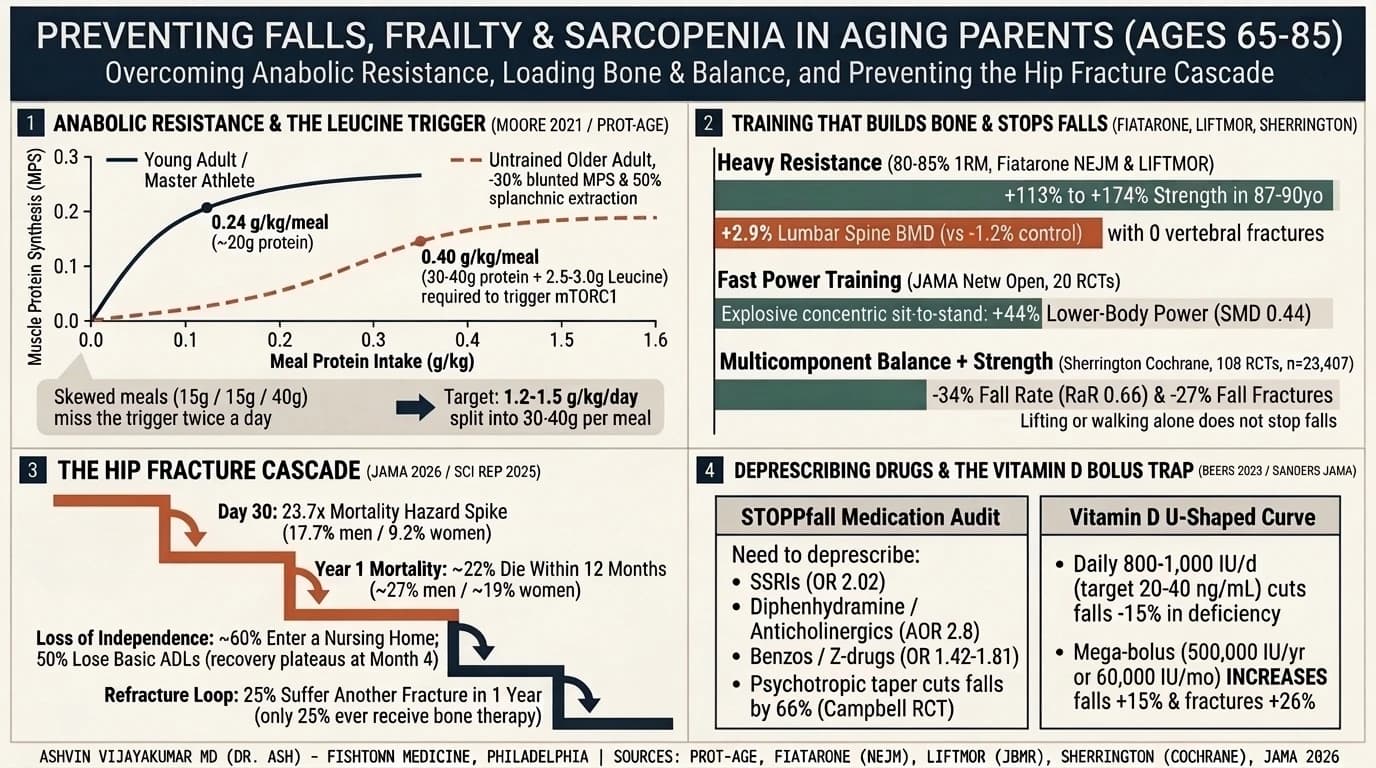
0.40 g/kg) with2.5 to 3.0 gof leucine per meal (1.2 to 1.5 g/kg/daytotal) to switch muscle building on (Moore 2021, BauerPROT-AGE2013).- Train for both bone and balance: Heavy lifting (
80% to 85% 1RM) builds strength by 113% to 174% even in 87-to-90-year-olds (Fiatarone NEJM 1994) and adds +2.9% lumbar spine bone density (WatsonLIFTMOR2018). Still, lifting alone does not stop falls. Adding balance-challenging exercises cuts fall rates by 34% (Sherrington Cochrane 2019).- Clear out balance-poisoning pills (
FRIDs): Sleeping pills,PMallergy meds (diphenhydramine,AOR 2.8), benzodiazepines (OR 1.42 to 1.81), andSSRIs(OR 2.02) double fall risk. Tapering off psychotropic pills cuts falls by 66% (Campbell 1999).- Use steady daily Vitamin D (
800 to 1,000 IU/day) instead of mega-boluses: Daily modest dosing cuts falls by 15% in deficient elders (<= 20 ng/mL), whereas mega-bolus doses (500,000 IU/yearor60,000 IU/month) increase falls by 15% and fractures by 26% (Sanders JAMA 2010).
Why is preventing the first hip fracture so urgent after age 65?
A hip fracture carries a 22% one-year mortality rate (27% in men and 19% in women), sends 60% of community-living older adults into a nursing home, and leaves half of survivors unable to dress, bathe, or walk independently (Johannesdottir JAMA 2026, Leibson 2002).
When members in their 30s, 40s, and 50s talk with us about their parents, we often start with brain sharpness (telling lifelong ADHD apart from early dementia). Right behind memory comes the second threat to an older parent's independence: presarcopenia (early muscle loss), osteopenia (thinning bone), and a single mechanical fall.
The numbers after a hip fracture explain why we treat muscle and balance with the same seriousness as heart attacks or cancer:
| Stage After Hip Fracture | Clinical Reality in Adults 65 to 85 | Key Evidence |
|---|---|---|
| First 30 Days | 3% to 11% die within 30 days (17.7% in men vs 9.2% in women; 28.3% in patients with >= 5 chronic conditions vs 7.8% with none). Mortality hazard jumps 23.67-fold in Month 1. | Liebermann 2025; Zhang Sci Rep 2025 |
| 1-Year Mortality | ~22% worldwide median 1-year mortality (~27% in men, ~19% in women; 12% to 16% in specialized orthogeriatric hospital units). Excess mortality stays ~2.0x higher 10 years later. | Johannesdottir JAMA 2026; Haentjens 2010 |
| Loss of Independence | 22% to 75% never regain prefracture walking. Only ~50% recover basic daily tasks (ADLs) and ~25% recover shopping or housework (IADLs). Recovery plateaus at 4 months. | Dakhil 2022; Zhao 2024 |
| Nursing Home Admission | ~60% enter a nursing home within 3 months and ~64% within 1 year (compared to 3% to 7% of matched peers). Living alone and cognitive slips are the strongest predictors. | Leibson 2002; Wahlsten 2020 |
| The Refracture Loop | ~25% break another bone within 1 year (10.6% break the other hip, which carries 26% to 37% 1-year mortality). Yet only ~25% receive bone-strengthening medication after surgery. | Ren 2026; Li 2026 |
Stopping this cascade before the first fracture happens is far more effective than trying to rebuild a 78-year-old parent after hip surgery.
Step 1: How do you overcome "anabolic resistance" with protein and leucine?
Older muscle requires 30 to 40 grams of protein (~0.40 g/kg) and 2.5 to 3.0 grams of the amino acid leucine at a single meal to turn on muscle building, which is 65% more per meal than a 30-year-old needs (Moore 2021, Kristiansen 2025).
Many older parents eat lighter as they age: a piece of toast and one egg at breakfast (~8g protein), a bowl of soup or salad at lunch (~12g), and a piece of chicken or fish at dinner (~35g). In a 28-year-old, small meals still nudge muscle growth. In a 72-year-old, a 12-gram meal does almost nothing for muscle.
Why aging muscle ignores small protein meals
A 2025 meta-analysis of 46 clinical studies (n = 1,280) confirmed that older adults have lower resting muscle protein synthesis (SMD -0.167) and a ~30% weaker muscle-building response after eating (SMD -0.348) than younger adults (Kristiansen 2025, McKendry 2024). Three physical changes cause this anabolic resistance:
- The gut and liver trap twice as much leucine: In older men, gut and liver tissues (
splanchnic extraction) hold onto 50% of swallowed leucine compared to only 23% in young men, leaving half as much in the bloodstream to reach arm and leg muscles (Boirie 1997). - Stiffer blood vessels slow delivery: Age-related blood vessel stiffness blunts insulin-driven blood flow into muscle capillaries after a meal (Banks 2022).
- Higher
mTORC1switch threshold: Inside the muscle cell, the growth switch (mTORC1) needs a stronger leucine signal (2.5 to 3.0 gper meal) before it starts building new muscle fibers (Ely 2023). In older men,15 gof protein at breakfast failed to switch onmTORC1at all, while40 g(~0.5 g/kg) turned it on strongly (McKendry 2024).
The encouraging finding from that same 2025 meta-analysis is clear: lifting weights restores the muscle's sensitivity to protein (Kristiansen 2025). When an older adult challenges a muscle and then feeds it 30 to 40 g of protein, the machinery still works.
| Guideline / Metric | Healthy Adults 65 to 85 | Active Training or Chronic Illness | Per-Meal Target & Leucine Trigger |
|---|---|---|---|
US / Canada RDA (Minimum Floor) | 0.8 g/kg/day (prevents deficiency only; loses -0.64 kg limb muscle in 10 wks, Mitchell 2017) | Not adjusted | None specified |
PROT-AGE Consensus (Bauer 2013) | 1.0 to 1.2 g/kg/day | 1.2 to 1.5 g/kg/day (>= 1.2 for exercising elders) | 30 to 40 g protein (~0.40 g/kg) + 2.5 to 3.0 g leucine per meal |
ESPEN Expert Group (Deutz 2014) | 1.0 to 1.2 g/kg/day | 1.2 to 1.5 g/kg/day (up to 2.0 g/kg in severe illness) | Spread evenly across 3 meals (Breakfast / Lunch / Dinner) |
| RCT Hypertrophy Target (Mitchell 2017) | 1.5 to 1.6 g/kg/day (gained +1.49 kg lean mass over 10 wks in men > 70) | Pair with resistance training (+0.54 kg limb muscle & +1.71 kg grip across 28 RCTs, Kirwan 2022) | Adding 3 to 5 g leucine or 25 g whey isolate rescues a low-protein breakfast (Devries 2018, Murphy 2016) |
Kidney safety note: Higher protein does not harm healthy kidneys in older adults (Traylor 2018). The PROT-AGE and ESPEN guidelines restrict protein only in patients with severe chronic kidney disease (eGFR < 30) who are not on dialysis. If your parent has mild creatinine changes, check Cystatin C to measure true kidney filtration.
Step 2: Which exercises build bone and muscle vs. which ones stop falls?
Heavy resistance and fast power training (80% to 85% 1RM) rebuild muscle strength and bone density, while multicomponent balance + strength training is required to cut fall rates by 34% (Fiatarone NEJM 1994, Watson LIFTMOR 2018, Sherrington Cochrane 2019).
Adult children and even many doctors worry that a 72-year-old mother with osteopenia or an 82-year-old father who walks slowly is "too fragile to lift heavy weights." Randomized clinical trials proved the opposite: light weights (40% 1RM) and casual walking fail to rebuild aging bone or stop falls.
1. Heavy resistance training (Fiatarone NEJM 1994): Never too old to load
Maria Fiatarone tested progressive heavy leg training (80% of 1-rep max, 3 sets of 8 reps, 3 days a week) in frail nursing-home residents with an average age of 87 to 90 years:
- 8-Week Nonagenarian Trial (
mean age 90): Leg strength jumped 174%, thigh muscle size grew 9%, and tandem walking speed rose 48% (Fiatarone JAMA 1990). - 10-Week
NEJMFICSITTrial (n = 100,mean age 87): Strength rose 113%, stair-climbing power rose 28%, and walking speed rose 12% (Fiatarone NEJM 1994). Notably, a nutrition drink alone without lifting produced zero strength gain.
2. Fast power training (JAMA Network Open 2022): Speed saves you from a trip
When your parent catches a toe on a rug, slow strength is not enough; their leg has to fire in milliseconds. Across 20 randomized trials (mean age 70), power training (standing up from a chair or pressing a weight as fast as safely possible on the way up, then lowering slowly over 2 to 3 seconds) beat traditional slow strength training for both physical function (SMD 0.30) and lower-body power (SMD 0.44, Balachandran JAMA Netw Open 2022).
3. Heavy lifting for osteopenia and osteoporosis (LIFTMOR & MEDEX-OP)
In the landmark LIFTMOR trial (Watson 2018), 101 postmenopausal women (mean age 65, T-score < -1.0) were randomized to 8 months of supervised, twice-weekly 30-minute High-Intensity Resistance and Impact Training (HiRIT) (5 sets of 5 reps at > 85% 1RM deadlifts, overhead presses, and squats, plus heel-drop landings) vs. low-intensity home exercise:
- Lumbar spine bone density (
BMD) rose+2.9%in the heavy-lifting group while dropping-1.2%in the low-intensity group. - Femoral neck (hip)
BMDrose+0.3%vs.-1.9%in controls, and femoral neck cortical bone thickness increased. - Safety: Compliance was 92%, spinal posture (
thoracic kyphosis) improved, and there were zero vertebral fractures (Watson 2019). TheMEDEX-OPtrial confirmed these spine gains (Kistler-Fischbacher 2021). Read our full guide to DEXA and Trabecular Bone Score (TBS) for how we track bone quality.
Longevity Medicine
A personalized longevity strategy starts with knowing your real baselines.
4. Why balance training is mandatory to stop falls (Sherrington Cochrane Review)
Lifting weights alone does not reliably reduce falls; stopping falls requires pairing strength work with balance challenges. In the anchor Cochrane review of 108 randomized trials (n = 23,407, mean age 76) (Sherrington 2019, Sherrington 2020):
| Exercise Modality | Effect on Fall Rate | Evidence Certainty | Clinical Takeaway for Your Parent |
|---|---|---|---|
Multicomponent (Balance + Strength) | -34% fall rate (RaR 0.66) | Moderate to High | The gold standard endorsed by the 2024 USPSTF (Nicholson JAMA 2024). |
Balance & Functional Training (> 3 hrs/wk) | -24% overall (-39% when > 3 hrs/wk) | High | Tandem stance, single-leg reach, stepping over obstacles, and sit-to-stand drills. |
| Tai Chi | -19% fall rate (RaR 0.81) | Low to Moderate | Helpful for weight-shifting and dual-task balance. |
| Resistance Training Alone (Without Balance) | Uncertain (No clear fall reduction) | Very Low | Builds essential muscle and bone, must be paired with balance work to stop falls. |
| Walking Alone | No fall reduction | Low | Good for heart health; does not prevent trips or slips. |
Step 3: Which medications double fall risk (STOPPFall & 2023 Beers Criteria)?
Brain-active and anticholinergic pills (SSRIs, sleeping pills, benzodiazepines, PM allergy drugs like diphenhydramine, and gabapentin) raise fall risk by 42% to 180%, and tapering off psychotropic drugs cuts falls by 66% (Seppala STOPPFall 2021, Campbell 1999, Yin 2026).
Before buying grab bars or new shoes, open your parent's pill organizer. Taking 4 or more daily medications raises fall risk by 75% (OR 1.75, Leung JAMA 2024). Even more important, specific Fall-Risk-Increasing Drugs (FRIDs) slow reaction time and cloud balance:
- Antidepressants (
SSRIsOR 2.02, overall antidepressantsOR 1.57): Often overlooked as a fall trigger,SSRIsdouble fall odds and can also lower blood sodium (hyponatremia) and bone density (Seppala 2018). - Over-the-counter
PMsleep aids & bladder pills (High Anticholinergic BurdenAOR 2.8): Diphenhydramine (Benadryl,Tylenol PM,Advil PM), doxylamine, and older overactive-bladder pills (oxybutynin) score a3on the Anticholinergic Burden scale, raising fall risk by> 50%(AOR 2.2 to 2.8, Clarkson 2025) while also mimicking early dementia. - Benzodiazepines &
Z-drugs(OR 1.42, long-actingOR 1.81): Alprazolam, lorazepam, clonazepam, and zolpidem (Ambien) impair nighttime balance when your parent walks to the bathroom at 3 AM. The 2023 AGS Beers Criteria explicitly warns that short-acting benzodiazepines are not safer than long-acting ones in older adults (2023 Beers Panel). - Gabapentin, pregabalin (
OR 1.55), and opioids (OR 1.60): Cause daytime and nighttime unsteadiness. - What about blood pressure pills? Here the evidence is counterintuitive: do not blindly stop blood pressure medications to prevent falls. A 2025 Cochrane review (Gnjidic 2025) and an individual-participant JAMA meta-analysis (Juraschek 2023) showed that intensive blood pressure control does not increase population falls, and stopping BP drugs can worsen standing dizziness. Only adjust BP meds (such as alpha-blockers like tamsulosin or loop diuretics) if a standing blood pressure check confirms orthostatic hypotension (
>= 20 mmHgsystolic or>= 10 mmHgdiastolic drop within 3 minutes of standing).
In the landmark Campbell randomized trial, slowly tapering older adults off psychotropic sleep and anxiety pills cut their fall rate by 66% (RH 0.34) (Campbell 1999), a finding confirmed across settings in a 2026 meta-analysis (OR 0.61, Yin 2026).
Step 4: The Vitamin D bolus trap: Why 800 to 1,000 IU/day works and mega-doses cause falls
Vitamin D follows a strict U-shaped curve for falls: a steady 800 to 1,000 IU/day cuts falls by 15% in older adults with deficiency (25(OH)D <= 20 ng/mL), whereas mega-bolus doses (60,000 IU/month or 500,000 IU/year) and excessive blood levels (> 40 to 60 ng/mL) paradoxically increase falls and fractures (Tan 2024, Sanders JAMA 2010, Appel STURDY 2021).
Many older adults are prescribed 50,000 IU weekly/monthly capsules or take 5,000 to 10,000 IU/day assuming more Vitamin D means stronger bones and fewer falls. Four major clinical trials proved that high-dose or bolus Vitamin D triggers falls:
- Annual Mega-Bolus (
Sanders JAMA 2010): A single yearly dose of500,000 IUin older women increased falls by 15% (HR 1.16) and fractures by 26% (HR 1.26), with fall risk jumping 31% in the first 3 months right after the dose (Sanders 2010). - Monthly High Dose (
Bischoff-Ferrari JAMA Intern Med 2016): Older adults given60,000 IU/monthhad a 67% fall incidence compared to 48% in those given the standard24,000 IU/month(800 IU/dayequivalent, Bischoff-Ferrari 2016). - High Daily Doses (
STURDYTrial,Annals 2021): In older adults with higher fall risk, doses of>= 1,000 to 4,000 IU/daydid not beat200 IU/dayand raised serious falls (HR 1.87) and fall hospitalizations (HR 2.48, Appel 2021, Wanigatunga 2021). - Why mega-doses backfire: A massive surge of Vitamin D triggers the hormone
FGF-23and the enzymeCYP24A1, which rapidly break down active1,25(OH)2Dinside muscle cells and stimulate bone-resorbingRANKL(Cianferotti 2026). - The safe clinical rule: Check your parent's blood
25(OH)Dlevel. If it is low (<= 20 to 30 ng/mL), replete with a steady800 to 1,000 IU/dayof Vitamin D3, aiming for a sweet-spot blood level of20 to 40 ng/mL(Dawson-Hughes 2022, Tan 2024).
Guidance from the Clinic: How We Support the Sandwich Generation

Key Takeaways
- A hip fracture is a medical emergency with cancer-level mortality: `~22%` die within 1 year, `~60%` enter a nursing home, and `25%` break another bone within 12 months (Johannesdottir *JAMA* 2026).
- Beat anabolic resistance at every meal: Older muscle needs `30 to 40 g` of protein (`0.40 g/kg`) and `2.5 to 3.0 g` of leucine per meal (`1.2 to 1.5 g/kg/day` total) paired with resistance training (Bauer 2013, Moore 2021).
- Pair heavy resistance/power training with balance drills: Heavy loading (`80% to 85% 1RM`) builds muscle (`+113%`, `Fiatarone`) and spine bone (`+2.9%`, `LIFTMOR`), fast concentric power training builds chair-rise speed (`SMD +0.44`), and multicomponent balance + strength training cuts falls by `34%` (`Sherrington`).
- Taper balance-poisoning drugs and avoid Vitamin D mega-boluses: Auditing `SSRIs`, `PM` anticholinergics, and sleep pills cuts falls up to 66% (`Campbell 1999`), and steady `800 to 1,000 IU/day` Vitamin D3 (`target 20 to 40 ng/mL`) avoids the +15% fall spike caused by bolus dosing (`Sanders 2010`).
Related at Fishtown Medicine
- Is It Lifelong ADHD, Inattention, or Early Dementia in an Aging Parent? - our companion Sandwich Generation guide on memory slips, the
AD8, and thep-tau217blood test - The Aging Parents Playbook - moving from crisis management to system design (home safety, legal documents, and Philadelphia care resources)
- Bone Density & Trabecular Bone Score (
TBS): Quality and Quantity - why standard DEXAT-scoresmiss fragile bone scaffolding and howTBSworks - DEXA Body Composition Testing (
ALMI& Visceral Fat) - how we measure limb muscle mass (ALMI) to catch presarcopenia decades early - How Much Protein Do You Need for Muscle, Aging, and Longevity? - protein targets across your 30s, 40s, 50s, and 70s
- Creatine Beyond Muscle: Brain, Bone, and Aging - how
3 to 5 g/dayof creatine monohydrate supports older muscle, bone, and cognition - The Marginal Decade: Planning for the Last 10 Years of Your Life - how we back-cast your strength,
VO2 max, and balance from age 85 to today
Scientific References
- Kristiansen JB, Vissing K, Nielsen JL. "Age-Related Anabolic Resistance and Post-Absorptive Muscle Protein Synthesis: Integrative Evidence From a Systematic Review and Meta-Analysis." Frontiers in Physiology. 2025. PubMed
- Moore DR. "Protein Requirements for Master Athletes: Just Older Versions of Their Younger Selves." Sports Medicine. 2021;51(Suppl 1):13-30. DOI
- Bauer J, Biolo G, Cederholm T, et al. "Evidence-Based Recommendations for Optimal Dietary Protein Intake in Older People: A Position Paper From the PROT-AGE Study Group." Journal of the American Medical Directors Association. 2013;14(8):542-559. PubMed
- Kirwan RP, Mazidi M, Rodríguez García C, et al. "Protein Interventions Augment the Effect of Resistance Exercise on Appendicular Lean Mass and Handgrip Strength in Older Adults: A Systematic Review and Meta-Analysis of Randomized Controlled Trials." American Journal of Clinical Nutrition. 2022;115(3):897-913. PubMed
- Fiatarone MA, O'Neill EF, Ryan ND, et al. "Exercise Training and Nutritional Supplementation for Physical Frailty in Very Elderly People." New England Journal of Medicine. 1994;330(25):1769-1775. NEJM
- Watson SL, Weeks BK, Weis LJ, et al. "High-Intensity Resistance and Impact Training Improves Bone Mineral Density and Physical Function in Postmenopausal Women With Osteopenia and Osteoporosis: The LIFTMOR Randomized Controlled Trial." Journal of Bone and Mineral Research. 2018;33(2):211-220. PubMed
- Sherrington C, Fairhall NJ, Wallbank GK, et al. "Exercise for Preventing Falls in Older People Living in the Community." Cochrane Database of Systematic Reviews. 2019;1(1):CD012424. PubMed
- Johannesdottir F, Roberts JE, Kiel DP, Tsai JN. "Hip Fractures: A Review." JAMA. 2026. JAMA
- Seppala LJ, Petrovic M, Ryg J, et al. "STOPPFall (Screening Tool of Older Persons Prescriptions in Older Adults With High Fall Risk): A Delphi Study by the EuGMS Task and Finish Group on Fall-Risk-Increasing Drugs." Age and Ageing. 2021;50(4):1189-1199. PubMed
- Sanders KM, Stuart AL, Williamson EJ, et al. "Annual High-Dose Oral Vitamin D and Falls and Fractures in Older Women: A Randomized Controlled Trial." JAMA. 2010;303(18):1815-1822. JAMA

Frequently Asked Questions
Common Questions
Ready when you are
The chat is our AI assistant, answering from our published guides. To talk it through with Dr. Ash himself, start with the intake.