
A smartwatch or ring can raise a hand and say you might have sleep apnea, but it cannot give you a diagnosis or an all-clear. If your watch flags you, or if you wake between 2 AM and 5 AM, get up to urinate at night, grind your teeth, wake with a morning headache, have hard-to-control blood pressure, or show high hemoglobin on bloodwork, the next step is a medical sleep test. A 1-night disposable WatchPAT One home test suits most adults when it is read using the 3%-arousal (3%A) and RDI rules instead of the insurance 4% rule (which misses 71.1% of mild sleep apnea). In a lean adult or woman with strong symptoms, a negative home test should be followed by an in-lab study.
TL;DR: Your watch is good at raising a hand and bad at giving an all-clear. The Apple Watch and Samsung apnea features flag signs of moderate-to-severe apnea, yet a silent watch misses more than half of moderate cases. Even more important, 86% of lean adults with sleep apnea and 60.7% of women have a low arousal threshold. Their brain wakes up before blood oxygen drops 4%. That turns airway resistance into 3 AM insomnia, nighttime urination (
50% to 77%), teeth grinding (21% to 41%), or morning headaches instead of loud snoring. A 1-night disposable WatchPAT One home sleep test costs about $129.99. Pick "Sleep Test & Results" at checkout so Dr. Ash can read your3%pAHIandpRDIhimself. The insurance4%rule misses 71.1% of mild OSA, and finger-based home kits have only 42% severity match in mild cases and lean women. Because of that, a normal home result plus strong symptoms means you need an in-lab study with3%AandRDIscoring.
This page helps you decide if your symptoms, bloodwork, or wearable call for a sleep test. We cover which test fits you, why 4% AHI scoring misses lean adults and women, and what CPAP and non-CPAP treatments change. Once you are ready to order, read our guide to what a home sleep apnea test costs and how to do one. It covers the $129.99 disposable WatchPAT One kit, the setup steps, and the DOT rules.
How common is sleep apnea, and why is it missed in women and lean adults?
Your airway narrows or closes while you sleep. Airflow drops, and either your blood oxygen falls or your brain pulls you toward waking to open the airway again. That cycle can repeat dozens or hundreds of times before your alarm goes off.
Close to a billion adults worldwide (~936 million between ages 30 and 69) have at least mild sleep apnea. About 425 million have moderate-to-severe disease.1 When researchers screened the general public, 82% of men and 93% of women with moderate-to-severe apnea had never been diagnosed.3
Why are women and lean, fit adults missed at such high rates? Traditional screening questionnaires (STOP-Bang, Berlin, Epworth) were built around a high-BMI male profile: loud snoring, witnessed pauses, and falling asleep at traffic lights (Dunietz Chest 2026).
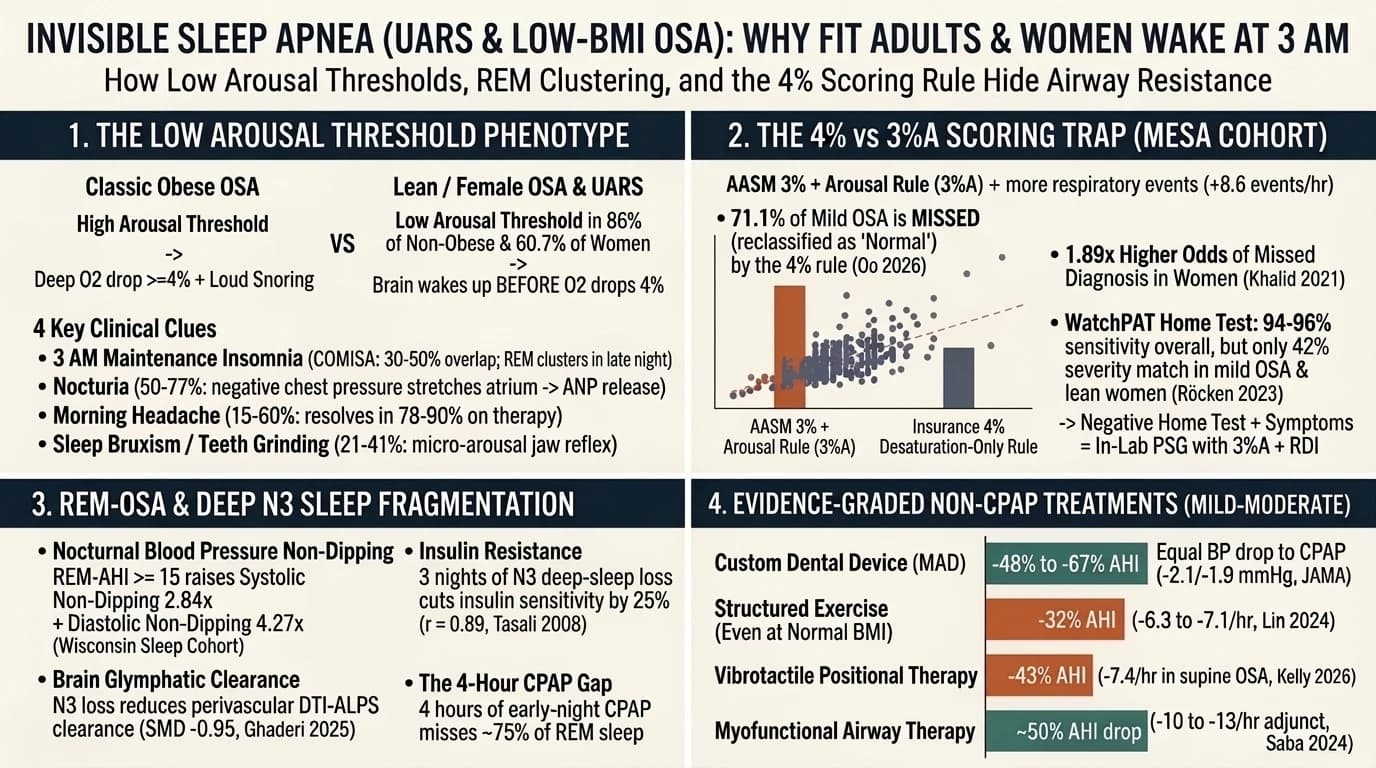
In 86% of non-obese sleep apnea patients and 60.7% of women, the main driver is a low arousal threshold (Low AT) paired with jaw structure (retrognathia) or REM muscle relaxation (Citton 2025, Antonaglia 2022). Instead of sleeping through a collapse until oxygen drops 4%, a low-arousal-threshold brain jolts awake after a few seconds of narrowed airflow. Up to 40% of women with AHI > 15 report zero classic snoring or daytime sleepiness. They show up instead with 3 AM insomnia (COMISA), nighttime urination, morning headaches, teeth grinding, and daytime fatigue (Trotta 2026, Basoglu 2018).
Can my Apple Watch or Oura ring detect sleep apnea?
No. Your watch cannot diagnose you, and it was never cleared to. What it can do is tell you to go get tested, and that nudge is helpful.
Take the Apple Watch. It reads tiny wrist movements over 30 days and notifies you when the pattern matches moderate-to-severe apnea. Apple's study put its specificity near 98 percent, so when it fires, take it seriously. Sensitivity was about 66 percent overall and around 43 percent for moderate cases.4 A silent watch misses roughly a third of sleep apnea overall, more than half of moderate cases, and nearly all mild or arousal-driven cases (UARS). Samsung's Galaxy Watch feature uses the blood-oxygen sensor over 2 nights and ends up in the same spot. It flags, it does not diagnose, and it misses milder disease.
Oura and Whoop are wellness trackers, not FDA-cleared apnea tests. Their overnight oxygen traces come from consumer sensors instead of medical oximeters. A choppy oxygen line or high nighttime stress score is a good reason to ask the question, though it cannot give you a final answer.
So the rule is simple: a wearable flag means test. And a quiet watch in someone with 3 AM awakenings, morning grogginess, night moaning, nocturia, or high hemoglobin means test anyway.
What is the AHI, and why does the 4% rule miss 71% of mild sleep apnea?
The Apnea-Hypopnea Index (AHI) counts complete pauses (apneas) plus partial narrowings (hypopneas) per hour of sleep. Yet the insurance 4% hypopnea rule ignores brain arousals and reclassifies 71.1% of mild sleep apnea patients as "normal" (Oo 2026).
Under 5 events per hour is normal, 5 to 15 is mild, 15 to 30 is moderate, and over 30 is severe. Still, the biggest trap in sleep medicine is how a lab counts a hypopnea:
| Scoring Metric | How It Defines an Event | What It Catches (and Misses) | Key Clinical Evidence |
|---|---|---|---|
Insurance / CMS 4% Rule (AHI 4%) | Airflow drops >= 30% for >= 10s with >= 4% oxygen drop only (ignores brain arousals) | Misses 71.1% of mild OSA (MESA cohort) and moves 60% of patients into a lower tier. Women are 1.89x more likely to have 3%A OSA missed by the 4% rule (6.87x in women aged 40 to 60 with high BMI). | Oo 2026; Khalid 2021 |
AASM Recommended 3%A Rule (AHI 3%A) | Airflow drops >= 30% for >= 10s with >= 3% oxygen drop OR an EEG brain arousal | Scores +8.6 events/hour higher than the 4% rule and captures 84% of arousal events that 4% scoring throws away. | Berry AASM 2022; Tu 2024 |
RDI (AHI + RERA Index) & UARS | Adds Respiratory Effort-Related Arousals (RERAs): airflow flattening that wakes the brain with < 3% oxygen drop | Detects Upper Airway Resistance Syndrome (UARS), where AHI <= 5 and oxygen stays >= 92%, yet RDI > 5 causes worse fatigue than mild 4% OSA. | de Godoy 2016; Tufik 2022 |
REM-Predominant AHI (REM-AHI) | REM-AHI / NREM-AHI > 2 (events concentrated during late-night REM sleep) | Common in women and lean adults. Even when total AHI is < 10, REM-AHI >= 15 raises systolic BP non-dipping 2.84x and diastolic non-dipping 4.27x, and drives insulin resistance (HOMA-IR). | Wisconsin Sleep Cohort (Mokhlesi 2015); Chami 2015 |
Beyond 3%A and RDI, we check hypoxic burden, which is the total area of oxygen drops across the night.8 We also check deep N3 slow-wave sleep percentage. Falling into the lowest quartile of N3 sleep raises new high blood pressure risk by 69% to 83% (OR 1.69 to 1.83, Javaheri 2018). Suppressing N3 sleep for 3 nights cuts insulin sensitivity by 25% ($r = 0.89$, Tasali 2008).
Does treating sleep apnea protect your heart and brain?
Treating sleep apnea lowers daytime and nighttime blood pressure, restores nighttime BP dipping, improves energy, and cuts atrial fibrillation recurrence.13 Still, large heart trials (SAVE, ISAACC, RICCADSA) did not prove that CPAP alone prevents heart attacks in patients who were not sleepy.61112
Why did those trials come up neutral on heart attacks? First, patients wore their CPAP masks for only ~3.3 hours a night on average. Because REM sleep clusters in the final third of the night, 4 hours of CPAP covers only ~25% of REM sleep. That leaves 75% of the most damaging REM apneas untreated (Varga & Mokhlesi 2019). Second, those trials excluded very sleepy patients and patients with high hypoxic burden.
For brain health, the 2024 American Heart Association Statement notes that sleep apnea breaks up deep N3 sleep. Your brain needs N3 sleep for glymphatic clearance of amyloid-beta and tau (DTI-ALPS SMD -0.95 in severe OSA, Ghaderi 2025, Lee 2025). Treating airway resistance to protect full-night N3 and REM sleep is a key part of long-term vascular and brain care.
Fishtown Medicine
A 90-minute conversation with Dr. Ash. A written plan you can follow.
Home sleep test (WatchPAT) vs. in-lab PSG: which do you need?
A 1-night disposable WatchPAT One home test (94% to 96% sensitivity) is the right first step for most adults. Still, its severity match drops to 42% in mild OSA and shows its widest gap in younger, leaner women. A negative or borderline home test in a symptomatic patient must be followed by an in-lab study (PSG) with 3%A and RDI scoring (Ichikawa 2022, Ioachimescu 2020, Röcken 2023).
A home test like the disposable WatchPAT One uses a finger probe (PAT), a wrist unit, and a chest sensor for 1 night in your own bed. It costs $129.99 on CPAP Store USA. Select "Sleep Test & Results" so Dr. Ash can read the full PDF report (3% pAHI, pRDI, REM vs NREM, and body position) and write any needed prescription himself.
Knowing what WatchPAT can and cannot do prevents missed diagnoses:
- High sensitivity (
94% to 96%), low mild-end match (43% to 44%): In a 500-patient study against in-labPSG,WatchPATmatched severity in 83% of severe OSA, 41% of moderate OSA, and only 42% of mild OSA (Ioachimescu 2020, Iftikhar 2022). - Why lean women have the highest
PAT-PSGmismatch: In a 940-patient clinical study, female sex, younger age, and lower BMI predicted mismatch betweenWatchPATand in-labPSG(Röcken 2023). BecauseWatchPAThas no scalp EEG leads, it estimatesRERAsfrom finger pulse changes and heart-rate jumps. Those match weakly ($r \approx 0.20$) with true EEG brain arousals (Riha ERS 2023). - Our two-step rule: If a $129.99
WatchPATconfirms sleep apnea, you have your answer in one night at home. If yourWatchPATlooks normal or borderline and you have 3 AM insomnia, nocturia, morning headaches, or high hemoglobin, we move to an in-labPSGwithAASM 3%AandRDIscoring.7
Who should get tested (including fit, lean adults and women who do not snore)?
Testing follows both classic symptoms and quiet clinical clues that show up in lean athletes and perimenopausal women:
- Fit, lean athletes with high hemoglobin on bloodwork: We often see active adults in their 30s and 40s who play ice hockey or train several nights a week, eat well, and barely drink alcohol. Often their first clue is a high hemoglobin and hematocrit on routine labs, sometimes paired with a mildly rising ALT or uric acid. When oxygen drops briefly during sleep, the kidneys release erythropoietin (
EPO), telling bone marrow to make extra red blood cells. - Subtle nighttime clues (moaning, teeth grinding, and nocturia): When we ask fit patients and their partners closer questions, loud snoring is often absent. Instead, a partner notices moaning in sleep (
catathrenia) or teeth grinding (bruxism, present in21% to 41%of OSA) (Pereira 2026). Waking up to urinate (nocturia, present in50% to 77%of OSA viaANPrelease, Vrooman 2024) and waking with a dull morning headache (15% to 60%) are major clues. - Jaw and chin anatomy (
retrognathia): You do not need extra body weight to have a narrow airway. A slightly recessed chin or smaller lower jaw leaves less room behind the tongue. In fact,86%of non-obese OSA patients carry a low arousal threshold plus jaw crowding (Antonaglia 2022). - Women in perimenopause and menopause (
3 AM COMISA): Menopause roughly doubles sleep apnea risk (HR 1.27after surgical menopause in the Nurses' Health Study, strongest in lean women, Huang 2018). Women most often show up with 3 AM insomnia (COMISA), morning fatigue, or brain fog instead of snoring.
By contrast, if you have zero symptoms, normal blood pressure, restorative sleep, and normal labs, the US Preventive Services Task Force does not recommend routine screening.9
What are the treatment options (CPAP and evidence-graded non-CPAP alternatives)?
Treatment is matched to your severity (mild-to-moderate vs. severe) and the physical reason your airway narrows:
| Treatment Modality | AHI Reduction in Trials | How It Compares to CPAP | Blood Pressure & Metabolic Impact | Best Clinical Fit |
|---|---|---|---|---|
| CPAP (Continuous Positive Airway Pressure) | Near-complete (~85% to 95%) when worn all night | Gold standard for AHI drop; must be worn >= 6 hours to cover late-night REM sleep. | SBP -2.5 / DBP -2.0 mmHg; resolves nocturia and 78% to 90% of morning headaches. | Moderate-to-severe OSA, or mild OSA with high hypoxic burden. |
Custom Titratable Dental Device (MAD) | -48% in mild, -67% in moderate OSA (-16.8/h pooled, Liao 2024) | Slightly less AHI drop than CPAP, equal improvement in daytime energy, quality of life, and BP because nightly wear is +0.7 to +1.1 hours longer (Hamoda CHOICE 2025). | SBP -2.1 / DBP -1.9 mmHg (equal to CPAP in JAMA meta-analysis, Bratton 2015). | First-line CPAP alternative for mild-to-moderate OSA, UARS, teeth grinding, and lean retrognathia. |
| Structured Exercise (Aerobic + Resistance) | ~32% reduction (-6.3 to -7.1 events/h, Lin 2024) | Adjunct to CPAP or MAD; improves deep N3 sleep and daytime fatigue. | Improves insulin sensitivity and daytime/nighttime BP. | Works even at normal BMI without weight loss by reducing overnight fluid movement into the neck. |
| Vibrotactile Positional Therapy | ~43% reduction (-4.4 to -7.4 events/h in supine OSA, Kelly Thorax 2026) | Inferior to CPAP for AHI (~6.4/h higher), much better adherence than old tennis-ball belts. | Not established in RCTs. | Supine-isolated mild OSA where side-sleeping normalizes the airway. |
| Orofacial Myofunctional Therapy | ~50% reduction (-10 to -13 events/h) and ESS -5.7 (Saba 2024) | Low-certainty evidence with short follow-up; inferior to CPAP. | Not studied. | Adjunct alongside a custom MAD or nasal breathing rehab. |
Weight Loss & Tirzepatide (Zepbound) | -49% with >= 10% lifestyle weight loss; -25 to -29 events/h on tirzepatide (Malhotra NEJM 2024) | 34.4% 10-year remission in Sleep AHEAD; FDA-approved for obesity-driven moderate-to-severe OSA. | SBP -6.5 / DBP -3.3 mmHg (lifestyle weight loss, Chen 2026). | Adults with obesity-driven OSA. Does not apply to lean anatomical OSA / UARS. |
Guidance from the Clinic

Key Takeaways
- 86% of lean OSA patients and 60.7% of women have a low arousal threshold, showing up with 3 AM insomnia (`COMISA`), nighttime urination (`50% to 77%`), morning headaches (`15% to 60%`), teeth grinding (`21% to 41%`), or high hemoglobin instead of loud snoring.
- Insurance `4%` scoring misses `71.1%` of mild OSA (`MESA` cohort) and misses women `1.89x` more often; always read the `AASM 3%A` and `RDI` numbers.
- Smartwatches cannot give an all-clear: The Apple Watch misses more than half of moderate OSA, and a $129.99 `WatchPAT One` home test (`42%` mild match) must be followed by an in-lab `PSG` if a lean adult or woman has strong symptoms and a negative home report.
- `REM`-predominant OSA (`REM-AHI >= 15`) and deep `N3` sleep loss drive nighttime blood pressure non-dipping (`RR 2.84 to 4.27`), a 25% drop in insulin sensitivity, and reduced brain glymphatic clearance (`DTI-ALPS SMD -0.95`).
- Custom titratable dental devices (`MADs`) cut `AHI` by `48% to 67%` and match CPAP on blood pressure (`-2.1 / -1.9 mmHg`), while exercise cuts `AHI` by `~32%` even at a normal BMI.
Related at Fishtown Medicine
- Is It Insomnia or Sleep Apnea? (
COMISA&UARS) - why 3 AM awakenings, nocturia, and teeth grinding in women and lean adults are often airway resistance - What a Home Sleep Apnea Test Costs, and How to Do One - prices, the $129.99 disposable WatchPAT One, setup steps, and DOT rules
- Your Apple Watch Says You Might Have AFib. Now What? - the companion "your watch flagged something" question, and the apnea-AFib link
- Tirzepatide (Zepbound, Mounjaro) - the drug now approved for obesity-related sleep apnea
- Sleep Apnea in Fit Men - apnea, testosterone, and why lean athletes are missed
- Sleep: The Foundation of Recovery - sleep architecture, HRV, and what wearables track well
- Sleep Disorders Treatment in Philadelphia - how we evaluate and treat sleep problems in the practice
- When the Adhesive Is the Problem - skin reactions to monitor patches, sensors, and watch bands
Scientific References
- Benjafield AV, Ayas NT, Eastwood PR, et al. "Estimation of the Global Prevalence and Burden of Obstructive Sleep Apnoea: A Literature-Based Analysis." Lancet Respiratory Medicine. 2019;7(8):687-698.
- Peppard PE, Young T, Barnet JH, et al. "Increased Prevalence of Sleep-Disordered Breathing in Adults." American Journal of Epidemiology. 2013;177(9):1006-1014.
- Young T, Evans L, Finn L, Palta M. "Estimation of the Clinically Diagnosed Proportion of Sleep Apnea Syndrome in Middle-Aged Men and Women." Sleep. 1997;20(9):705-706.
- Apple Inc. "Estimating Sleep Apnea Risk from Breathing Disturbances: Sleep Apnea Notification Feature Performance." Validation white paper, 2024. (FDA 510(k) K240929.)
- Yaggi HK, Concato J, Kernan WN, et al. "Obstructive Sleep Apnea as a Risk Factor for Stroke and Death." New England Journal of Medicine. 2005;353(19):2034-2041.
- McEvoy RD, Antic NA, Heeley E, et al. "CPAP for Prevention of Cardiovascular Events in Obstructive Sleep Apnea (SAVE)." New England Journal of Medicine. 2016;375(10):919-931.
- Kapur VK, Auckley DH, Chowdhuri S, et al. "Clinical Practice Guideline for Diagnostic Testing for Adult Obstructive Sleep Apnea: An American Academy of Sleep Medicine Clinical Practice Guideline." Journal of Clinical Sleep Medicine. 2017;13(3):479-504.
- Azarbarzin A, Sands SA, Stone KL, et al. "The Hypoxic Burden of Sleep Apnoea Predicts Cardiovascular Disease-Related Mortality." European Heart Journal. 2019;40(14):1149-1157.
- US Preventive Services Task Force. "Screening for Obstructive Sleep Apnea in Adults: US Preventive Services Task Force Recommendation Statement." JAMA. 2022;328(19):1945-1950.
- Malhotra A, Grunstein RR, Fietze I, et al. "Tirzepatide for the Treatment of Obstructive Sleep Apnea and Obesity (SURMOUNT-OSA)." New England Journal of Medicine. 2024;391(13):1193-1205.
- Sanchez-de-la-Torre M, Sanchez-de-la-Torre A, Bertran S, et al. "Effect of Obstructive Sleep Apnoea and Its Treatment with Continuous Positive Airway Pressure on the Prevalence of Cardiovascular Events in Patients with Acute Coronary Syndrome (ISAACC study)." Lancet Respiratory Medicine. 2020;8(4):359-367.
- Peker Y, Glantz H, Eulenburg C, et al. "Effect of Positive Airway Pressure on Cardiovascular Outcomes in Coronary Artery Disease Patients with Nonsleepy Obstructive Sleep Apnea (RICCADSA)." American Journal of Respiratory and Critical Care Medicine. 2016;194(5):613-620.
- Shukla A, Aizer A, Holmes D, et al. "Effect of Obstructive Sleep Apnea Treatment on Atrial Fibrillation Recurrence: A Meta-Analysis." JACC: Clinical Electrophysiology. 2015;1(1-2):41-51.
- Citton GM, Antonaglia C, Fabozzi A, et al. "Sex Differences in Low Arousal Threshold in Obstructive Sleep Apnea." Respiratory Medicine. 2025. PubMed
- Oo HH, Wu ZH, Liu D, et al. "Varying Hypopnea Definitions and Treatment Eligibility in Obstructive Sleep Apnea." Sleep & Breathing. 2026. DOI
- Röcken J, Schumann DM, Herrmann MJ, et al. "Peripheral Arterial Tonometry Versus Polysomnography in Suspected Obstructive Sleep Apnoea." European Journal of Medical Research. 2023;28:244. DOI
- Mokhlesi B, Hagen EW, Finn LA, et al. "Obstructive Sleep Apnoea During REM Sleep and Incident Non-Dipping of Nocturnal Blood Pressure." Thorax. 2015;70(11):1062-1069. PubMed
- Bratton DJ, Gaisl T, Wons AM, Kohler M. "CPAP vs Mandibular Advancement Devices and Blood Pressure in Patients With Obstructive Sleep Apnea: A Systematic Review and Meta-Analysis." JAMA. 2015;314(21):2280-2293. JAMA

Frequently Asked Questions
Common Questions
Deep-Dive Questions
Ready when you are
The chat is our AI assistant, answering from our published guides. To talk it through with Dr. Ash himself, start with the intake.