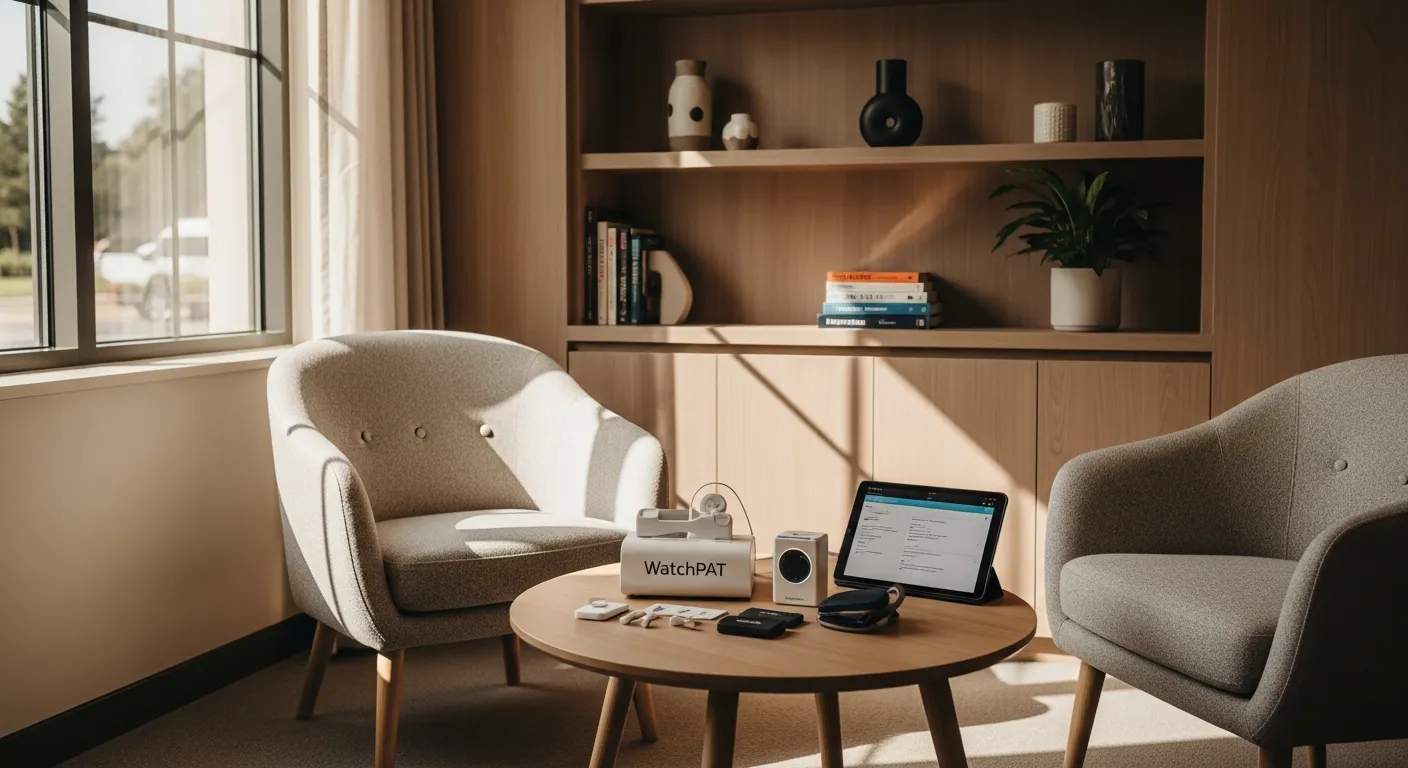

A home sleep apnea test measures breathing, oxygen, and pulse overnight in your own bed for a fraction of the cost of an in-lab study. Disposable 1-night versions like the WatchPAT One run about $129.99 (HSA and FSA eligible), return a PDF report within 12 hours, and are often accepted for DOT medical certification. When ordering on CPAP Store USA, Fishtown Medicine members should select the "Sleep Test & Results" option instead of the higher-priced prescription tier, because Dr. Ash reads the report and writes any needed prescription himself.
TL;DR: If you snore, wake up groggy, or someone has noticed you moaning or gasping at night, a 1-night home sleep test can tell us what is happening. You wear a small disposable sensor on your finger, wrist, and chest in your own bed for 1 night. On CPAP Store USA, the disposable WatchPAT One costs about $129.99 and is HSA and FSA eligible. Pick the "Sleep Test & Results" option at checkout (not "Sleep Test Results & Prescription"), because Dr. Ash reads your report and writes any needed prescription himself. Since it is a consumer kit, the company emails the PDF report directly to you within about 12 hours - upload that PDF to your portal so we can review it together. A negative home test does not rule out sleep apnea if your symptoms continue; in that case, an in-lab study is the next step. Tonight, while you sort this out: sleep on your side instead of your back, with a pillow behind you so you do not roll over, 1 pillow under your shoulders, and 2 under your head.
This page covers the test itself: what each version costs, which checkout option to pick, how to run the kit at home, whether a DOT examiner will accept it, and when the result is enough to act on. If your question is whether you should be tested at all, what your smartwatch is telling you, or what an AHI number means once you have one, our guide to sleep apnea screening and what your wearable can tell you covers that ground.
What does a home sleep apnea test measure?
A home sleep apnea test records your breathing, oxygen, and pulse overnight while you sleep in your own bed. Most kits measure chest movement, blood oxygen levels, heart rate, body position, and snoring. Newer disposable devices like the WatchPAT One work from your finger, wrist, and chest. They read tiny pulse-wave changes in the arteries of your fingertip (peripheral arterial tonometry) alongside oxygen and heart rate to detect when your airway narrows or closes.
What comes back is a count of how many times per hour your breathing stopped or became shallow. This is the apnea-hypopnea index (AHI), paired with the respiratory disturbance index (RDI) and how far your oxygen fell. A sleep doctor reviews the recording and creates a report. Dr. Ash reads that full report alongside your symptoms and bloodwork to guide your plan.
The best part is how ordinary the night is. You sleep in your own bed on your normal schedule. There are no wires on your scalp and no technician watching from another room. For many people, that gives a truer picture of a typical night than sleeping in a hospital lab.
How much does each version cost, and which option should I pick?
A disposable 1-night home test you order yourself costs about $129.99, while a hospital sleep lab can run over $1,000 without insurance.
An in-lab sleep study (a full polysomnogram with brain-wave leads and an overnight technician) runs from several hundred dollars to well over $1,000 in Philadelphia without insurance. A physician-ordered home test through a sleep clinic usually runs in the low hundreds and often requires insurance pre-approval. A disposable single-use home test you buy directly runs $130 to $190, with the FDA-approved WatchPAT One available for $129.99 on CPAP Store USA, the lowest-cost source we have found.
When you open the CPAP Store USA product page, you will see a dropdown menu titled Service Level with two choices:
- Sleep Test & Results ($129.99) - Pick this option. It includes the disposable WatchPAT One device and the official sleep study data report. Because Dr. Ash reviews your study and writes any needed prescription himself as part of your care, you do not need to pay extra for their retail prescription bundle.
- Sleep Test Results & Prescription - Skip this upgrade unless you do not have a doctor managing your care.
Because you buy the kit directly as a consumer, the company does not send the report to your doctor automatically. They email the PDF report directly to you the next business day, usually within 12 hours of uploading your morning data. As soon as that PDF arrives in your inbox, upload it to the records section of your Fishtown Medicine portal so we can review the numbers together. The kit is also HSA and FSA eligible.
Why would Dr. Ash order a home sleep test if I am fit and do not snore loudly?
Sleep apnea is not limited to people who carry extra weight or snore loud enough to shake the walls. Jaw structure, tongue position, and subtle airway narrowing can cause overnight oxygen drops in lean, active adults.
In clinic, we regularly see fit patients in their 30s and 40s who play ice hockey or run several nights a week, eat well, stop eating 3 hours before bed, and barely drink alcohol. Often their first clue shows up on routine bloodwork as a persistently high hemoglobin and hematocrit (red blood cell count). When your airway narrows and your oxygen drops briefly during deep sleep, your kidneys sense that low oxygen and release a hormone called erythropoietin (EPO). EPO tells your bone marrow to build extra red blood cells to carry more oxygen. That nudges your hemoglobin upward even when you feel fine during the day.
When we dig into the sleep history in those cases, the classic textbook picture is rarely there. Instead of loud sawing snoring, a partner might notice moaning in sleep, restless tossing, or teeth grinding. The patient might wake up gasping for air only once every month or two, or feel groggy for the first hour every morning despite getting 7 to 8 hours in bed. Often the cause is anatomy: a slightly recessed chin or smaller lower jaw (retrognathia) leaves less room behind the tongue. When throat muscles relax during deep sleep or back-sleeping, the tongue slides backward and narrows the airway regardless of how lean or fit you are. A 1-night home sleep test lets us check that airway question right in your own bed.
Is the disposable home test as accurate as a lab study?
A disposable home test has lower resolution than an in-lab study, so knowing what it can and cannot do matters. It does not use scalp leads to record brain waves (EEG), so it estimates when you were asleep instead of measuring sleep stages directly. That matters because the apnea index divides breathing events by hours of sleep. Counting awake time in bed as sleep can make the score look milder than it is. Home devices are also less precise at separating obstructive apnea, where the throat narrows, from central apnea, where the brain briefly pauses the signal to breathe.
What the home test does very well is answer a focused question: is your airway closing at night, how often is your oxygen dropping, and does your heart rate jump with those drops? When suspicion is strong - whether from snoring, morning grogginess, sleep moaning, or unexplained high hemoglobin on labs - a positive home study gives us a clear answer in 1 night.
If your home study comes back normal but you still wake up unrefreshed or have strong clinical clues, we keep looking. Because home kits can undercount milder airway resistance, a normal home result alongside convincing symptoms is a reason to step up to a full in-lab study.
Does a home test work for a DOT physical?
Often yes, and you should confirm with your medical examiner before you buy.
Commercial drivers run into this constantly. When a DOT medical examiner suspects sleep apnea, they commonly issue a short-term 3-month certificate and require a sleep study before granting a full card. That turns a health question into a job deadline, which is where fast, affordable home testing helps most.
Fishtown Medicine
A 90-minute conversation with Dr. Ash. A written plan you can follow.
The disposable WatchPAT One is FDA-approved and carries DOT and FAA certification, and most examiners accept a home study that includes a formal doctor interpretation. Still, the final call belongs to the examiner signing your medical card. Call their office first, confirm they accept a WatchPAT One home study, and order once they say yes. Bring the complete multi-page PDF report to your re-check instead of a single summary screen.
Sleep apnea is 1 of 4 findings that most often shorten a commercial driver's certificate. Our CDL and DOT driver health page covers how to stay ahead of all 4, and our guide to Pennsylvania CDL self-certification explains the 45-day PennDOT clock when a medical card expires.
How do I use the device?
The WatchPAT One uses 3 simple contact points for 1 night: a wrist unit, a finger sleeve probe, and a small microphone and movement sensor on your chest. Because the kit is 100% disposable, there is nothing to charge and nothing to mail back when you finish.
Put the kit on when you are already in your pajamas and ready to turn out the lights, since the recording starts as soon as you activate it in the app. Before you start:
- Prep your hand: Remove rings and watches, skip hand lotion, and make sure the nail on your test finger is trimmed short with no nail polish or acrylics. The finger probe reads pulse changes through the fingertip, and long nails or polish can block the sensor.
- Download the app and attach the chest sensor: Open the WatchPAT One app on your phone and follow the step-by-step screens. Stick the small chest sensor over the center of your breastbone, just below the notch at the base of your throat. Trim a small patch of chest hair if needed so the sticker holds flat, thread the wire inside your pajama top, and place a strip of medical tape or a band-aid over the sticker so it stays put overnight.
- Put on the wrist unit and finger probe: Strap the wrist unit onto your non-dominant hand, snug but comfortable. Slide any finger except your thumb all the way into the probe with the "TOP" tab facing upward. Press the probe firmly against your leg or a table, then pull the "TOP" tab straight out and down slowly without twisting it.
- Sleep at least 6 hours with your phone plugged in: Keep your phone plugged into its charger, off airplane mode, with Bluetooth on, within 15 feet of your bed. Aim for at least 6 hours of recording time. If you get up to use the bathroom during the night, leave the sensors on your body and leave your phone by the bed.
- Upload in the morning: When you wake up, tap stop in the app and wait a few minutes until the screen confirms your data has uploaded before removing the sensors.
The manufacturer offers a short 4-minute walkthrough video worth watching before bedtime: WatchPAT setup instructions. Follow the printed card inside your box if any screen details differ slightly.
Why we point people to this test
We have no financial relationship with CPAP Store USA or the maker of the WatchPAT, and we make zero dollars when you order one.
Fishtown Medicine accepts no commissions, kickbacks, or affiliate fees from device companies or labs. We point patients to this specific link because $129.99 is the lowest price we have found for an FDA-approved disposable WatchPAT One, results come back in about 12 hours, and the device works for both everyday workups and DOT certification. If a better or less expensive option comes along, we will update this page right away.
What happens if the test is positive?
A positive sleep test opens a conversation about why your airway narrows and which treatment matches both your severity and your anatomy.
Continuous positive airway pressure (CPAP) splints the airway open with gentle air pressure and remains the gold standard for moderate-to-severe obstructive sleep apnea. For milder sleep apnea, upper airway resistance, or lean patients whose airway narrows because of jaw and chin structure (retrognathia), a custom oral appliance made by a sleep dentist is often a comfortable, travel-friendly option. It gently holds the lower jaw and tongue forward overnight. Positional therapy (staying off your back), clearing nasal congestion, and building muscle and metabolic health all play a role depending on what drives your events. We review your oxygen curves, body-position data, and symptoms together to pick the path that fits your life.
What can I do tonight, before my test arrives?
Sleeping on your side instead of your back is the fastest zero-cost change you can make tonight.
When you lie flat on your back, gravity pulls the base of your tongue and soft palate straight back into your throat. Breathing events and oxygen drops are often two to three times worse on your back than on your side. Tuck a firm pillow behind your back so you do not roll onto your spine overnight. Raising your upper body slightly also helps: place 1 pillow under your shoulders and 2 under your head so your torso rises gently without bending your neck forward.
Finishing dinner at least 3 hours before bed and skipping evening alcohol or sedating sleep aids also keeps the muscles of your upper airway firmer through the night.
Key Takeaways
- A 1-night disposable WatchPAT One home sleep test records breathing events, oxygen drops, heart rate, and body position in your own bed for about $129.99 (HSA and FSA eligible).
- When ordering on CPAP Store USA, pick the "Sleep Test & Results" ($129.99) option - Dr. Ash reads the report and writes any needed prescription himself.
- Because it is a direct consumer purchase, the PDF report is emailed to you within about 12 hours; upload that full PDF to your Fishtown Medicine portal so we can review it together.
- Lean, fit adults can still have sleep apnea driven by jaw and chin anatomy (retrognathia), often showing up as morning grogginess, moaning in sleep, or high hemoglobin and hematocrit on routine bloodwork.
- A negative home test in someone with a convincing story warrants an in-lab sleep study to be sure.
- While you wait for your test, sleep on your side with a pillow behind your back, place 1 pillow under your shoulders and 2 under your head, and keep alcohol at least 3 hours away from bedtime.
Related at Fishtown Medicine
- Sleep Apnea Screening and Your Wearable - the companion page: whether you should be tested at all, what a watch flag means, and how to read an AHI once you have one
- Sleep Disorders Treatment in Philadelphia - the fuller picture on insomnia, apnea, and circadian problems
- Paying Cash for Care - how to sequence testing when you are between insurance plans
- Metabolic Health - the insulin resistance that travels with untreated apnea
- Affordable Labs and Imaging - how our billing works and how to keep testing costs down
Scientific References
- Kapur VK, Auckley DH, Chowdhuri S, et al. "Clinical Practice Guideline for Diagnostic Testing for Adult Obstructive Sleep Apnea: An American Academy of Sleep Medicine Clinical Practice Guideline." Journal of Clinical Sleep Medicine. 2017;13(3):479-504. PubMed
- Yalamanchali S, Farajian V, Hamilton C, et al. "Diagnosis of Obstructive Sleep Apnea by Peripheral Arterial Tonometry: Meta-analysis." JAMA Otolaryngology Head and Neck Surgery. 2013;139(12):1343-1350. PubMed
- Peppard PE, Young T, Palta M, Skatrud J. "Prospective Study of the Association between Sleep-Disordered Breathing and Hypertension." New England Journal of Medicine. 2000;342(19):1378-1384. PubMed
- Tregear S, Reston J, Schoelles K, Phillips B. "Obstructive Sleep Apnea and Risk of Motor Vehicle Crash: Systematic Review and Meta-Analysis." Journal of Clinical Sleep Medicine. 2009;5(6):573-581. PubMed

Frequently Asked Questions
Common Questions
Deep-Dive Questions
Ready when you are
The chat is our AI assistant, answering from our published guides. To talk it through with Dr. Ash himself, start with the intake.