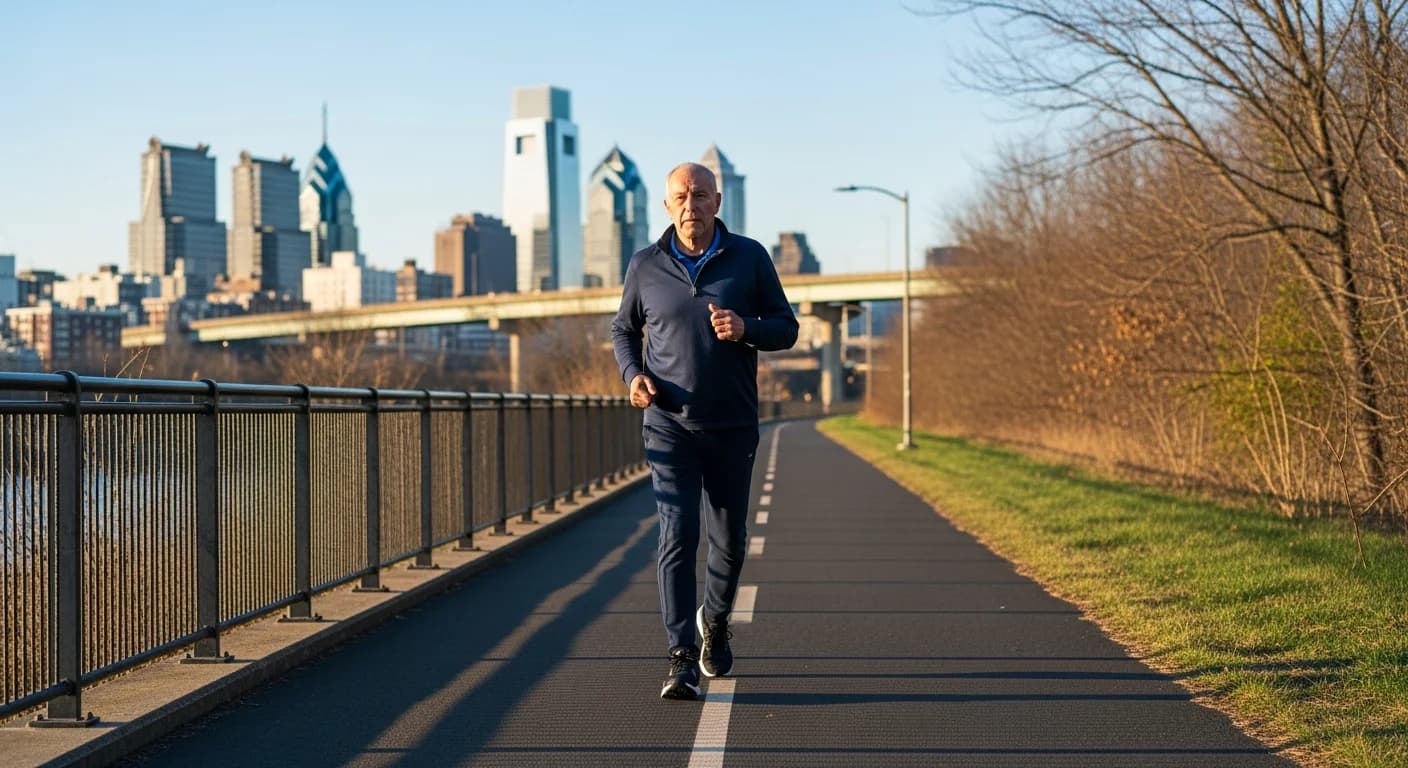

Fishtown Medicine does not perform DOT physicals. Only a medical examiner listed on the FMCSA National Registry may perform or sign one, and drivers can find one through the registry directory at nationalregistry.fmcsa.dot.gov. What Fishtown Medicine does is the work around that appointment: bringing blood pressure, blood sugar, and sleep apnea into the range an examiner needs to see, treating what turns up, and keeping the records organized so a 2-year card is realistic. Dr. Ash is licensed across 40 states, so care continues on a regional run or a long haul.
TL;DR: Fishtown Medicine does not do DOT physicals. Only an examiner on the federal National Registry can do that one, and you can find one near you at nationalregistry.fmcsa.dot.gov. What we do is get you ready for it and keep you well between cards. Most drivers who walk out with a 3-month certificate instead of a 2-year one lose it over 4 things: blood pressure, sleep apnea, blood sugar, and the medicines they take. All 4 can be worked on, and most take 4 to 12 weeks to move, so the time to start is a couple of months out and not the week your card expires. Do this now: check your blood pressure at home twice a day and write the numbers down, and if you snore and wake up tired, get a sleep test before an examiner asks you for one. If you drive across state lines, Dr. Ash is licensed in 40 states, so your doctor does not change when your route does.
The week before a med card expires is a bad week to find out your blood pressure is 168 over 104. You slept 5 hours in the bunk, you had 2 coffees on the way in, the cuff goes on 3 minutes after you sit down, and the examiner writes a 3-month certificate instead of a 2-year one. Now you have a deadline, a recheck to pay for, and a dispatcher who wants to know why your availability changed.
What I want you to know is that almost none of that is about the day of the exam. It is about the 8 weeks before it. Blood pressure responds to treatment in a few weeks. Sleep apnea, once it is tested and treated, usually turns a conditional certificate into a full one. Blood sugar moves over a couple of months. The drivers who get 2-year cards are not luckier or younger, they are the ones whose numbers were handled before anybody put a cuff on their arm.
This page covers what costs drivers their certification, how far ahead each thing needs to start, and what care looks like when your job takes you across 6 states in a week.
Does Fishtown Medicine do DOT physicals?
No. Fishtown Medicine does not perform DOT or CDL physical examinations, and that is a settled decision rather than a case-by-case one. Federal rules allow only a medical examiner listed on the FMCSA National Registry to perform, certify, or sign any part of a DOT physical, and Dr. Ash is not on that registry. A form partly filled out by a physician who is not a certified examiner is worse for you than a blank one, because it can cost you the appointment you already paid for.
You can find a certified examiner near you through the federal directory at nationalregistry.fmcsa.dot.gov. In Philadelphia, most urgent care chains have at least one certified examiner on staff, and the exam typically runs $75 to $150 self-pay. Call ahead and ask 2 questions: whether the examiner on duty that day is on the National Registry, and what they want to see if you already have a diagnosis like sleep apnea or diabetes.
What we handle is the part the examiner is measuring. That distinction matters more than it sounds, because the exam is a snapshot and the snapshot is of your ordinary Tuesday. Nobody passes a DOT physical on the strength of one good morning.
What costs drivers their card?
The certificate an examiner writes is graded, not pass or fail. A driver in good shape gets up to 2 years. A driver whose numbers are borderline gets 1 year, or 6 months, or 3 months, and each short card means another appointment, another fee, and another chance for something to go wrong. Here is what shortens the card most often.
Blood pressure
Blood pressure is the single most common reason a driver walks out with less than a 2-year card. Federal guidance ties the certificate length directly to the reading:
| Blood pressure at the exam | What the examiner can issue |
|---|---|
| Under 140/90 | Up to 2 years |
| 140 to 159 over 90 to 99 | 1 year |
| 160 to 179 over 100 to 109 | A one-time 3-month certificate, then 1 year if you come back under 140/90 |
| 180/110 or higher | Disqualified until it comes down under 140/90, then 6-month certificates |
Two things follow from that table. The first is that the gap between a 2-year card and a 3-month card can be 20 points, which is a dose adjustment and a few weeks of attention rather than a life overhaul. The second is that a single reading in a strange room decides it, so the reading you get at home matters enormously. Bring a log. An examiner looking at 30 home readings averaging 132 over 84 is looking at a different driver than one reading of 152 over 96.
If you take nothing else from this page: buy a validated upper-arm cuff, check twice a day for 2 weeks, and bring the numbers. Our home blood pressure guide covers how to measure so the numbers are worth showing, and the piece on when blood pressure medication stops working covers what to do when you are already on something and it is not holding.
One caution worth saying plainly: 140/90 is the number that keeps your card. It is not the number that keeps you from a stroke at 58. Those are 2 different targets, and this page is about the first one because your job depends on it. The second one is the conversation we have after your card is safe.
Sleep apnea
There is no federal rule requiring every driver to be screened for sleep apnea, which surprises people. What exists instead is examiner judgment, and examiners have gotten more attentive to it, because the crash data is hard to argue with. A meta-analysis of commercial drivers found that untreated obstructive sleep apnea raises crash risk substantially, and a study of drivers under an employer-mandated treatment program found that those who did not stick with treatment had roughly a 5-fold higher rate of preventable crashes than matched controls who did.
In practice, an examiner who sees a thick neck, a high BMI, loud snoring, or daytime sleepiness can issue a short conditional certificate and require a sleep study before a longer card. That turns a medical question into a work question with a date on it, which is the worst way to encounter it.
Get ahead of it. A home sleep test done in your own bed costs a fraction of a night in a sleep lab, with disposable single-use versions running roughly $130 to $190, and results are often accepted for DOT certification. Our home sleep apnea testing guide covers which version answers which question and how to run the kit, and the piece on sleep apnea screening and wearables covers who should be tested and how to read the result. Call whoever will do your exam and ask which test they accept before you buy anything, because that answer varies and buying the wrong one is a wasted $150.
Treated apnea is not a disqualification. Drivers on CPAP who use it and can show they use it get certified routinely. The download from the machine is the evidence, so keep it.
Blood sugar and diabetes
Insulin-treated diabetes has not been an automatic disqualification since 2018. The rule now is that your treating clinician completes an assessment of your diabetes management on form MCSA-5870, and the certified examiner uses that assessment to certify you for up to a year at a time. That is a meaningful change, and a lot of drivers still believe the old rule and avoid starting insulin they need.
This is the 1 piece of DOT paperwork we do handle. The assessment is completed by the clinician treating your diabetes rather than by the examiner, so it falls on our side of the line even though the exam itself does not. Dr. Ash completes it for members he treats for diabetes. The timing is the part to plan around: it has to be completed within 45 days before your exam, so tell us the exam date rather than the date you need the form.
What the assessment asks about is what we work on anyway: your most recent A1c, whether your blood sugar record is complete enough to review, and whether you have had a low that needed someone else's help or caused a seizure or a blackout. That last one carries specific timing rules, and a severe low in the past 12 months changes what happens next. A1c moves over about 3 months because that is how long a red blood cell lives, so this is the item that most rewards starting early. Our type 2 diabetes reversal page and the prediabetes page cover what that work looks like.
The medicines you take
Federal rules bar certain medications outright and leave others to the examiner's judgment based on what your prescribing physician says about them. Schedule I substances, amphetamines, and narcotics are the restricted categories, and methadone specifically disqualifies. Anticoagulants, seizure medications, and some psychiatric medications require documentation rather than a flat no.
This is where a driver benefits from having a physician who knows the whole picture and can write a clear letter about what you take and why it does not impair you. It also connects to something worth stating up front: Fishtown Medicine does not prescribe opioids of any kind, for any duration or indication. For a driver, that policy and the federal rules point the same direction, and the practical effect is that pain gets treated here with approaches that do not put your certification at risk.
One more that comes up often enough to name: a Pennsylvania medical marijuana card gives a commercial driver no protection whatsoever. Federal rules govern your certification, marijuana remains federally controlled, and a positive test ends a driving career no matter what your state card says. Our guide to Pennsylvania's medical marijuana program spells out where the state protections stop, and for a CDL holder they stop before they start.
Vision and hearing
Fishtown Medicine
A 90-minute conversation with Dr. Ash. A written plan you can follow.
These are the fixed standards, and they are the least negotiable items on the exam. Vision requires at least 20/40 in each eye and 20/40 with both together, with or without correction, at least 70 degrees of horizontal field in each eye, and the ability to recognize the colors of traffic signals. Hearing requires perceiving a forced whisper at 5 feet or better in at least one ear, or an average hearing loss of 40 decibels or less at 500, 1000, and 2000 Hz.
Corrective lenses are fine, and they produce a restriction on your card rather than a denial. What catches drivers off guard is an uncorrected change nobody checked, or wax occluding an ear canal on exam day. Both are 20-minute problems if you find them a month early and a lost appointment if you find them in the chair.
The heart
After a heart attack, a stent, or bypass surgery, federal guidance sets waiting periods before recertification and generally wants stress testing before a driver goes back out. There is no shortcut through that, but there is a large difference between arriving with the cardiology records in hand and arriving without them. If something has happened to your heart, the paperwork is half the battle, and gathering it is work we can do while you are still driving.
Why the card is the wrong finish line
Most drivers already know this part without anybody telling them. You have watched someone in this line of work go out on disability. Maybe a back, maybe a heart, maybe a stroke that came out of nowhere at 54 after years of a blood pressure nobody treated. It is not a secret that this job is hard on a body.
The numbers back up what the yard already knows. The federal survey of long-haul truck driver health found obesity roughly twice as common among long-haul drivers as among the general working population, with correspondingly higher rates of high blood pressure and diabetes. The occupational picture is long hours seated, food chosen from what is open at 2 in the morning, sleep broken across a schedule that ignores daylight, and a medical system that most drivers touch once every 2 years, in a chair, being graded.
That last part is the piece worth changing. A DOT physical is a screening, and a screening's whole job is to find things that are already there. It is not care. Nobody's blood pressure gets treated at a DOT physical, nobody's A1c gets followed, nobody calls you in March to see whether the medication is working. The exam tells you there is a problem and then hands you back to a system you may not have a door into.
What proactive care does differently is find the same things 5 years earlier, when a medication and a few habits still change the ending. The conditions that end driving careers are almost all slow ones, and slow is the kind of problem primary care is built for. Getting your card is the deadline. Not ending up as the guy the yard talks about is the point.
What if I do not have insurance?
A lot of drivers do not, and being straight about that is more useful than pretending otherwise. Owner-operators, 1099 contractors, and people between carriers often have no employer plan, and the marketplace quote can land higher than a truck payment. So the numbers here are flat and posted.
Membership at Fishtown Medicine is $250 a month, with quarterly and annual rates on the membership pricing page, and that covers your primary care itself: visits, follow-ups, and direct messaging with Dr. Ash, with no copays and no per-visit charges. Labs run at physician-routed cash rates, which for the panels a driver needs is usually a fraction of list price. The membership is generally HSA and FSA eligible.
A membership has a boundary worth stating. It is not hospital coverage, and it does not pay for an emergency room or a surgery. Drivers who go this route often pair it with a high-deductible or catastrophic plan for the big events. Our page on seeing a doctor without insurance in Philadelphia lays out the full cost comparison, including the sliding-scale community health centers that are the right answer if money is the binding constraint right now.
How does care work when I am 700 miles from Philadelphia?
Dr. Ash holds medical licenses across 40 states, which means care continues on a regional run or a long haul instead of stopping at the state line. You message him from wherever the truck is. Video visits happen from the cab or the sleeper. Prescriptions go to a pharmacy near your route rather than one back home you will not see for 3 weeks, and labs get drawn at any Quest or Labcorp, of which there are thousands.
That coverage is the part of this that is hard to get anywhere else. Urgent care works fine for a sinus infection in Ohio, but the doctor there does not know you, will not follow up, and cannot tell whether the blood pressure reading in front of them is your normal or a warning. Continuity is the whole value of primary care, and continuity is the thing a driving job tends to destroy.
Where the limits are: home visits are a Greater Philadelphia benefit and do not travel, and some controlled-substance prescribing requires an in-person evaluation under state or federal rules, which gets planned around your schedule rather than sprung on you.
How fast can this move?
Faster than the system you are used to, which is most of the point. The intake takes about 3 minutes and Dr. Ash reads it himself. Messages get answered by your doctor rather than routed through a portal. When something needs a visit, it happens the same week and often the same day, by video, at an hour that works around your driving.
For a driver with a card expiring, a workable timeline looks like this. At 8 to 12 weeks out, start home blood pressure readings and get labs drawn, including A1c and lipids. At 6 to 8 weeks out, treat whatever the numbers show and get a sleep test moving if snoring or daytime sleepiness is part of the picture. At 2 to 4 weeks out, recheck the numbers that were off and gather documentation for anything the examiner will ask about. Then book the exam.
If your card expires in 10 days and you are reading this now, that is a different conversation and still worth having. Tell us the date. Some things move in 10 days and some do not, and knowing which is which beats guessing.
Key Takeaways
- Fishtown Medicine does not perform DOT physicals; only an examiner on the FMCSA National Registry may, and the directory is at nationalregistry.fmcsa.dot.gov.
- Certificate length is graded, and blood pressure is the most common reason a driver gets 3 months instead of 2 years. A home reading log is worth bringing.
- Sleep apnea is not disqualifying when it is diagnosed and treated, and a home sleep test done early beats one demanded on a deadline.
- Insulin-treated diabetes has not been automatically disqualifying since 2018. The treating-clinician assessment (MCSA-5870) is the 1 piece of DOT paperwork Dr. Ash completes, and it has to be done within 45 days before your exam.
- Start 8 to 12 weeks before your exam date. Most of what shortens a card can be changed in that window.
- Dr. Ash is licensed across 40 states, so care continues on a regional run or a long haul. Membership is $250 a month, HSA and FSA eligible, with no copays.
Related Services and Reading
- Pennsylvania CDL Self-Certification and the 45-Day Downgrade Clock
- What a Home Sleep Apnea Test Costs, and How to Do One
- When Blood Pressure Medication Stops Working
- Seeing a Doctor Without Insurance in Philadelphia
- Virtual Primary Care Across Pennsylvania
- Type 2 Diabetes Reversal
- Membership Pricing
Scientific References
- Federal Motor Carrier Safety Administration. Medical Examiner Handbook and 49 CFR 391.41, Physical Qualifications for Drivers.
- Sieber, W. K., Robinson, C. F., Birdsey, J., et al. (2014). Obesity and other risk factors: the National Survey of U.S. Long-Haul Truck Driver Health and Injury. American Journal of Industrial Medicine, 57(6), 615-626.
- Tregear, S., Reston, J., Schoelles, K., & Phillips, B. (2009). Obstructive sleep apnea and risk of motor vehicle crash: systematic review and meta-analysis. Journal of Clinical Sleep Medicine, 5(6), 573-581.
- Tregear, S., Reston, J., Schoelles, K., & Phillips, B. (2010). Continuous positive airway pressure reduces risk of motor vehicle crash among drivers with obstructive sleep apnea: systematic review and meta-analysis. Sleep, 33(10), 1373-1380.
- Burks, S. V., Anderson, J. E., Bombyk, M., et al. (2016). Nonadherence with employer-mandated sleep apnea treatment and increased risk of serious truck crashes. Sleep, 39(5), 967-975.

Frequently Asked Questions
Common Questions
Deep-Dive Questions
Ready when you are
The chat is our AI assistant, answering from our published guides. To talk it through with Dr. Ash himself, start with the intake.