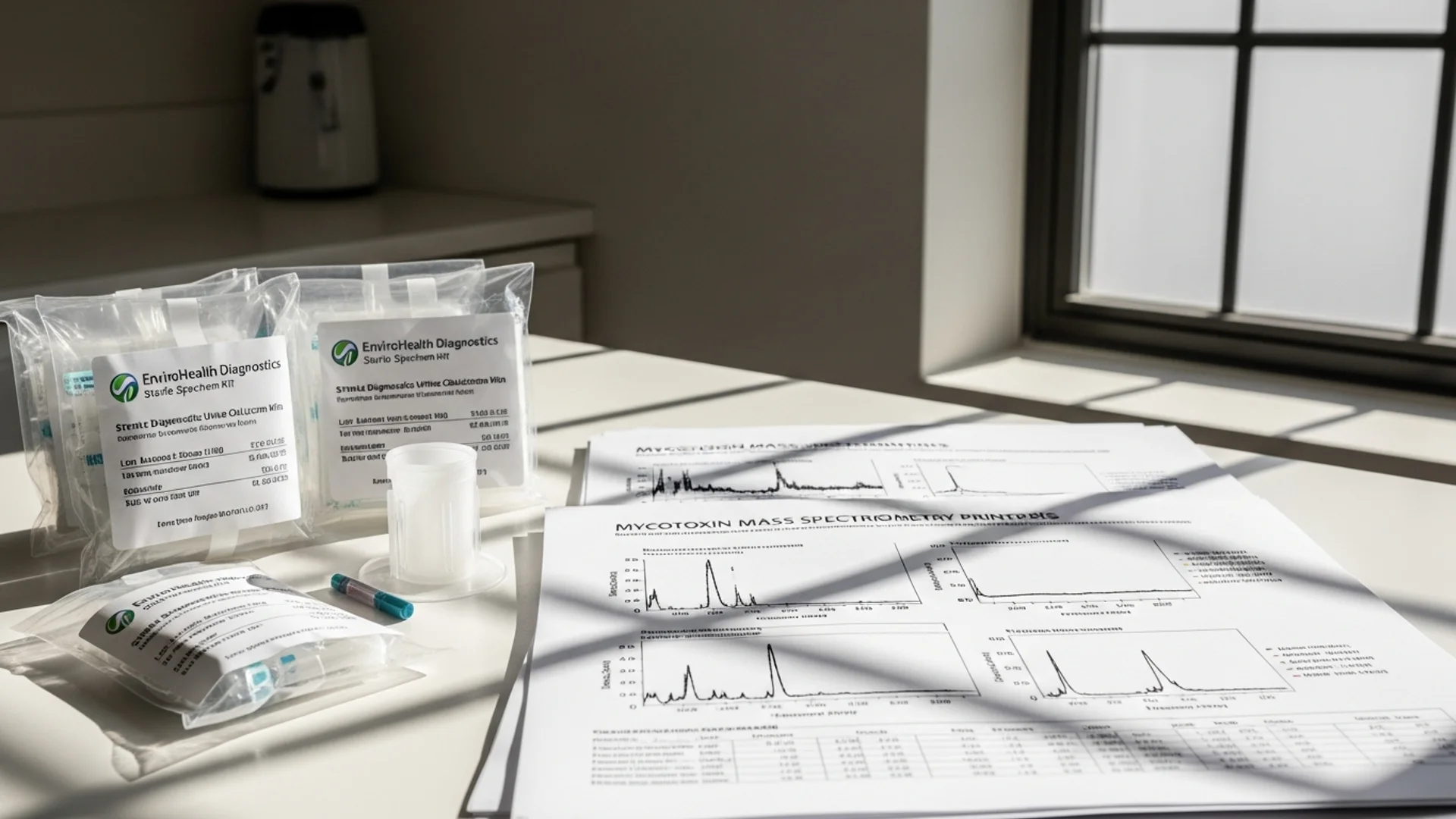

A home mold test tells you mold is present. It does not tell you the mold is making you sick. Those are two separate questions, and proving the second one, that your body is reacting to the mold, is what changes your care and what carries weight if a dispute ever arises. The strongest step is a mold-specific IgE blood test, which measures your immune reaction to specific molds, is driven by your symptoms, and is usually covered by insurance. Mycotoxin urine panels, by contrast, are expensive, paid out of pocket, and do not establish that a mold caused your symptoms. Documented damp-building illness covers allergy, asthma, and irritation; the broader 'mold toxicity' claims are far less settled.
TL;DR: There are two questions hiding inside "is mold making me sick," and almost everyone runs them together. The first is whether mold is present in your home, which a swab or air test can answer. The second is whether that mold is causing something in your body, which no home test can answer. Proving the second one is the step that matters, both for your treatment and for any dispute with a landlord, and the way you prove it is by testing your immune reaction, not by testing the house again. A mold-specific IgE blood test is symptom-driven, usually covered by insurance, and answers the causal question directly. Mycotoxin urine panels are costly, paid out of pocket, and do not link a specific mold to your symptoms. The allergy, asthma, and irritation effects of damp buildings are well established; the wider "mold toxicity" story is not, and it helps to know which ground you are standing on.
If you have found mold in your home and you have felt unwell, the connection can feel obvious. Often it is worth taking seriously. But the leap from "there is mold here" to "the mold is why I feel this way" skips a step that turns out to be the whole game, clinically and otherwise.
What I want you to know is that a home test and a body test answer different questions, and confusing them is the most common way people spend money on the wrong proof. Documenting mold in the house is useful. It is not the same as showing that the mold is doing something to you, and it is the second finding that changes a treatment plan and holds up if it ever needs to.
Isn't finding mold in my home enough proof?
It proves the exposure. It does not prove the harm, and those are different claims.
A swab kit, a tape lift, or an air-sampling test can identify that mold is present and often which species: the common indoor ones like Aspergillus, Penicillium, Cladosporium, and the water-damage species people worry about most, including Stachybotrys and Chaetomium. When a report comes back showing active growth, that is meaningful documentation of a problem in the building.
But mold is present at some level in nearly every indoor space. The finding that matters for your health is not "is it here" but "is my body reacting to it." A home test cannot answer that, because it is measuring the air and the surfaces, not you. Two people can live in the same apartment with the same spores and have very different responses, because the reaction lives in the immune system, not in the spore count. So the home test is the right tool for the home question, and a second, different test is needed for the body question.
How does mold affect the body?
There are a few distinct mechanisms, and they are not equally well established. Keeping them separate is what keeps the workup on track.
- Allergy. This is the best-documented pathway. Mold is a common allergen, and in a sensitized person it drives the familiar allergic picture: nasal congestion, sneezing, itchy eyes, cough, and worsening asthma. This is IgE-mediated, and it is testable.
- Irritation and inflammation of the airway. Independent of classic allergy, damp indoor spaces are linked to respiratory symptoms, new-onset asthma, and, less commonly, hypersensitivity pneumonitis, an immune reaction in the lungs. The major reviews of indoor dampness support this association.
- Infection. Certain molds can cause invasive infection, but essentially only in people who are significantly immunocompromised, such as those on chemotherapy or with advanced immune suppression. For a healthy person worried about a moldy kitchen, this is not the scenario.
- The contested territory. Beyond these, there is a widely searched idea of "mold toxicity," "toxic mold syndrome," or a chronic inflammatory response driven by mycotoxins. The symptoms people describe are not in question, but the causal chain and the testing built around it are not well validated in the evidence. It is fair to hold this loosely: take the exposure and the symptoms seriously while saying plainly that this particular explanation is not settled science.
What test proves the mold is affecting me?
The one that measures your immune response rather than the environment: a mold-specific IgE blood test, or the equivalent allergy skin testing. It checks whether your body has built an antibody reaction to specific molds, which is the direct evidence that you, not just your apartment, are involved.
Two practical things make this the higher-value step. First, it answers the causal question: it moves you from "mold is in the house" to "my immune system is reacting to this mold," which is what guides treatment. Second, because it is ordered in response to symptoms, it is usually covered by insurance, unlike the out-of-pocket panels marketed directly to worried patients. When the picture involves flushing, hives, gut symptoms, and food triggers rather than sneezing and asthma, testing extends to the mast cell side of the immune system, because an environmental exposure can flare an already sensitized system.
Get Real Answers
Tired of being told your labs are 'normal'? Dr. Ash digs deeper.
Think of it as building a two-part case. The home test shows the mold is present. The immune test shows your body is responding to it. Neither half is convincing alone. Together they connect the exposure to the effect, which is the link that matters whether the audience is your treatment plan or, if it comes to that, a review of your housing situation.
Why doesn't mycotoxin urine testing hold up?
Because it tries to answer the causal question and cannot quite get there, at a high price.
Mycotoxin urine panels measure metabolites of mold toxins in your urine. The problems stack up. They are expensive and billed per toxin, so a broad panel runs into the hundreds of dollars and is generally not covered by insurance. The bigger issue is what a result does and does not mean. Mycotoxins enter the body through food as well as through buildings, so a positive does not prove your home is the source. And there is no validated link tying a given urine level to a specific set of symptoms, so even a clear positive does not establish that the toxin caused how you feel. It measures presence, not causation, which is the same limitation as the home test, just relocated into your body and made costlier. The same pattern shows up in heavy metal testing and detox protocols, where a level gets sold as an explanation.
That is why the immune-reaction test is the more useful move. It sidesteps the toxin-level question, which nobody can currently interpret with confidence, and answers the one that matters: is your body reacting. It is the question a careful clinician asks and the question a careful reviewer of a dispute would ask too.
What do I do about the exposure itself?
The medical principle is simple: reduce the exposure. The body cannot settle down while it is still being provoked, so getting away from ongoing water damage and active growth is part of the treatment, not separate from it.
How you accomplish that, professional remediation of the source versus relocating, is a practical and environmental decision rather than a laboratory one, and it depends on how extensive the growth is and what is feasible for your situation. A professional inspection can document the extent in a way a consumer kit cannot, which matters when hidden growth behind cabinets or walls is likely. This is where the medical role ends and a housing or environmental professional's begins. Bedbugs split along the same line and are worth reading about if that is the exposure you are dealing with, since the identification step and the renter's protections are what decide how quickly it gets handled. Nothing here is legal advice, and if a housing dispute is in play, that belongs with someone qualified in that area. The medical job is to establish whether your body is reacting, treat that reaction, and document it clearly.
Key Takeaways
- "Is there mold here" and "is mold making me sick" are two different questions; a home test only answers the first.
- A mold-specific IgE blood test measures your immune reaction, answers the causal question, and is usually covered by insurance.
- Home swab and air tests document exposure and are the right tool for the building, not for your body.
- Mycotoxin urine panels are costly, paid out of pocket, and cannot prove a specific mold caused your symptoms.
- Allergy, asthma, and airway irritation from damp buildings are well established; broader "mold toxicity" claims are not.
- Reducing the exposure is part of the treatment; remediation versus relocating is a practical decision, and housing disputes belong with a qualified professional.
Scientific References
- Institute of Medicine. Damp Indoor Spaces and Health. Washington, DC: The National Academies Press; 2004.
- World Health Organization. WHO Guidelines for Indoor Air Quality: Dampness and Mould. Copenhagen: WHO Regional Office for Europe; 2009.
- Mendell MJ, Mirer AG, Cheung K, Tong M, Douwes J. Respiratory and allergic health effects of dampness, mold, and dampness-related agents: a review of the epidemiologic evidence. Environmental Health Perspectives. 2011;119(6):748-756.
- Borchers AT, Chang C, Gershwin ME. Mold and Human Health: a Reality Check. Clinical Reviews in Allergy and Immunology. 2017;52(3):305-322.
- Hardin BD, Kelman BJ, Saxon A. Adverse human health effects associated with molds in the indoor environment. Journal of Occupational and Environmental Medicine. 2003;45(5):470-478.

Fishtown Medicine | Symptoms
Frequently Asked Questions
Common Questions
Deep-Dive Questions
Ready when you are
The chat is our AI assistant, answering from our published guides. To talk it through with Dr. Ash himself, start with the intake.