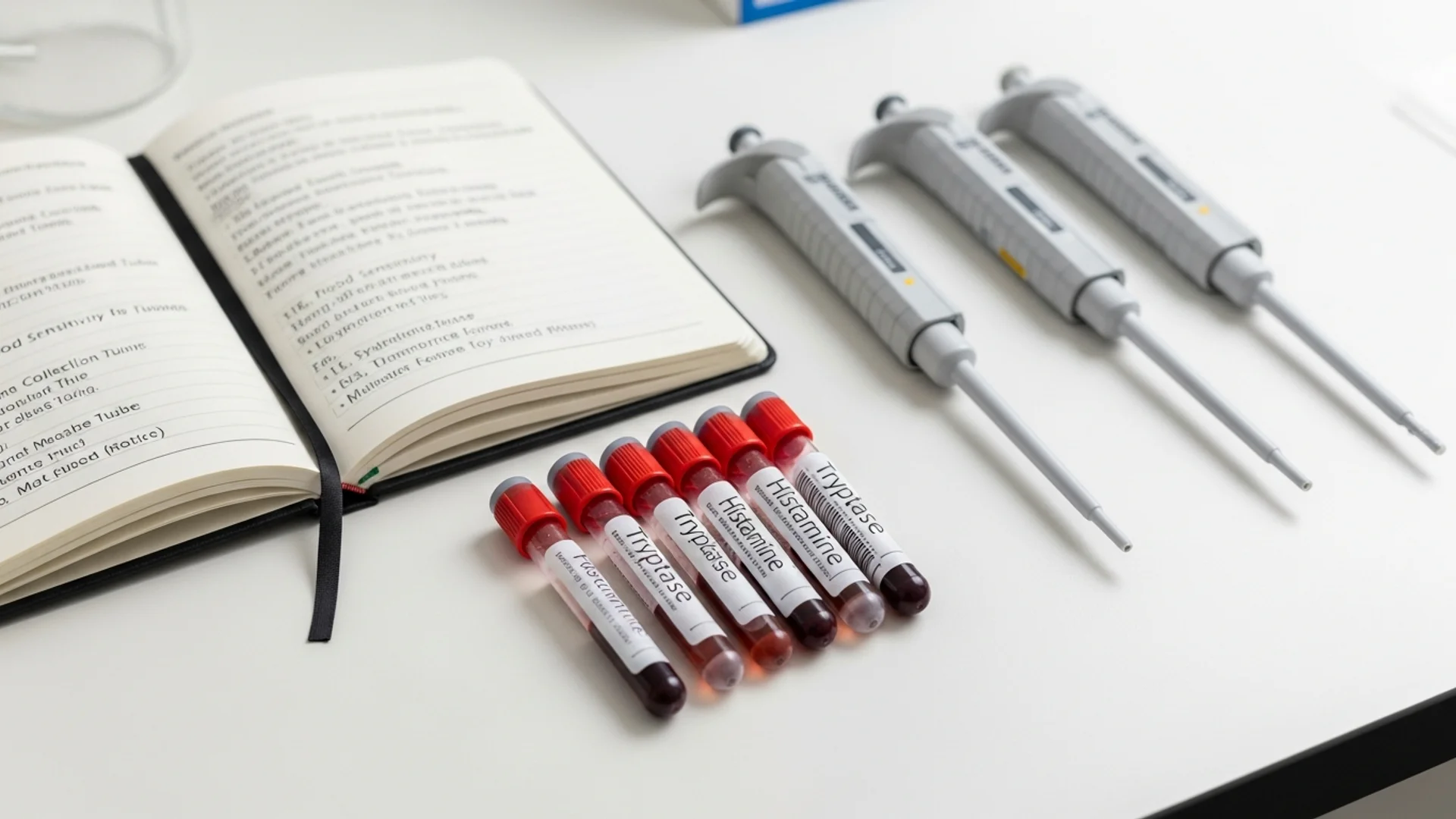

A negative allergy panel means your antibody-driven allergic system is quiet, which is useful to know, but it does not mean your symptoms are imagined. A separate pathway, mast cell activation and histamine handling, produces flushing, congestion, gut trouble, and food reactions without ever showing up on an IgE or skin-prick test. When allergy tests are negative and symptoms persist, the next step is a histamine and mast cell workup rather than a dismissal.
TL;DR: A negative allergy panel is useful information, but it answers a narrower question than most people are told. It confirms your antibody-driven allergic system is quiet. It says nothing about a separate pathway, mast cell activation and histamine handling, that can produce flushing, congestion, gut symptoms, and food reactions without ever triggering an IgE test. If your skin-prick test and blood panel came back negative and you still react to foods, seasons, and scents, you are not imagining it. You are most likely looking in the wrong drawer, and there is a specific next set of tests that opens the right one.
You did the responsible thing. You saw an allergist, went through the skin-prick grid, gave the blood, and waited. The results came back negative, with a low total IgE and nothing flagged against dust mite, cat, pollen, or foods. And then some version of the sentence that so many people carry out of that office: your tests are normal, this is probably stress.
But you know what happens when you eat certain meals. You know the flush, the congestion, the racing gut, the exhaustion that sets in an hour later. The test pointed one way and your body kept pointing the other, and you are left choosing between trusting a lab result and trusting your own lived experience.
What I want you to know is that both can be true at once. The allergy test was not wrong, and neither are you. The problem is that a negative allergy panel answers a much narrower question than the one you came in with, and the mechanism behind your symptoms often lives in a system those tests were never built to see.
What does a negative allergy test rule out?
Standard allergy testing measures one specific pathway: immunoglobulin E, or IgE. This is the antibody behind classic, immediate allergy, the peanut that closes a throat, the cat that swells an eye, the bee sting that drops blood pressure. Skin-prick tests and allergen-specific IgE blood panels are excellent at finding it.
When those come back negative, and the total IgE is low, the conclusion is clear: your antibody-driven allergic system is calm. You are not mounting a classic type 1 allergic response to the things that were tested. For anaphylaxis risk, that is reassuring information worth having.
Here is the catch. Symptoms that look and feel allergic, flushing, hives, congestion, itching, gut reactions, are not all driven by IgE. There is a second pathway, and it does not show up on any of those tests.
If it is not allergy, what is causing the reactions?
The cells at the center of allergic symptoms are called mast cells. They sit in your skin, sinuses, gut lining, and airways, loaded with histamine and other mediators. In classic allergy, IgE antibodies are the trigger that tells them to fire.
But mast cells have many other triggers. Temperature changes, friction, exercise, stress hormones, certain foods, alcohol, infections, and hormonal shifts can all set them off directly, with no antibody involved. When mast cells release their mediators too readily or too often, the result is a symptom picture that mimics allergy almost perfectly, without a single positive allergy test. This pattern is what physicians call mast cell activation.
A closely related problem is histamine intolerance. Histamine comes from two directions: your own cells release it, and it also arrives in food, building up in aged, fermented, and leftover items. Your body clears it using an enzyme in the gut wall called diamine oxidase, or DAO. When DAO is low or overwhelmed, histamine from an ordinary meal is not broken down fast enough, and it spills into circulation. The reaction that follows can look like a food allergy on the plate and feel like one in the body, yet no IgE test will ever flag the food, because the mechanism is enzymatic, not antibody-driven. Wheat reactions have their own version of this problem, and celiac testing after you have already gone gluten-free explains why that blood test turns negative once the food is out.
One more thing belongs on the list when the reactions are itchy bumps that show up overnight, because it is not immunological at all and it gets missed for months: our guide to telling whether it is bedbugs covers what settles that question, and scabies, which is the look-alike that needs a prescription.
There is a third quiet possibility worth naming: non-allergic rhinitis. Sinuses can react to particulate matter, dry air, pollution, and even strong scents through simple irritation and local histamine release, again with no allergy behind it. Pollen can inflame a nose it is not allergic to, purely by mechanical irritation. This is why someone can suffer every spring and still test negative to every tree and grass in the region.
Why do allergy tests come back negative when I clearly react?
Because the tests and the mechanism are answering different questions.
A skin-prick test asks: do you have IgE antibodies to this specific allergen? A specific-IgE blood panel asks the same thing. If the answer is no, both tests are negative, and both are correct. Neither test asks whether your mast cells are activating through a non-antibody trigger, or whether your gut is short on the enzyme that clears dietary histamine. Those are separate questions that need separate tools.
An unusually low total IgE can even be a clue in itself. When someone has years of allergic-seeming symptoms but a total IgE that is barely registering and a fully negative allergen panel, that combination points away from classic allergy and toward the histamine and mast cell side of the map. That negative result is a signpost, telling you which direction to look next.
Get Real Answers
Tired of being told your labs are 'normal'? Dr. Ash digs deeper.
Does a family history of "sensitivity" mean anything if nobody has allergies?
It can mean a great deal, and it is one of the most useful pieces of information you can bring.
Ask about your relatives, and the answer is often that nobody has allergies in the formal sense, meaning no EpiPen, peanut avoidance, or positive test in the whole family. But then the details come out. A parent who gets carsick easily. A grandparent with lifelong sinus trouble and multiple sinus surgeries. Relatives who cannot tolerate strongly scented candles or perfume. Acid reflux running through the family. A mother with a stack of undiagnosed conditions her doctors never connected.
None of that is allergy. All of it can be histamine. Histamine handling has a strong hereditary component, and it tends to show up as a pattern across a family rather than a single named disease. When that pattern is visible across multiple relatives and both sides of a family, it is a signal that your symptoms are wired in, not invented. Families with this pattern often avoid certain foods without ever calling it an allergy, because those foods reliably make them feel unwell. They learned to steer around a problem no test had a name for.
What workup finds the cause?
When allergy testing is negative and symptoms persist, the productive next steps move deliberately from the allergic system to the histamine and mast cell system:
- Total IgE and allergen-specific IgE, if not already done, to confirm the allergic system is quiet and close that chapter.
- Serum tryptase, a mast cell marker. One important caution: tryptase is often normal even in people with clear mast cell symptoms, because release is episodic, so a normal result does not rule the picture out. A persistently elevated tryptase, on the other hand, warrants evaluation for hereditary alpha-tryptasemia, a genetic pattern tied to extra copies of a tryptase gene that clusters in these same multigenerational families.
- A symptom-timed mediator workup when confirmation is needed, which can include 24-hour urine measures of histamine and prostaglandin metabolites collected during a flare.
- Foundational labs that shape treatment: iron studies and ferritin, vitamin D, B12, thyroid, and a metabolic panel, because deficiencies here make mast cells more reactive.
- A structured trial of mast-cell-targeted treatment, since a clear response is itself part of how this is confirmed when the blood tests stay silent.
For someone deep into a search for the underlying cause, genetic testing is a reasonable conversation. A small number of genes are known to affect histamine handling, DAO enzyme function, and mast cell stability, and identifying one can turn a scattered supplement plan into a targeted one. The caveat, in 2026, is that we do not yet know what every gene does, so a test can come back without a clear answer. But the raw data lasts a lifetime, and the science keeps catching up to it.
What helps once you know it is histamine, not allergy?
The strategy has two halves: reduce the histamine load, and steady the cells that release it.
Antihistamines block the receptors histamine acts on, and they can bring dramatic relief. They are a legitimate and useful tool. But they do not stop mast cells from firing, they only intercept the signal afterward, which is why symptoms can break through and why stopping abruptly after regular use can trigger a rebound flare that feels worse than the starting point. The goal is to use them thoughtfully, at the lowest dose that holds, without white-knuckling the hardest days.
The second half is stabilizing the mast cells themselves so they release less in the first place. This is where a layered approach comes in: mast cell stabilizers, DAO enzyme support taken before histamine-rich meals, an H2-type blocker for the gut and its acid, and, when needed, a prescription stabilizer. Underneath all of it is membrane health, because a mast cell is a living, active wall. Adequate omega-3 fats, magnesium, vitamin D, and correcting iron or other deficiencies all make that wall harder to rupture. None of these is a single fix on its own, which is why the plan is built and adjusted over time rather than prescribed in one visit.
Diet has a place but rarely as the first move. A low-histamine trial helps some people meaningfully and does little for others, and in someone already anxious about food it can do harm by shrinking life further. The bias should be toward finding the mechanism and treating it, keeping the plate as full and normal as the body allows.
Key Takeaways
- A negative allergy panel confirms your antibody-driven allergic system is quiet, not that your symptoms are imagined.
- Mast cell activation and histamine intolerance produce allergy-like symptoms through pathways that IgE and skin-prick tests do not measure.
- An unusually low total IgE with a fully negative panel points toward the histamine side, not away from a cause.
- A multigenerational pattern of sensitivity, carsickness, scent intolerance, reflux, sinus trouble, is a strong signal even when nobody in the family has a formal allergy.
- The productive next step is a histamine and mast cell workup rather than a dismissal.
- Treatment combines a thoughtful antihistamine strategy with mast cell stabilizers and membrane support, adjusted over time.
Scientific References
- Maintz L, Novak N. Histamine and histamine intolerance. American Journal of Clinical Nutrition. 2007;85(5):1185-1196.
- Comas-Baste O, Sanchez-Perez S, Veciana-Nogues MT, Latorre-Moratalla M, Vidal-Carou MC. Histamine Intolerance: The Current State of the Art. Biomolecules. 2020;10(8):1181.
- Weiler CR, Austen KF, Akin C, et al. AAAAI Mast Cell Disorders Committee Work Group Report: Mast cell activation syndrome (MCAS) diagnosis and management. Journal of Allergy and Clinical Immunology. 2019;144(4):883-896.
- Valent P, Akin C, Bonadonna P, et al. Proposed Diagnostic Algorithm for Patients with Suspected Mast Cell Activation Syndrome. Journal of Allergy and Clinical Immunology: In Practice. 2019;7(4):1125-1133.
- Lyons JJ, Yu X, Hughes JD, et al. Elevated basal serum tryptase identifies a multisystem disorder associated with increased TPSAB1 copy number. Nature Genetics. 2016;48(12):1564-1569.

Fishtown Medicine | Symptoms
Frequently Asked Questions
Common Questions
Deep-Dive Questions
Ready when you are
The chat is our AI assistant, answering from our published guides. To talk it through with Dr. Ash himself, start with the intake.