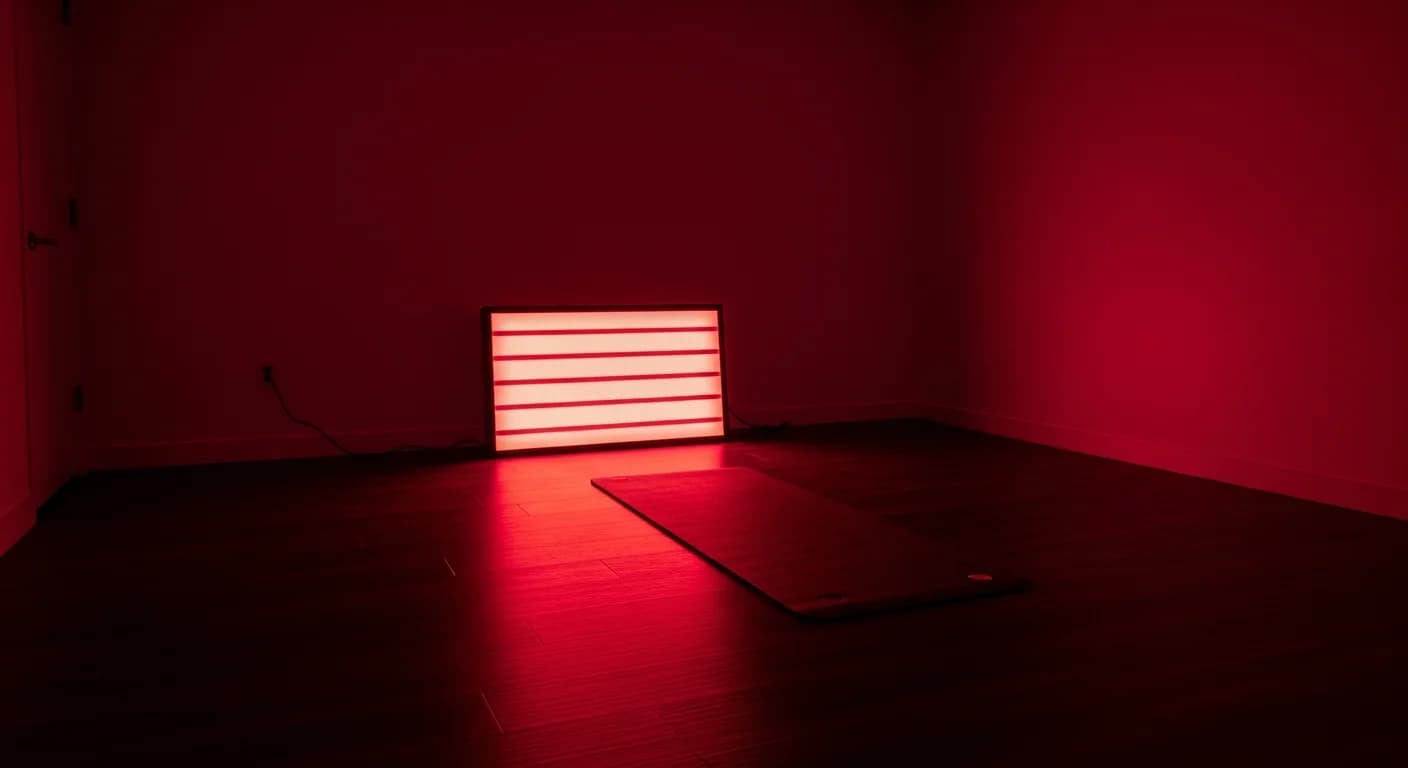

Red light therapy (photobiomodulation) uses specific wavelengths of red and near-infrared light (660nm and 850nm) to recharge your mitochondria, the tiny power plants inside your cells. The light helps your cells make more energy (ATP), which can ease pain, calm inflammation, and speed up muscle and skin recovery.
Beyond the Wellness Trend
Red Light Therapy (also called photobiomodulation) is often sold as a beauty treatment. What it does is simpler and more useful than that. It is a tool for recharging the energy factories inside your cells.
You may have seen the glowing red panels on social media or in wellness studios. It is fair to wonder if this is just another trend. The mechanism, however, is grounded in well-studied biophysics. Plants use specific wavelengths of sunlight to make energy through chlorophyll. Your cells respond to specific wavelengths of red light (660nm) and near-infrared light (850nm) to make more ATP, the molecule your body uses for energy.
At Fishtown Medicine, we treat photobiomodulation (PBM for short) as a precise metabolic lever. We use it to support recovery and calm inflammation rather than treating it as magic.
How Does Red Light Work Inside Your Cells?
To understand why this works, look inside the mitochondria (the small energy factories in every cell) at an enzyme called Cytochrome C Oxidase, or CCO. CCO is the final step in the electron transport chain, which is the assembly line that makes ATP (your cellular energy currency).
Here is the problem. When you are stressed, tired, or inflamed, a molecule called nitric oxide can stick to CCO. That sticking slows down ATP production, almost like sand in a gear.
Photons (light particles) at the right wavelengths interact with CCO and dislodge the nitric oxide. Oxygen returns to its proper spot, and the cellular engine restarts. In a very literal way, you are unsticking the metabolic engine with light.
This is the work of Dr. Michael Hamblin, a leading researcher whose papers we rely on heavily.
What Conditions Does Red Light Therapy Help With?
PBM is FDA cleared for treating certain types of pain and signs of skin aging. The clinical effects often reach further than the skin.
- Skin and collagen. PBM stimulates fibroblasts, the cells that make collagen, which is why it can improve fine lines and scar texture.
- Muscle recovery. For patients who train hard, PBM appears to lower delayed onset muscle soreness (the achy feeling 24 to 48 hours after a workout) by calming inflammatory signals.
- Joint pain. PBM is a useful add-on for arthritis, helping reduce local inflammation without adding another pill.
- Thyroid support. Early evidence suggests PBM may help thyroid function in conditions like Hashimoto's (an autoimmune thyroid condition) by lowering local autoimmune activity. We treat this with tempered confidence and careful monitoring rather than as a settled fact.
Proven, Promising, and Overhyped: A Straight Look at the Claims
Red light therapy is neither a miracle nor a scam, and the claims sort into three buckets. Most of the internet hype lives in the third one.
Worth considering, with reasonable evidence:
- Skin aging. Controlled trials back red and near-infrared light for modest improvements in fine lines, skin texture, and collagen density. This is one of the better-supported uses, and devices are FDA-cleared for it. It works best layered onto the rest of a skin plan, where sunscreen and retinoids still do the heavy lifting.
- Androgenetic hair loss. FDA-cleared low-level laser and LED devices have modest but documented regrowth data for pattern hair thinning, with laser-based devices tending to outperform LED. It works only while you keep using it, and it pairs best with proven treatments like minoxidil and finasteride inside a wider hair plan.
- Localized pain and recovery. For joint pain, tendon trouble, and post-exercise soreness, the evidence supports short-term, modest relief as an add-on rather than a cure.
- Inflammatory acne. Light-based treatment has a place here, usually alongside standard care.
Promising but unsettled, from small or early studies:
Thyroid (Hashimoto's), fibromyalgia, and a mild whole-body anti-inflammatory effect from local treatment all have early signals and clear limitations. We use these with humility and monitoring, keeping them in a supporting role.
Overblown, where the claims outrun the data:
Fishtown Medicine
A 90-minute conversation with Dr. Ash. A written plan you can follow.
Fat loss and body contouring, "detox," dramatic athletic-performance gains, cognitive enhancement, and whole-body cures for chronic disease. A glowing panel will not melt fat or detoxify you, and the marketing here runs well ahead of the science.
Two truths keep expectations in check. First, this is an adjunct rather than a replacement for the treatments that make the biggest difference: sunscreen and retinoids for skin, evidence-based medication for hair loss, and proper rehabilitation for pain. Second, dose matters, and more is not better. Photobiomodulation follows a biphasic dose-response, meaning the right wavelength, intensity, and time help, while too much can do nothing or even set you back. The right dose even depends on the target: energy-hungry tissues like muscle and brain tend to respond to lower doses, while skin, tendon, and cartilage need more. Many at-home devices are underpowered or used incorrectly, which is a big reason results disappoint.
Why Does Device Quality Matter So Much for Red Light Therapy?
A standard red light bulb does not do the job. Effective therapy comes from the right physics rather than a red glow. Clinical results depend on two variables.
- Wavelength. You want specific bands. Around 660nm (red) targets surface tissue like skin. Around 850nm (near-infrared, invisible to the eye) reaches deeper tissue like muscle and joints.
- Power density (irradiance). The device should deliver more than 50 mW/cm² (a measure of how much light energy hits each square centimeter of skin) so the photons reach the tissue you care about.
At Fishtown Medicine, we point patients toward medical-grade devices (such as Joovv or PlatinumLED) that publish verified output numbers.
Guidance from the Clinic

Our Perspective: We treat the body as one connected system. Rather than silencing a symptom, we want to give the body the energy resources it needs to repair itself.
Is Red Light Therapy Different from a Sauna?
Yes, they work in very different ways, and they pair well.
Sauna therapy relies on heat stress (a useful biological challenge called hormesis). You sweat, your heart rate climbs, and heat shock proteins activate.
Red light is photobiomodulation, a biochemical effect. You usually do not sweat, and the action happens at the level of electrons inside your mitochondria.
Many patients use both. Think of them as fire and light. Each one targets a different stress pathway, and the benefits stack.
Actionable Steps in Philly
How to bring light therapy into your routine.
- The free option. The sun delivers a strong dose of near-infrared light at sunrise. Get outside for 10 minutes before 8 AM. Morning light helps set your circadian rhythm (your internal sleep and wake clock) and gives you free PBM.
- Local access. Several Philly wellness spots, including Restore Hyper Wellness, offer clinical-grade PBM sessions. This is a low-commitment way to test whether the therapy helps your joint pain before buying a device.
- Home use. If the therapy works for you, a small panel for your desk or bathroom is a high-yield purchase. 10 minutes a day keeps the dose consistent.
Let's figure this out together.
Book Your Warm Invitation Call Here
Scientific References
- Hamblin MR. Mechanisms and Mitochondrial Redox Signaling in Photobiomodulation. Photochem Photobiol. 2018. (The definitive review of the CCO mechanism).
- de Freitas LF, Hamblin MR. Proposed Mechanisms of Photobiomodulation or Low-Level Light Therapy. IEEE J Sel Top Quantum Electron. 2016. (Engineering perspective on light-tissue interaction).
- Hamblin MR. Mechanisms and applications of the anti-inflammatory effects of photobiomodulation. AIMS Biophys. 2017. (Detailing cytokine reduction pathways).
- Ferhatoglu SY, et al. Low-level laser therapy in the treatment of Hashimoto's thyroiditis: A randomized clinical trial. Photobiomodulation, Photomedicine, and Laser Surgery. 2020.
- Afifi L, et al. Low-level laser therapy as a treatment for androgenetic alopecia: A systematic review. Lasers in Surgery and Medicine. 2017;49(1):27-39.
- Huang YY, Chen ACH, Carroll JD, Hamblin MR. Biphasic Dose Response in Low Level Light Therapy. Dose-Response. 2009;7(4):358-383.

Fishtown Medicine | Articles
Frequently Asked Questions
Common Questions
Deep-Dive Questions
Ready when you are
The chat is our AI assistant, answering from our published guides. To talk it through with Dr. Ash himself, start with the intake.