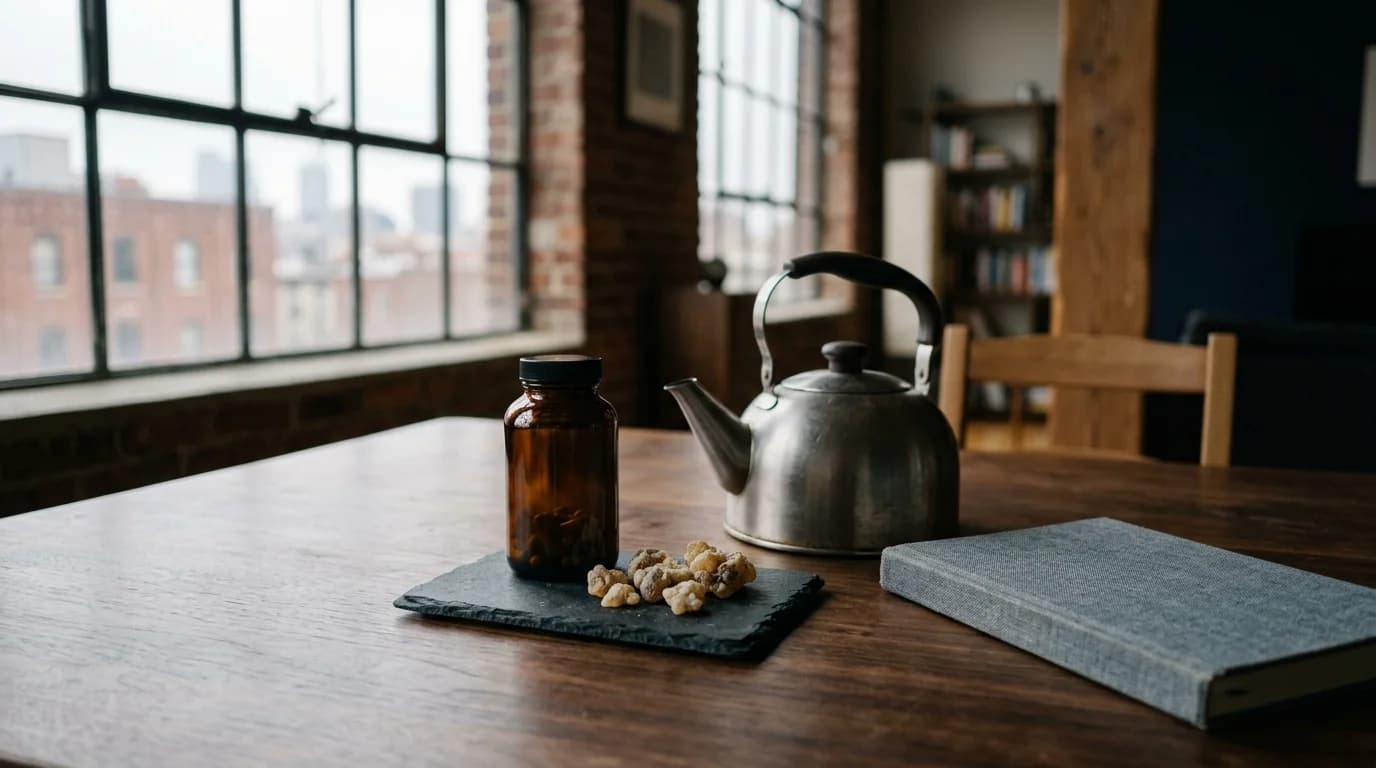

Boswellia serrata, also called frankincense, is a plant extract whose active compound AKBA blocks the 5-LOX inflammation pathway. In standardized doses it can ease osteoarthritis pain and stiffness within a few weeks, offering a useful option for people who cannot tolerate NSAIDs. Look for extracts standardized to AKBA content.
A standardized plant extract for osteoarthritis pain, built around a different inflammation pathway than NSAIDs.
- Osteoarthritis relief. In randomized trials, standardized Boswellia eased knee osteoarthritis pain, improved function, and increased walking distance.1
- A different mechanism. Its active compound AKBA inhibits 5-LOX, an inflammation enzyme that NSAIDs do not touch, which is why it can help when ibuprofen-type drugs are off the table.2
- Backed by pooled data. A meta-analysis of 7 trials found Boswellia relieved pain and stiffness and improved joint function, with benefit building over at least 4 weeks.3
What Is Boswellia?
Boswellia serrata is the tree that gives us frankincense, the resin burned as incense for thousands of years. Its medicinal value comes from a family of compounds called boswellic acids, and one in particular: AKBA (acetyl-11-keto-beta-boswellic acid). AKBA blocks an enzyme called 5-lipoxygenase, or 5-LOX, which manufactures leukotrienes (inflammatory signaling molecules involved in joint and airway inflammation).
Most over-the-counter pain relievers (ibuprofen, naproxen, aspirin) work on a different enzyme, COX. By targeting 5-LOX instead, Boswellia offers a complementary angle on inflammation, and it sidesteps the stomach, kidney, and cardiovascular risks that come with long-term NSAID use. We think of it as a tool for the patient whose knees ache on Philly's cobblestone streets but whose stomach cannot handle a daily Advil.
Who Benefits Most from Boswellia?
In our practice, Boswellia earns its place for specific patients:
- Knee and joint osteoarthritis. The best-studied use, with consistent improvements in pain and function.1 If the knee pain started with a specific twist or an awkward jump rather than gradual wear, read our guide to knee injuries and sprains first.
- NSAID-intolerant patients. People with reflux, ulcers, kidney concerns, or cardiovascular risk who cannot take daily anti-inflammatories.
- Chronic inflammatory joint pain. Often layered with other lifestyle and physical-therapy approaches.
- As a partner to curcumin. The two are frequently combined for osteoarthritis, hitting inflammation from two directions.
Who Should Be Cautious with Boswellia?
- Pregnancy and breastfeeding. Avoid, since safety data is lacking.
- People on multiple medications. Boswellia can influence liver enzymes that process certain drugs, so we review your full list.
- Autoimmune conditions on immune-modulating drugs. Coordinate with your specialist before adding it.
How we evaluate it: do you need it, is it safe, does the dose work, then cost
Every supplement we recommend runs the same 4 gates, in order, and most things never make it past the first one (the whole process is in how we choose supplements).
- Do you need it? Joint pain that is bothering you now is the reason to consider this, particularly when anti-inflammatories are a problem for your stomach, kidneys, or blood pressure. There is no marker to check, so we set a specific complaint and a date to judge it.
- Is it safe? We want a standardized extract from a manufacturer you can name, with third-party testing. Stomach upset is the usual complaint, and it interacts with blood thinners enough to raise before starting one.
- Does the dose work? The active fraction is AKBA, and the label has to state it, since a large capsule of unstandardized resin can carry very little. Most of the useful trials run 100 to 250 mg of AKBA daily, split through the day.
- What does it cost? Standardized products run about $20 to $40 a month, and the unstandardized ones are cheaper because they contain less of what works.
- What we make on it: nothing. Our only charge is the flat membership fee, and nothing is ever added on top of it. We take nothing on supplements, labs, imaging, or medication, which means every discount we can negotiate reaches you at cost. There is no conflict of interest here to work around, so the 4 gates above are the only things deciding what you hear from us.
How Should You Dose Boswellia?
The key is standardization rather than raw milligrams of extract.
Fishtown Medicine
A 90-minute conversation with Dr. Ash. A written plan you can follow.
- Standardized extract. Look for products standardized to a defined boswellic acid content, ideally AKBA. Studied AKBA-enriched extracts used 100 to 250 mg daily.2
- Generic extract. Often dosed at 300 to 500 mg, 2 to 3 times daily, but potency varies widely without standardization.
- Give it time. Expect to judge results at 4 weeks, not 4 days.3
When Is the Best Time to Take Boswellia?
- With food. Boswellic acids absorb better alongside a meal containing some fat.
- Split or once daily. Both work. Consistency matters more than the schedule.
- Daily, not as-needed. Unlike an NSAID you take during a flare, Boswellia works by building anti-inflammatory effect over weeks.
Why Standardization Matters
- AKBA is the workhorse. Branded extracts like those standardized to 30% AKBA were the ones tested in trials. Generic "Boswellia 500 mg" may contain very little AKBA.
- Resin quality varies. Frankincense is an agricultural product, and boswellic acid content swings by source and processing.
- Buy tested brands. Look for third-party testing and a stated AKBA percentage rather than total extract weight.
What Are the Common Side Effects?
- Generally well tolerated. Trials reported side effects similar to placebo.
- Mild GI upset. Some people notice nausea, acid reflux, or loose stool, usually mild and dose-related.
What Pairs Well with Boswellia?
- Curcumin. The classic osteoarthritis pairing, combining 5-LOX and COX-pathway effects.
- Omega-3 fish oil. Adds further anti-inflammatory support for joints.
- Collagen peptides. Aimed at the cartilage and connective tissue rather than the inflammation itself, which makes it a different job from this one.
- Strength training and physical therapy. The muscle around a joint is its shock absorber. No supplement replaces building it.
A note on cost: any discount we negotiate on professional-grade supplements passes straight through to you, with no markup. Here is how we choose and source supplements.
Scientific References
- Kimmatkar N, Thawani V, Hingorani L, Khiyani R. Efficacy and tolerability of Boswellia serrata extract in treatment of osteoarthritis of knee: a randomized double blind placebo controlled trial. Phytomedicine. 2003;10(1):3-7.
- Sengupta K, Alluri KV, Satish AR, et al. A double blind, randomized, placebo controlled study of the efficacy and safety of 5-Loxin for treatment of osteoarthritis of the knee. Arthritis Res Ther. 2008;10(4):R85.
- Yu G, Xiang W, Zhang T, Zeng L, Yang K, Li J. Effectiveness of Boswellia and Boswellia extract for osteoarthritis patients: a systematic review and meta-analysis. BMC Complement Med Ther. 2020;20(1):225.

Frequently Asked Questions
Common Questions
Deep-Dive Questions
Ready when you are
The chat is our AI assistant, answering from our published guides. To talk it through with Dr. Ash himself, start with the intake.