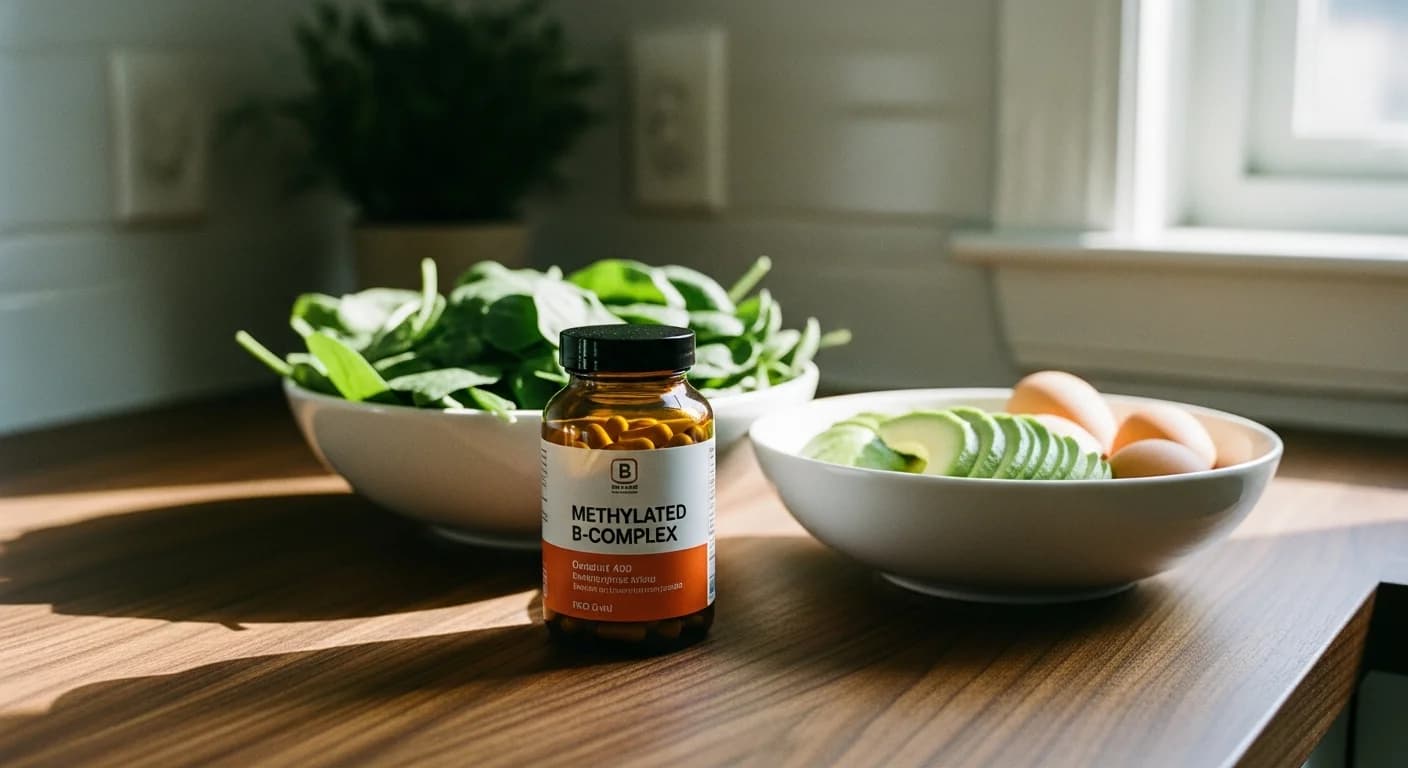

Yes, you can take too much of some B vitamins. Vitamin B6 causes dose-dependent nerve damage, with a United States upper limit of 100 mg a day and a European limit of 12 mg. Folic acid and methylfolate share a 1,000 mcg ceiling, set because high folate can hide a B12 deficiency. Vitamin B12 has no established upper limit.
TL;DR: Yes, you can take too much of some B vitamins. The big one is vitamin B6. Too much B6 over months can damage the nerves in your hands and feet, and the numbness can take a long time to fade. The United States sets the daily ceiling at 100 mg. Europe lowered its ceiling to 12 mg in 2023. Too much folate is a different problem: it can hide a B12 shortage, so your blood test looks normal while nerve damage keeps going. Vitamin B12 has no known ceiling and is safe at high doses. Niacin (B3) causes flushing, and gram-size doses of the slow-release kind can injure the liver. Here is what to do, in order. Line up every bottle you take, including your multivitamin and any energy drink or protein powder. Add up the B6 in milligrams and the folate in micrograms across all of them. Then ask your doctor to check B12, folate, and homocysteine before you raise any dose.
Most people who bring me a B complex are doing something sensible. They read that the methylated forms work better, they picked a careful brand, and they take it every morning without a second thought. The question almost nobody gets asked is how much is in the capsule and what else in the cabinet holds the same vitamins. That question matters more than the brand, because 2 of the 8 B vitamins carry a ceiling you can cross without feeling anything for months.
Why doesn't "water-soluble" mean the extra washes out?
The phrase "water-soluble, so any excess washes out" is close to true for most of the B vitamins and wrong for the ones that matter. Water solubility describes how a vitamin travels in the blood and how readily the kidneys clear it. It says nothing about what that vitamin does to tissue during the hours it is circulating, and it says nothing at all about what happens over 3 years of daily dosing.
Vitamin B6 is the counterexample that ends the argument. The Food and Nutrition Board at the National Academies set an upper intake level for B6 in adults because of nerve damage, and sensory neuropathy is the specific endpoint the whole limit is built on. A nutrient cannot both wash out harmlessly and be the reason a federal panel wrote a safety ceiling.
There is a second problem with the excretion argument, which is that it treats each day as a separate event. When the European Food Safety Authority reviewed B6 in 2023, it applied an uncertainty factor of 4 to its reference dose partly to account for the inverse relationship between dose and time to onset of symptoms: the lower the daily dose, the longer the exposure has to run before anything shows up. A year without symptoms is therefore weak evidence of safety at that dose, because the clock may simply be short.
Folate is the other exception, and for a different reason. The harm there comes less from the folate molecule than from what a high folate intake conceals.
How much vitamin B6 is too much?
Vitamin B6 toxicity is the best-established harm in this whole category, and the 2 major regulators are nowhere near each other on the number.
In the United States, the Food and Nutrition Board set the tolerable upper intake level for adults at 100 mg per day. The basis was sensory neuropathy. Trials in patients taking an average of about 200 mg per day for up to 5 years found no neuropathy, and the board halved that figure to 100 mg because the long-term data had gaps it did not want to build on. Those limits do not apply to people taking B6 as a prescribed medical treatment, who should be doing so under a physician's supervision.
In 2023, the European Food Safety Authority set the upper level for all adults, including pregnancy and lactation, at 12 mg per day, down from the 25 mg per day figure European regulators had used since 2000. The panel identified a reference point of 50 mg per day from a case-control study, supported by case reports and pharmacovigilance data, then applied an uncertainty factor of 4. The same opinion notes that most human evidence comes from case reports describing clinical neuropathy at intakes between 100 and 6,000 mg per day, with latency running anywhere from 1 to 72 months, and that a lowest-observed-effect level could not be established from the human data at all.
Read those 2 paragraphs together and the picture is clear enough. Regulators disagree by roughly 8-fold on where the ceiling belongs, the disagreement is about how much caution the sparse data deserve, and the recent movement has been downward.
What the nerve injury looks like
A 2023 systematic review in Nutrients pooled 20 studies and found that higher vitamin B6 levels produce a predominantly sensory neuropathy of the axonal type. In plain terms, the long sensory nerves are the ones that suffer: numbness, tingling, burning in the feet and hands, and unsteadiness on your feet in the dark or on uneven ground. The same review found that after pyridoxine is stopped, patients report their symptoms improving.
That is the true version of "reversible." The literature describes improvement rather than a return to baseline, the improvement runs over months, and how much comes back appears to depend on how long the exposure ran before anyone connected it to the bottle. Stopping the B6 is the treatment, and stopping it earlier is better than stopping it later.
The uncomfortable case reports
A case report published in Cureus in 2023 describes an older adult with 3 years of progressive peripheral neuropathy and a serum vitamin B6 of 259.9 nmol/L against a reference range of 20 to 125 nmol/L. The only source was a daily multivitamin containing 6 mg of B6, well under both regulatory ceilings. A month after stopping it, the dizziness had resolved and the numbness and tingling had partly improved.
I want to be careful about what a report like that can and cannot support. It is a single patient, which is the weakest tier of clinical evidence, and it cannot establish that 6 mg per day causes neuropathy in anyone. What it does is mark the edge of what is known, and the edge is closer to ordinary doses than most people assume.
What happens when you take too much folate?
The upper intake level for folate in adults is 1,000 mcg (micrograms) per day, and the wording around it does a lot of work. The limit applies to folic acid from supplements and fortified food, and it excludes the folate you eat in whole food. There is no ceiling on the folate in lentils and spinach.
The reason that ceiling exists has nothing to do with folate being poisonous. It was set to keep high folate intake from masking a vitamin B12 deficiency, rather than on any finding about folate metabolism itself.
The masking problem, step by step
Vitamin B12 deficiency does 2 separate things to the body at the same time. It makes red blood cells large and eventually causes anemia, and it damages the spinal cord and the peripheral nerves. Those 2 injuries run on different tracks.
Folate corrects the blood picture. It does nothing for the nerves. So a person with an untreated B12 deficiency who takes enough folic acid can watch the complete blood count normalize and feel somewhat better, while the neurological injury continues underneath with the warning light switched off. Carried long enough, that damage stops being recoverable. This is why the order of operations matters so much: check B12 before raising folate, and correct a low B12 first or alongside, never folate alone.
The limit applies to methylfolate too
This is the part most methylated-B-complex users have never been told. When the European Food Safety Authority revisited folate in 2023, it retained the 1,000 mcg per day adult limit and stated that the limit applies to the combined intake of folic acid, (6S)-5-methyltetrahydrofolic acid glucosamine salt, and L-5-methyltetrahydrofolic acid calcium salt.
Methylfolate is the third item on that list. Choosing the active form solves an absorption and conversion problem, which is why we prefer it and why our B-complex guide recommends it. It does not buy you a higher ceiling, and it does not exempt you from the masking problem, because the thing being masked is a B12 deficiency and 5-MTHF corrects the blood count just as folic acid does.
The cancer signal, at its true strength
In the Aspirin/Folate Polyp Prevention Study, 1,021 people with a history of colorectal adenomas were randomized to 1 mg per day of folic acid or placebo (Cole and colleagues, JAMA, 2007). Folic acid did not prevent new adenomas, and at a surveillance colonoscopy beginning around 3 years after randomization the folic acid group had more advanced and more multiple adenomas. Among the 643 men in the same trial, 10-year prostate cancer incidence was 9.7% in the folic acid group against 3.3% in the placebo group (Figueiredo and colleagues, Journal of the National Cancer Institute, 2009).
Those numbers deserve to be taken seriously and also kept in proportion. Both findings come from a trial designed to answer a different question, in a population already selected for adenoma history, and a later meta-analysis of folic acid trials for adenoma prevention found no protective effect either way (odds ratio 1.08). The reasonable conclusion is caution about long-term supplemental folate at or above 1 mg per day in someone with a personal history of colorectal adenomas or prostate cancer, and a conversation with their oncologist if cancer is active. It is not a reason for the general population to fear folate.
Unmetabolized folic acid, which the internet oversells
At high intakes, folic acid turns up in the bloodstream in its unconverted form, because the body's capacity to convert it is limited. That observation is well established, and its meaning is not. The most-cited human finding linked plasma unmetabolized folic acid to reduced natural killer cell activity in postmenopausal women (Troen and colleagues, Journal of Nutrition, 2006), an observational association in a modest sample. A later laboratory study found that folic acid did not regulate natural killer cell activity directly, which weakens the causal reading of the first result.
Reviews of this literature keep arriving at the same place: the observations of harm from excess folic acid, high folate status, and unmetabolized folic acid remain inconclusive and have not been strong enough to change public health recommendations. If you have read that unmetabolized folic acid is a documented danger, you have read past what the data support.
What is the methyl trap, and how is it different from "overmethylation"?
The methyl trap, also called the folate trap, is established biochemistry that has been in the textbooks for decades. It describes what goes wrong in vitamin B12 deficiency, and understanding it takes about 3 sentences of chemistry.
Your cells shuttle folate between several chemical forms. The step that produces 5-methyltetrahydrofolate (5-MTHF, the same molecule sold as methylfolate) runs in one direction and does not reverse, and the only exit from 5-MTHF back to usable tetrahydrofolate is an enzyme called methionine synthase. Methionine synthase requires vitamin B12 as a cofactor to do its job.
Take away the B12 and the exit closes. Folate accumulates as 5-MTHF with nowhere to go, the other folate forms your cells need for DNA synthesis run short, and you end up with a cellular folate deficiency in a person whose folate intake is fine (Smulders and colleagues, British Journal of Haematology, 2006). The anemia that results is indistinguishable from true folate deficiency, which is part of why B12 deficiency gets missed.
Two practical consequences fall out of this. Giving folate to someone who is B12 deficient does not open the trap, because the missing piece is the B12. And giving folate makes the trap harder to see, since it normalizes the blood count that would otherwise have prompted the workup.
Now the distinction that gets lost online. The supplement-community claim borrows this vocabulary to describe a different idea altogether: that taking methylfolate floods the body with methyl groups and triggers an adverse reaction. The methyl trap is a story about too little B12. That claim is a story about too much methylfolate. They share a few syllables and nothing else.
How strong is the evidence that high-dose methylfolate causes anxiety?
Weak, and I would rather say that plainly than repeat a claim because it is popular.
The "overmethylation" framework traces back to one researcher's clinical observations rather than to controlled trials, and the concept has not been demonstrated in the peer-reviewed literature. The mechanism usually offered, that methylfolate accelerates neurotransmitter production faster than a slow COMT enzyme variant can clear it, has a plausible shape and no trial behind it. Genotype does not rescue the argument either: an MTHFR result cannot predict whether folate will improve or worsen mood, anxiety, agitation, or sleep in a given person, and it cannot measure functional methylation status.
Fishtown Medicine
A 90-minute conversation with Dr. Ash. A written plan you can follow.
The controlled data point the other way. In 2 randomized, double-blind, placebo-controlled trials of L-methylfolate at 15 mg per day added to an SSRI in people whose depression had not responded to the antidepressant alone (Papakostas and colleagues, American Journal of Psychiatry, 2012), adverse event rates were no different from placebo, and neither were withdrawals due to adverse events. 15 mg per day is 15,000 mcg, which is many times what a methylated B complex delivers. A design like that is where a reliable anxiety-and-insomnia effect would have surfaced, and it did not.
Here is what I still take seriously. Some people tell me they feel jittery or wired in the first week on a methylated B complex, and that report deserves a response rather than a lecture about evidence. The response costs nothing: start every other day, build up slowly, and move to a hydroxocobalamin plus folinic acid product if the feeling persists. That is sensible practice and we do it.
What I avoid is the label. Calling the experience "overmethylation" hands an untested mechanism more authority than it has earned, and the practical cost is that it pulls attention toward a harm nobody has demonstrated and away from the 2 harms that are documented, dose-dependent, and capable of leaving something behind.
Which B vitamins are safe at high doses, and which are not?
Being accurate about the safe ones matters as much as flagging the risky ones, because a reader who thinks every B vitamin is dangerous will stop the one that is helping.
| B vitamin | Adult upper limit (United States) | What the limit protects against |
|---|---|---|
| B3, niacin | 35 mg per day | Flushing; liver injury at gram-size doses |
| B6, pyridoxine | 100 mg per day (Europe: 12 mg per day) | Sensory peripheral neuropathy |
| B9, folate | 1,000 mcg per day of folic acid or methylfolate from supplements and fortified food | Masking a B12 deficiency while nerve damage continues |
| B12, cobalamin | None established | No limit set, because toxicity potential is low |
| B1, B2, B5, B7 | None established | No dose-related harm identified at intakes reviewed |
Niacin (B3) is the third one to respect
The 35 mg per day upper level for niacin was set on flushing as the critical adverse effect, against a recommended intake of 16 mg of niacin equivalents per day for men and 14 mg for women. The flush brings burning, tingling, and itching, can arrive within 30 minutes of a dose, and is classified as an unpleasant side effect rather than a harmful one. Plenty of people cross 35 mg without consequence.
Liver injury is the part that deserves care, and it is formulation-specific. Niacin hepatotoxicity is dose-dependent and considerably more common with sustained-release preparations than with immediate-release crystalline niacin or prescription extended-release niacin. Most cases are mild and resolve after stopping the product, but a minority progress to acute liver failure that is fatal or requires emergency transplant. The high-risk pattern is a person taking gram-size doses of an over-the-counter time-release niacin for cholesterol without anyone checking liver enzymes.
B12 is the low-risk one
The Food and Nutrition Board declined to set an upper limit for vitamin B12 because its potential for toxicity is low, and high oral doses are considered safe. That is why B12 replacement can be dosed generously without the arithmetic we apply to B6.
Low risk is a different claim from useful, though. Taking large amounts of B12 when your levels and methylmalonic acid are fine produces expensive urine and nothing else, which is the first gate in how we choose supplements doing its job. The one B12 caution in our library is about form rather than dose: cyanocobalamin is the wrong choice in Leber hereditary optic neuropathy and in reduced kidney function, where methylcobalamin and hydroxocobalamin are preferred.
Thiamin (B1), riboflavin (B2), pantothenic acid (B5), and biotin (B7) have no upper limits either. Biotin carries a different kind of problem: at high doses it interferes with the immunoassays used for thyroid and troponin testing, which is why we stop a B complex 72 hours before any blood draw. That is a lab-accuracy issue rather than a toxicity issue, and the B-complex guide covers the details.
How do people end up taking too much without knowing?
Almost always by stacking, and almost never on purpose.
A multivitamin, a separate B complex, an energy drink, a pre-workout, a fortified cereal, and a greens powder can each carry B6 and folate. Every label looks modest read on its own, and the number that determines your risk is the total across all of them, which no label prints and no product is required to warn you about. The case report above involved a person whose entire supplement regimen was a single daily multivitamin.
Two background facts push the totals higher than people expect. Enriched grains in the United States have been fortified with folic acid since 1998, so the average American baseline intake is meaningful before any capsule enters the picture. And high-potency products advertise multiples of the daily value on the front of the bottle, because a bigger multiple looks like a better product on a shelf. A percentage of the daily value is a marketing number rather than a dosing decision, and 5,000% of the daily value of anything should make you reach past the front label and read the panel on the back.
The correction is unglamorous and takes about 10 minutes. Put every bottle on the counter, write down the B6 in milligrams and the folate in micrograms from each panel, and add the columns. Most people are surprised once, then never again.
How does Fishtown Medicine decide on a B vitamin dose?
The same 4 gates run here as everywhere else, in the same order, and this topic is where the second gate earns its place ahead of the third.
Do you need it? B12, folate, homocysteine, and sometimes methylmalonic acid tell us whether a B complex belongs in your plan at all. A B complex taken without any of those checked is the most common supplement bought on principle rather than on a number.
Is it safe for you? With B vitamins this gate is mostly arithmetic and sequencing. We total your B6 across every product you take, total your folate across supplements and fortified food, confirm B12 status before raising folate, and ask about a personal history of colorectal adenomas or prostate cancer before anyone stays on 1 mg of supplemental folate long term. If your feet have been numb or tingling, B6 gets totaled before anything else happens.
Does the dose work? The dose is set by the marker we are trying to move, whether that is a homocysteine target, a methylmalonic acid trending toward the top of its range, or an MCV climbing above 86. Our homocysteine and methylation guide walks through those targets. A number on a label has no idea what your labs say.
What does it cost? Cost breaks ties among options that already cleared the first 3 gates, and it never opens the conversation. We take nothing on supplements, so telling you to stop 3 of the 5 things in your cabinet costs us nothing and saves you money.
Philadelphia adds its own wrinkle here. Between long winters, the after-shift energy drinks that get a lot of our restaurant and hospital patients through a double, and the pre-workouts that circulate in the gyms around Fishtown and Northern Liberties, the B6 total in this city is frequently higher than anyone realizes. It is a good reason to bring the bottles.
Guidance from the Clinic

Actionable Steps
Count what you are already taking before you change anything.
- Put every bottle on the counter. Include the multivitamin, the B complex, the greens powder, the pre-workout, and any energy drink you have more than occasionally. Anything with a supplement facts panel counts.
- Add up the B6 in milligrams. Compare your total against 100 mg per day, the United States ceiling, and against 12 mg per day, the European one. Anywhere above 12 mg is a dose to have a conversation about rather than a dose to panic about.
- Add up the folate in micrograms. Folic acid and methylfolate share the same 1,000 mcg per day ceiling from supplements and fortified food. Whole-food folate is not counted.
- Get B12, folate, and homocysteine checked before you raise any folate dose. Correcting a low B12 first is what keeps folate from hiding it, and homocysteine tells us whether the B vitamins are doing their job.
- Report numbness or tingling in your feet or hands right away. Sensory symptoms in someone taking high-dose B6 are the reason to stop and be examined, and earlier beats later on how much recovers.
Key Takeaways
- Vitamin B6 is the best-documented B vitamin toxicity: the United States upper limit is 100 mg per day, the European limit is 12 mg per day as of 2023, and the injury is a sensory axonal neuropathy that improves after stopping without reliably returning to baseline.
- Folate's 1,000 mcg per day upper limit exists to prevent masking a vitamin B12 deficiency, and European regulators apply that same limit to methylfolate, so choosing the active form does not raise the ceiling.
- The methyl trap is established biochemistry about too little B12, and it is a different claim from the supplement-community idea that too much methylfolate causes an adverse reaction.
- Evidence for "overmethylation" from high-dose methylfolate is weak: it rests on clinical observation rather than trials, while randomized trials at 15 mg per day showed adverse event rates no different from placebo.
- Vitamin B12 has no established upper limit and is low-risk at high doses; niacin's 35 mg per day limit is set on flushing, with liver injury a concern mainly at gram-size doses of sustained-release products.
- Stacking is how most people cross a limit: total the B6 in milligrams and the folate in micrograms across every product before changing a dose.
A note on cost: any discount we negotiate on professional-grade supplements passes straight through to you, with no markup. Here is how we choose and source supplements.
Related at Fishtown Medicine
- B-Complex Clinical Guide - which forms to use, how to dose them, and the biotin-before-labs rule
- How We Choose Supplements - the 4 gates: need, safety, dose, then cost
- MTHFR and Methylation - what the gene variant does and does not predict
- Homocysteine and Methylation Testing - the markers we dose against
- Supplement Exit Strategies - how to stop something safely once it has done its job
- Personalized Supplement Logic - why the dose belongs to your labs rather than to a label
Scientific References
- National Institutes of Health, Office of Dietary Supplements. "Vitamin B6: Fact Sheet for Health Professionals." https://ods.od.nih.gov/factsheets/VitaminB6-HealthProfessional/
- National Institutes of Health, Office of Dietary Supplements. "Folate: Fact Sheet for Health Professionals." https://ods.od.nih.gov/factsheets/Folate-HealthProfessional/
- National Institutes of Health, Office of Dietary Supplements. "Vitamin B12: Fact Sheet for Health Professionals." https://ods.od.nih.gov/factsheets/VitaminB12-HealthProfessional/
- National Institutes of Health, Office of Dietary Supplements. "Niacin: Fact Sheet for Health Professionals." https://ods.od.nih.gov/factsheets/Niacin-HealthProfessional/
- Institute of Medicine, Food and Nutrition Board. Dietary Reference Intakes for Thiamin, Riboflavin, Niacin, Vitamin B6, Folate, Vitamin B12, Pantothenic Acid, Biotin, and Choline. National Academies Press, 1998. https://www.nationalacademies.org/read/6015/chapter/9
- EFSA Panel on Nutrition, Novel Foods and Food Allergens. "Scientific opinion on the tolerable upper intake level for vitamin B6." EFSA Journal. 2023. https://efsa.onlinelibrary.wiley.com/doi/10.2903/j.efsa.2023.8006
- EFSA Panel on Nutrition, Novel Foods and Food Allergens. "Scientific opinion on the tolerable upper intake level for folate." EFSA Journal. 2023. https://efsa.onlinelibrary.wiley.com/doi/10.2903/j.efsa.2023.8353
- "The Role of Vitamin B6 in Peripheral Neuropathy: A Systematic Review." Nutrients. 2023;15(13):2823. https://doi.org/10.3390/nu15132823
- Paluszny A, Qiu S. "Vitamin B6 Toxicity Secondary to Daily Multivitamin Use: A Case Report." Cureus. 2023. https://pubmed.ncbi.nlm.nih.gov/38098895/
- StatPearls. "Vitamin B6 Toxicity." NCBI Bookshelf. https://www.ncbi.nlm.nih.gov/books/NBK554500/
- Smulders YM, et al. "Cellular folate vitamer distribution during and after correction of vitamin B12 deficiency: a case for the methylfolate trap." British Journal of Haematology. 2006. https://pubmed.ncbi.nlm.nih.gov/16445837/
- Papakostas GI, et al. "L-methylfolate as adjunctive therapy for SSRI-resistant major depression: results of two randomized, double-blind, parallel-sequential trials." American Journal of Psychiatry. 2012. https://pubmed.ncbi.nlm.nih.gov/23212058/
- Cole BF, Baron JA, Sandler RS, et al. "Folic Acid for the Prevention of Colorectal Adenomas: A Randomized Clinical Trial." JAMA. 2007. https://pubmed.ncbi.nlm.nih.gov/17551129/
- Figueiredo JC, et al. "Folic Acid and Risk of Prostate Cancer: Results From a Randomized Clinical Trial." Journal of the National Cancer Institute. 2009;101(6):432-435. https://pubmed.ncbi.nlm.nih.gov/19276452/
- Troen AM, et al. "Unmetabolized folic acid in plasma is associated with reduced natural killer cell cytotoxicity among postmenopausal women." Journal of Nutrition. 2006. https://pubmed.ncbi.nlm.nih.gov/16365081/
- LiverTox: Clinical and Research Information on Drug-Induced Liver Injury. "Niacin." National Institute of Diabetes and Digestive and Kidney Diseases, NCBI Bookshelf. https://www.ncbi.nlm.nih.gov/books/NBK548176/

Frequently Asked Questions
Common Questions
Deep-Dive Questions
Ready when you are
The chat is our AI assistant, answering from our published guides. To talk it through with Dr. Ash himself, start with the intake.