
Vitamin K2 is a fat-soluble vitamin that activates proteins in your body to send calcium into bone and out of artery walls. It is different from Vitamin K1, which mainly handles blood clotting. Most adults benefit from 100 to 200 mcg of MK-7, the long-acting K2 form, taken with a fat-containing meal.
Vitamin K comes in 2 main forms: K1 (phylloquinone) and K2 (menaquinone). K1 is plentiful in leafy greens and mostly supports blood clotting. K2 has a different job. K2 activates proteins that decide where calcium gets deposited in your body.
What Vitamin K2 is and what it does
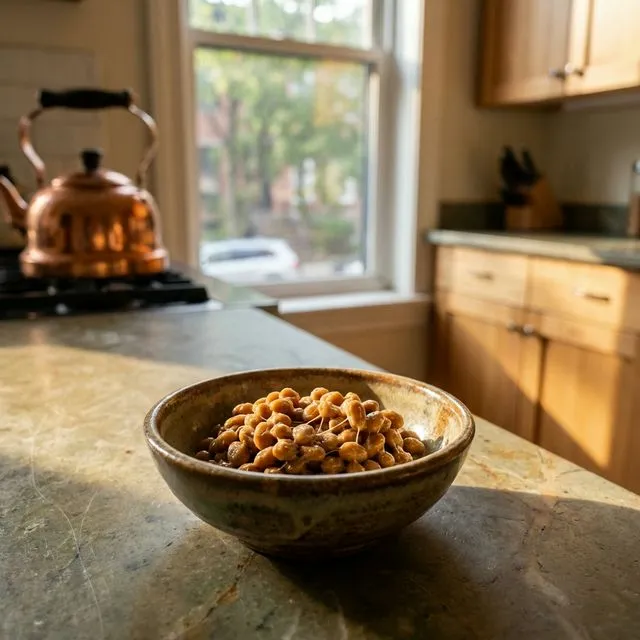
Vitamin K2 is a fat-soluble vitamin found in fermented foods (natto, cheese, sauerkraut) and animal products (egg yolks, liver). It works by activating 2 important proteins that manage calcium traffic throughout the body.
The first is osteocalcin, made by bone-building cells. When K2 activates osteocalcin, it binds calcium into the bone matrix, producing stronger, denser bones. The second is Matrix GLA Protein (MGP), found in arterial walls, cartilage, and soft tissues. When K2 activates MGP, it blocks calcium from depositing in soft tissue, keeping arteries more flexible and less calcified.
Without adequate K2, both proteins stay inactive. Calcium drifts freely and tends to settle in arteries instead of bone, which is the opposite of what you want. You can eat all the leafy greens you want and still be low in K2, because K1 and K2 are not the same nutrient.
Who this is for (and who it isn't)
Vitamin K2 fits adults across several common clinical profiles:
- Anyone taking Vitamin D3, particularly more than 2,000 IU daily. D3 increases calcium absorption, and K2 ensures that calcium goes into bone rather than arteries.
- Postmenopausal women focused on bone density.
- Anyone with cardiovascular risk (high ApoB, family history, coronary calcium on imaging).
- People on calcium supplements who want that calcium going to bone rather than artery walls.
- Anyone with low dietary K2, meaning no natto, limited cheese, eggs, or grass-fed dairy. Unless you eat natto regularly (and most Americans don't), supplementation is the practical path to adequate K2. Grass-fed animal fats carry a little MK-4, though as our tallow guide works out, the amounts are too small to count on.
It needs a conversation first, or extra monitoring, if:
- You take warfarin (Coumadin). K2 affects vitamin K-dependent clotting factors, although less than K1. Steady dosing and INR monitoring are essential. Work with your physician.
- You take other blood thinners. DOACs (direct oral anticoagulants like Eliquis or Xarelto) are not affected by Vitamin K, but check with your physician before starting.
How we evaluate it: do you need it, is it safe, does the dose work, then cost
Every supplement we recommend runs the same 4 gates, in order, and most things never make it past the first one (the whole process is in how we choose supplements).
- Do you need it? There is no routine test, so this is usually decided by what else you are taking. Anyone on more than 2,000 IU of D3 has a reason, and anyone on warfarin needs the conversation before starting.
- Is it safe? We want a third-party-tested product (NSF or USP) with consistent, verified dosing. For warfarin patients, product consistency is a safety issue, because a fluctuating K2 dose creates fluctuating INR readings.
- Does the dose work? Form drives effectiveness here. MK-7 is the preferred form for most adults: it has a long half-life of about 72 hours and works with once-daily dosing. MK-4 has a short half-life of about 6 to 8 hours and needs multiple doses per day to keep blood levels steady. For most supplement use cases, MK-7 wins on convenience and coverage.
- What does it cost? Among pure, verified options, we take the best value. K2 supplements are generally affordable; the meaningful cost variable is whether the product is third-party tested and clearly labeled for MK-7 content.
- What we make on it: nothing. Our only charge is the flat membership fee, and nothing is ever added on top of it. We take nothing on supplements, labs, imaging, or medication, which means every discount we can negotiate reaches you at cost. There is no conflict of interest here to work around, so the 4 gates above are the only things deciding what you hear from us.
How to dose it, and when
The right Vitamin K2 dose depends on your goal:
- General health: 100 to 200 mcg of MK-7 daily.
- With Vitamin D3: 200 mcg of MK-7 daily. This is the essential pairing.
- Osteoporosis support: 200 mcg of MK-7 daily.
- High-dose calcium users: 200 mcg of MK-7 daily.
Take K2 with a fat-containing meal. K2 is fat-soluble and absorbs much better with fat. Breakfast or lunch both work. There is no strong evidence that morning or evening timing changes the result.
What to expect on the timeline: K2 starts activating proteins within hours of a dose, but the long-term effect on bone and arteries plays out over months to years. The strongest bone data comes from studies using 180 mcg or more of MK-7 daily in postmenopausal women. We use K2 as a steady, long-term tool rather than a quick fix.
Flaws, side effects, and interactions
Fishtown Medicine
A 90-minute conversation with Dr. Ash. A written plan you can follow.
No supplement is perfect, and naming the downsides is part of the job.
- Warfarin and K2 need coordination. K2 affects how warfarin works, so the goal is a steady dose rather than avoidance. If you and your physician decide to use K2, the dose stays the same every day and INR is monitored closely.
- Limited K2 status testing. There is no simple, widely available blood test for Vitamin K2 status. Surrogate markers exist (undercarboxylated osteocalcin is a research tool, not commonly run in clinic) and CT coronary angiography gives an indirect picture of K2s protective effect over time, but we generally rely on clinical history and dietary assessment.
- A complement to the basics. K2 may slow the progression of arterial calcification rather than fully reverse it, and it does not lower LDL cholesterol or ApoB. Think of it as support for your lipid management and bone-density work.
- DOACs are not affected by K2, but always confirm with your prescribing physician before starting any new supplement.
What we recommend, and what we don't
- We look for: MK-7 as the active form, clearly labeled mcg content, and third-party testing for purity and consistency. A fermentation-derived MK-7 is ideal for vegan patients.
- Worth considering: a D3 plus K2 combination product if you already take D3, since the pairing is the most effective calcium strategy and simplifies the routine.
- We generally avoid: MK-4 as a sole supplement for most people (it requires multiple daily doses), products that list only "Vitamin K2" without specifying form and mcg, or high-dose K2 without physician coordination in warfarin patients.
Guidance from the Clinic
"Most patients taking Vitamin D3 or calcium supplements have never heard of K2. Once I explain that D3 increases calcium absorption and K2 decides where that calcium goes, the pairing makes immediate sense. We want calcium going to bone rather than artery walls. K2 is inexpensive, well-tolerated, and the evidence in postmenopausal women and cardiovascular risk is strong. It earns its place in a serious longevity stack."
Dr. Ash
Actionable Steps
A simple K2 plan you can start this week.
- Audit your stack. If you take Vitamin D3 or calcium and your supplement does not include K2, plan to add K2.
- Pick MK-7. Choose a 100 to 200 mcg MK-7 product, ideally NSF or USP verified.
- Pair with food. Take K2 with breakfast or lunch alongside a meal that contains some fat (eggs, avocado, olive oil).
- Add whole-food sources. A few times a week, work in pasture-raised eggs, grass-fed butter, or aged Gouda. Reading Terminal Market in Center City has good local options.
- Coordinate with your physician. If you take any blood thinner, do not start K2 on your own. We map out timing and labs together.
Key Takeaways
- K2 is not the same as K1: leafy greens cover K1, while K2 comes from fermented foods and animal products.
- K2 activates proteins that send calcium to bone and block it from depositing in artery walls.
- MK-7 is the practical form for once-daily dosing, at 100 to 200 mcg daily.
- Pair K2 with Vitamin D3 for the most effective calcium strategy.
- Warfarin patients need consistent dosing and INR monitoring; DOACs are generally not affected.
A note on cost: any discount we negotiate on professional-grade supplements passes straight through to you, with no markup. Here is how we choose and source supplements.
Scientific References
- Geleijnse JM, et al. Dietary intake of menaquinone is associated with a reduced risk of coronary heart disease: the Rotterdam Study. J Nutr. 2004.
- Knapen MH, et al. Menaquinone-7 supplementation improves arterial stiffness in healthy postmenopausal women. A double-blind randomised clinical trial. Thromb Haemost. 2015.
- Beulens JW, et al. High dietary menaquinone intake is associated with reduced coronary calcification. Atherosclerosis. 2009.

Frequently Asked Questions
Common Questions
Deep-Dive Questions
Ready when you are
The chat is our AI assistant, answering from our published guides. To talk it through with Dr. Ash himself, start with the intake.