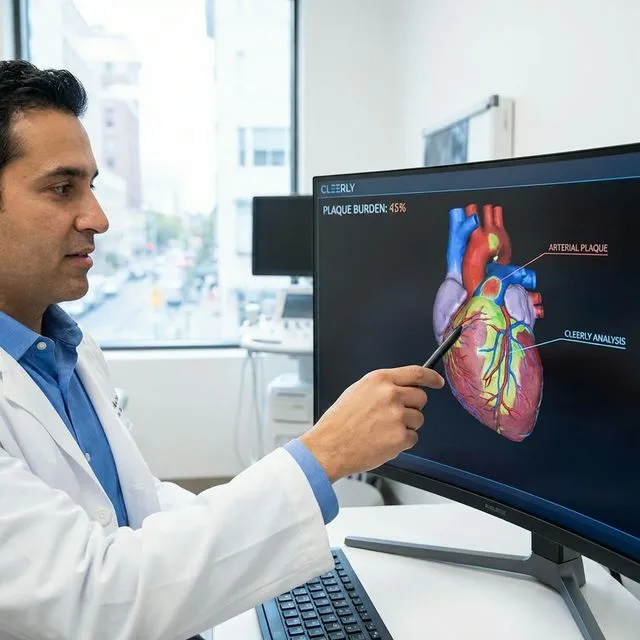

Cleerly is an AI analysis layered on top of a coronary CT angiogram (CCTA) that quantifies and classifies every millimeter of plaque in your heart arteries. Unlike a Calcium Score, which only sees old hardened plaque, Cleerly also detects soft, vulnerable plaque, the kind that ruptures and causes most heart attacks.
For 50 years, cardiology has been guessing. We measure cholesterol, the fuel, and blood pressure, the pressure, but we rarely look at the pipe (the artery itself) until it is clogged. Cleerly changes that.
The standard screening tool, the coronary calcium score (CAC), is good but limited. It only sees calcified plaque, the old, stable scars of past damage. It misses the soft plaque, the active, inflamed, lipid-rich material that ruptures and causes most heart attacks.
Cleerly is an AI analysis applied to a standard coronary CT angiogram (CCTA). It visualizes, quantifies, and phenotypes every millimeter of plaque in your arteries. It moves us from "risk factors" to "disease measurement."
How does Cleerlys AI plaque phenotyping work?
Cleerlys AI plaque phenotyping works by segmenting the coronary artery wall on a standard CCTA and analyzing tissue density at every voxel. The algorithm distinguishes between different plaque types so we can see how much plaque exists and what kind it is.
The tool: CCTA plus AI
We typically order a coronary CT angiogram with iodine contrast. Cleerlys algorithm then processes the images and produces a quantitative report on plaque burden, composition, and stenosis at each artery segment.
The PERFECT registry data
Cleerly separates plaque into:
- Calcified (white) plaque: Stable, old news. The mark of past damage. Low risk of rupture.
- Low-density non-calcified plaque (LD-NCP, red/yellow): Dangerous, vulnerable plaque. Thin cap and lipid core. If it bursts, it forms a clot instantly.
Key insight: You can have a calcium score of zero and still have meaningful soft plaque. This is the "widowmaker" scenario, and it is the gap a Cleerly CCTA closes.
Why do we order a Cleerly CTA?
We order a Cleerly CTA for two main reasons: to settle close-call decisions about treatment and to track plaque change over time.
1. The "statins vs. lifestyle" decision
You have an LDL of 130 mg/dL. You do not want to take a statin.
- Without Cleerly: We guess. We argue about risk calculators.
- With Cleerly: We look.
- Scenario A: Your arteries are pristine. Conclusion: your endothelium is resilient. We can wait on meds and double down on lifestyle.
- Scenario B: You have 200 mm³ of soft plaque. Conclusion: you have active heart disease today. The debate is over. We treat thoroughly to stabilize the plaque.
The same picture answers the question that comes up years later, when someone on a statin wants off it. What happens when you stop a statin depends heavily on how much plaque is there, which is knowable rather than a matter of opinion.
2. Tracking regression
Unlike calcium, which rarely goes down, soft plaque can be reversed. We can scan you today, prescribe a PCSK9 inhibitor like Repatha plus metformin and Zone 2 cardio, and rescan in 18 months. We can see the plaque shrink. This is the holy grail of preventive cardiology.
Who is Cleerly CTA for?
Cleerly CTA is for patients in specific clinical situations:
The "family history" phenotype
Your dad had a heart attack at 48. His cholesterol was "fine." You are worried. Cleerly tells you whether you inherited his anatomy or only his risk profile.
The "lipid-independent" risk
You have high Lp(a). This is a genetic risk factor that drives plaque growth on its own. Cleerly tells us whether the Lp(a) is biting the artery wall.
The data-driven executive
Fishtown Medicine
A 90-minute conversation with Dr. Ash. A written plan you can follow.
You want a baseline at age 40. You want to know your "vascular age" versus your chronological age, and you want measurable proof that your prevention plan is working.
Who is Cleerly CTA NOT for?
Cleerly CTA is not for everyone. We avoid it in:
The radiation-sensitive patient
A CCTA involves radiation, about 3 to 5 mSv, similar to roughly 100 chest X-rays or one year of background radiation. It is safe, but we do not order it lightly. We do not repeat it every year.
The contrast-reactive patient
It requires iodine contrast dye. If you have severe kidney disease (eGFR under 30) or a severe iodine allergy, we cannot do this scan and may pursue calcium scoring or stress imaging instead.
Very young (under 35)
Unless you have familial hypercholesterolemia (FH) or another major genetic risk, finding soft plaque before age 35 is rare. The radiation cost likely outweighs the benefit at that age.
What are the less expensive ways to answer the same question?
Cleerly stands at the top of a ladder, and most people are only ever shown the top rung. Three cheaper options sit underneath it, and for a good number of patients one of them settles the decision.
The first is a carotid and abdominal aortic ultrasound. Sound cannot image most arteries well, but the carotids run close to the surface of the neck and the aorta is the largest vessel in the body, so both show plaque clearly. These are usually covered when there is a reason to order them, and often under $100 cash for the pair. Plaque in either vessel means atherosclerosis has already started somewhere in your body, which is frequently all the information a treatment decision needs. A normal study does not clear your coronary arteries, and it should not be read that way.
The second is a coronary calcium score at roughly $100 to $150, which sees hardened plaque and nothing else. It is a reasonable triage step, with the caveat this page keeps returning to: a score of zero does not rule out soft plaque.
The third is the coronary CT angiogram without the Cleerly layer, at roughly $400 to $450. This is the same scan, the same scanner, and the same radiation, read by a radiologist instead of quantified by software. It sees soft plaque. What it will not give you is a number in cubic millimeters that a future scan can be measured against.
That last distinction is the case for paying more. If we are going to treat you and then rescan in 2 or 3 years to confirm the plaque is shrinking, the measurement is what makes the comparison mean anything, and a subjective read of "moderate plaque" on both scans tells us nothing. If the question is whether disease exists today, the cheaper read answers it.
What is the strategic roadmap for a Cleerly scan?
The strategic roadmap for a Cleerly scan covers ordering, prep, and follow-through:
- The order: We order a "CCTA with Cleerly Analysis" at a partnered imaging center.
- The prep: You may need a beta-blocker like metoprolol on the morning of the scan to lower your heart rate below 60 bpm for clear images. You will fast for 4 hours, hold caffeine the morning of, and avoid Viagra-class drugs for 48 hours since nitroglycerin is sometimes used.
- The result:
- Normal: Less than 100 mm³ plaque volume.
- Mild: Greater than 100 mm³.
- Severe: Greater than 300 mm³ or significant stenosis.
- The action plan:
- If soft plaque is greater than zero, we lower inflammation (hsCRP) and lower ApoB (60 mg/dL and under once soft plaque is present).
- We rescan in 2 to 3 years to verify regression.
Your arteries are not a mystery. They are a plumbing system. Lets send the camera down the drain.
A note on cost: any discount we negotiate on labs and imaging passes straight through to you, with no markup. Our affordable labs and imaging guide covers how the billing works.
Scientific References
- Min JK, et al. "Coronary CTA-derived plaque characteristics and the prediction of major adverse cardiovascular events." JACC: Cardiovascular Imaging. 2022.
- Williams MC, et al. "Coronary Atherosclerosis Imaging by Coronary CT Angiography." Circulation: Cardiovascular Imaging. 2020.
- Gulati M, et al. "2021 AHA/ACC/ASE/CHEST/SAEM/SCCT/SCMR Guideline for the Evaluation and Diagnosis of Chest Pain." Journal of the American College of Cardiology. 2021.
- Stone GW, et al. "A Prospective Natural-History Study of Coronary Atherosclerosis (PROSPECT)." New England Journal of Medicine. 2011.
Dr. Ash is a board-certified internal medicine physician at Fishtown Medicine in Philadelphia. He practices Medicine 3.0 preventive cardiology so your heart lasts as long as your ambition.

Frequently Asked Questions
Common Questions
Deep-Dive Questions
Ready when you are
The chat is our AI assistant, answering from our published guides. To talk it through with Dr. Ash himself, start with the intake.