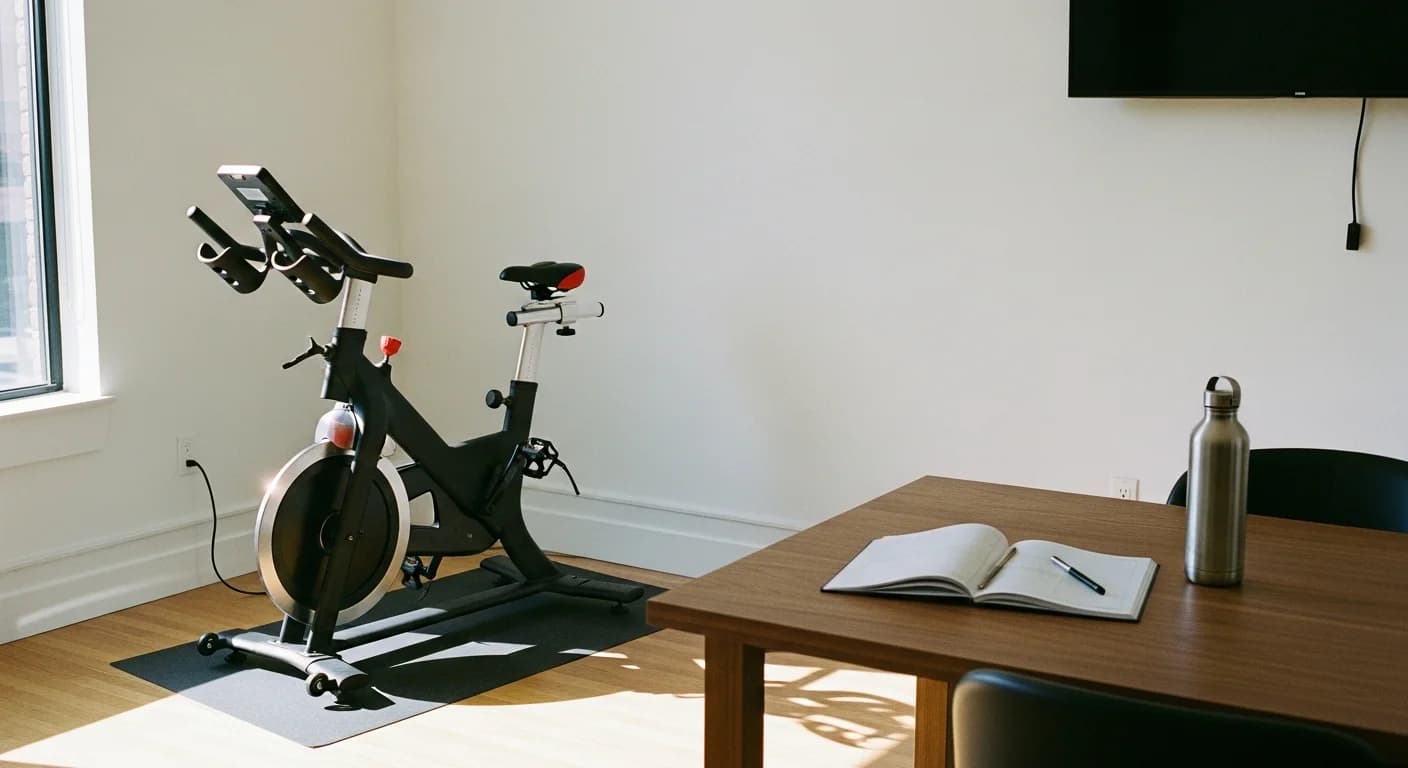
The 10-minute NASA Lean Test measures how your heart rate and blood pressure respond to gravity when your calf-muscle pump is turned off. After lying flat and quiet for 5 to 10 minutes and recording two baseline upper-arm blood pressure and pulse readings 1 minute apart (Supine 1 min and Supine 2 min), you stand barefoot with your heels 6 inches (15 cm) in front of a wall and lean back so only your shoulder blades touch the wall (buttocks clear, arms hanging loosely at your sides). A helper records blood pressure, pulse, and symptoms immediately upon leaning (Standing 0 min) and every 1 minute through Standing 10 min. In 112 healthy adults (Iftekhar et al., 2025), sustained heart rate rose only 6.2 +/- 6.9 bpm (0% false-positive POTS). A sustained heart-rate rise of 30+ bpm in adults (40+ bpm at ages 12 to 19) on at least 2 readings without a 20/10 mmHg blood pressure drop confirms postural orthostatic tachycardia syndrome (POTS) when upright symptoms have lasted at least 3 months.
TL;DR
- What This Test Does: Routine clinic visits and ER trips check your heart while you sit or lie flat, which misses POTS and upright blood pooling. The 10-minute NASA Lean Test checks your blood pressure and pulse while you lean against a wall with only your shoulder blades touching and your heels 6 inches out, turning off your leg muscles so gravity pooling shows up clearly.
- The 5 Simple Steps: Test in the morning before coffee with a helper standing nearby. (1) Take off shoes, socks, and compression tights. (2) Lie flat and quiet for 5 to 10 minutes and record two baseline readings 1 minute apart (
Supine 1 minandSupine 2 min). (3) Stand up, put your heels 6 inches from the wall, rest only your shoulder blades on the wall, and check right away (Standing 0 min). (4) Record BP, pulse, and symptoms every minute fromStanding 1 mintoStanding 10 min. (5) Stop and lie flat right away if you feel close to fainting.- What the Numbers Mean: A sustained pulse jump of 30+ beats per minute in adults (40+ bpm at ages 12 to 19) without a blood pressure drop points to POTS. A squeezed gap between top and bottom blood pressure (under 25% of the top number, like
105/93) shows blood pooling in your lower body, while a 20/10 mmHg blood pressure drop shows orthostatic hypotension.
When your heart races in the shower, your vision darkens when you stand up, or standing in line leaves you exhausted and shaky, a 10-second resting EKG on a flat exam table will almost always come back "normal." To catch an upright circulation problem, we have to test your body against gravity for a full 10 minutes. The 10-minute NASA Lean Test is the simplest way to measure standing heart rate and blood pressure in our Philadelphia clinic or at home with a partner.
 Positioning photographs and 10-minute lean test instructions courtesy of the Bateman Horne Center (NASA 10-Minute Lean Test PDF).
What is the 10-minute NASA Lean Test, and why do only your shoulder blades touch the wall?
The 10-minute NASA Lean Test is a passive standing test where resting only your shoulder blades on a wall with your heels 6 inches forward turns off your calf muscles, showing POTS and blood pooling without a tilt table.
When you stand in the middle of a room without support, your lower legs sway and clench to keep your balance. Every time your calf muscles tighten, they squeeze leg veins and pump blood back up toward your heart. That reflex is called the skeletal muscle pump. If you fidget or tense your legs to keep from feeling dizzy, that calf pumping can hide a circulation drop during a short check.
NASA doctors first solved this problem in astronauts returning from space. They had astronauts lean against a wall with their feet set forward (Bungo et al., Aviat Space Environ Med 1985). Researchers at the Bateman Horne Center in Salt Lake City built the modern 10-minute clinical protocol for patients with POTS, ME/CFS, Long COVID, and fibromyalgia (Lee & Vernon et al., J Transl Med 2020).
| Three Wall-Lean Rules (Bateman Horne Center Protocol) | What Your Body Does | Why It Matters for Accuracy |
|---|---|---|
| 1. Barefoot, Heels ~6 Inches (15 cm) From Wall | Shoes, socks, and compression stockings are off; heels rest about one hand-length in front of the baseboard. | Places your legs at a gentle passive angle (~10 degrees) so your calves and thighs do not work to balance you. Your helper can also see any purple color (acrocyanosis) in your feet. |
| 2. Only Shoulder Blades Touch the Wall | Upper back rests lightly on the wall while your lower back and butt stay off the wall. | Pressing your butt or whole spine flat against the wall lets you brace with your hips and thighs. Leaving a gap behind your butt keeps the lean passive. |
| 3. Arms Loose at Sides, No Talking or Shifting | Both arms hang naturally at your sides; you stay still and quiet except to report new symptoms. | Talking, crossing your arms, or shifting weight from foot to foot raises blood pressure and pumps blood upward. |
In a study of 112 healthy adults who completed the 10-minute NASA Lean Test (Iftekhar et al., Front Neurol 2025), the average sustained heart-rate rise was only 6.2 ± 6.9 beats per minute, and 0% of healthy participants had a false-positive POTS result.
What do you need before starting the NASA Lean Test at home?
You need an automatic upper-arm blood pressure cuff, a fingertip pulse monitor (or the pulse readout on your cuff), a flat wall, a timer, a recording sheet, and a helper to press the cuff button and write down your numbers while standing within arm's reach.
Setting up everything before you lie down keeps you from scrambling once the timer starts:
- An automatic upper-arm blood pressure cuff: Use a standard upper-arm cuff fitted snugly on your bare upper arm. Skip wrist cuffs because they drift whenever your hand moves above or below heart level.
- A fingertip pulse oximeter (optional): While your upper-arm cuff gives both blood pressure and pulse, clipping a simple fingertip pulse monitor onto your other hand lets your helper read your heart rate smoothly between cuff inflations.
- A helper (spotter): Do not run a home lean test alone if you get dizzy or have ever come close to fainting. Your helper has three jobs: pressing the cuff button each minute, writing down your numbers and symptoms so your arms stay relaxed, and helping you lie down if you feel faint.
- Morning timing before coffee or tea: Blood pooling is strongest in the morning after overnight sleep (Bryarly & Levine, JACC 2019). Test before caffeine or a big meal.
- Bare feet and loose clothing: Take off shoes, socks, and compression stockings or abdominal binders before lying down.
- Medication and salt safety rule: In research studies, clinics sometimes pause heart-rate or blood-pressure medications, extra sodium, and high fluid intake before a baseline test (Bateman Horne Center PDF). At home, stay on your beta-blockers, ivabradine, midodrine, fludrocortisone, and daily salt and water plan unless your doctor specifically asks you to hold them. If your test is already positive while you are taking high salt and electrolytes, that makes the result even stronger.
How do you do the 10-minute NASA Lean Test step by step?
You lie flat and quiet for 5 to 10 minutes to take two baseline readings 1 minute apart (Supine 1 min and Supine 2 min), then stand barefoot with your heels 6 inches from the wall and only your shoulder blades touching the wall while your helper records blood pressure, pulse, and symptoms at Standing 0 min and every minute through Standing 10 min.
The Three Positioning Photos (Courtesy of the Bateman Horne Center)
| A. Barefoot, Heels 6 Inches From Wall | B. Only Shoulder Blades Touch the Wall | C. Arms Loose at Sides With Pulse Monitor |
|---|---|---|
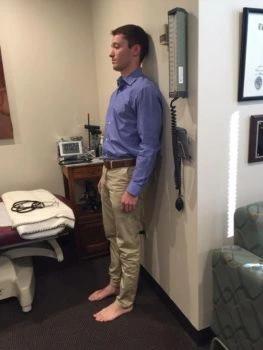 | 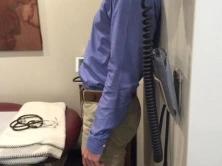 | 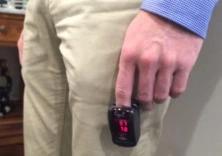 |
| Photo A: Stand barefoot with heels ~6 inches (15 cm) in front of the wall and legs relaxed. | Photo B: Rest only your shoulder blades against the wall. Keep your lower back and butt off the wall. | Photo C: Let both arms hang loosely at your sides while your helper logs vitals every 1 minute. |
Photographs courtesy of the Bateman Horne Center (NASA 10-Minute Lean Test Instructions).
The 5 Steps from Start to Finish
- Step 1 - Lie flat and still for 5 to 10 minutes: Put the blood pressure cuff on your upper arm, take off your shoes and socks, and lie flat on your back on a bed or couch with a thin pillow under your head. Rest in silence for 5 to 10 minutes without talking, crossing your legs, or looking at your phone. That lets your heart rate settle to a resting baseline.
- Step 2 - Take two flat baseline readings (
Supine 1 minandSupine 2 min): While you are still lying flat, have your helper press the cuff button and write down your blood pressure and pulse asSupine 1 min. Wait 1 full minute, then check again and write it down asSupine 2 min. Average those two numbers for your resting baseline. (If one reading was thrown off by a cough or movement, wait 1 more minute and take a third flat reading.) - Step 3 - Stand up smoothly, set your heels 6 inches out, and lean (
Standing 0 min): Walk a step or two to the wall, place your bare heels about 6 inches (15 cm) in front of the wall, and lean back so only your shoulder blades touch the wall (keep a clear gap behind your lower back and butt). Let both arms hang loosely at your sides. As soon as your shoulder blades touch the wall, start the 10-minute timer and have your helper take your first upright reading right away (Standing 0 min). - Step 4 - Check blood pressure, pulse, and symptoms every 1 minute (
Standing 1 mintoStanding 10 min): Stay in that wall lean for 10 minutes. At the start of every minute (1, 2, 3, 4, 5, 6, 7, 8, 9, and 10), have your helper press the cuff button and write down your blood pressure and heart rate. Have them note any symptoms you feel or signs they see (dizziness, dark or blurry vision, hot flash, sweating, extra saliva, tingling or purple feet, shaky knees, pounding heart, chest tightness, brain fog, or nausea). Do not chat between readings, and resist shifting your weight or wiggling your toes. - Step 5 - Stop and lie flat right away if you feel close to fainting: If your vision starts going black, your knees start to buckle, or you feel like you might pass out, tell your helper, stop the test right away, and lie flat on the floor or bed with your legs propped up. Have your helper take one final reading if safe and note the minute you stopped (
"Stopped at Minute 6 due to vision blacking out"). Stopping early because of near-fainting is an important finding. Do not try to push through a blackout to reach Minute 10.
How do you record your 10-minute NASA Lean Test results?
Use a 12-row log sheet with two flat baseline rows (Supine 1 min and Supine 2 min) followed by 11 upright rows (Standing 0 min through Standing 10 min), recording blood pressure, pulse, and symptoms on every line.
You can copy the blank table below into a notebook or notes app before you start, and compare it against the positive POTS example right underneath it.
Blank 10-Minute NASA Lean Test Recording Sheet
Fishtown Medicine
A 90-minute conversation with Dr. Ash. A written plan you can follow.
| Timepoint | Blood Pressure (Sys / Dia mmHg) | Heart Rate (bpm) | Symptoms & Visible Signs (e.g., dizzy, vision dark, sweaty, purple feet, shaky knees, nausea) |
|---|---|---|---|
| Supine 1 min (after 5-10 min flat) | ___ / ___ | ___ bpm | |
| Supine 2 min (1 min later, flat) | ___ / ___ | ___ bpm | Resting flat average HR = ___ bpm |
| Standing 0 min (right as shoulder blades touch wall, heels 6" out) | ___ / ___ | ___ bpm | |
| Standing 1 min | ___ / ___ | ___ bpm | |
| Standing 2 min | ___ / ___ | ___ bpm | |
| Standing 3 min | ___ / ___ | ___ bpm | |
| Standing 4 min | ___ / ___ | ___ bpm | |
| Standing 5 min | ___ / ___ | ___ bpm | |
| Standing 6 min | ___ / ___ | ___ bpm | |
| Standing 7 min | ___ / ___ | ___ bpm | |
| Standing 8 min | ___ / ___ | ___ bpm | |
| Standing 9 min | ___ / ___ | ___ bpm | |
| Standing 10 min | ___ / ___ | ___ bpm |
Sample Positive POTS & Venous Pooling Log
A positive home NASA Lean Test in a patient with POTS and lower-body blood pooling shows a clear jump in pulse and a narrowed blood pressure gap:
| Timepoint | Blood Pressure (mmHg) | Pulse Gap (Pulse Pressure) | Heart Rate (bpm) | Change From Flat Baseline (~79 bpm) | Symptoms Logged by Patient |
|---|---|---|---|---|---|
| Supine 1 min | 110 / 75 | 35 mmHg (32%) | 77 bpm | Baseline | Resting flat |
| Supine 2 min | 111 / 76 | 35 mmHg (32%) | 80 bpm | Baseline (~79 bpm avg) | Resting flat |
| Standing 0 min | 110 / 86 | 24 mmHg (22%) | 133 bpm | +54 bpm | Lightheaded right on standing |
| Standing 1 min | 114 / 87 | 27 mmHg (24%) | 126 bpm | +47 bpm | Hot flash |
| Standing 2 min | 105 / 93 | 12 mmHg (11% - narrow) | 135 bpm | +56 bpm | Vision going black (squeezed pulse gap) |
| Standing 3 min | 114 / 74 | 40 mmHg (35%) | 141 bpm | +62 bpm | Sweaty |
| Standing 4 min | 113 / 78 | 35 mmHg (31%) | 138 bpm | +59 bpm | Sustained fast pulse |
| Standing 5 min | 111 / 89 | 22 mmHg (20%) | 140 bpm | +61 bpm | Dizzy, extra saliva in mouth |
| Standing 6 min | 115 / 81 | 34 mmHg (30%) | 148 bpm | +69 bpm | Leg tingling |
| Standing 7 min | 113 / 80 | 33 mmHg (29%) | 141 bpm | +62 bpm | Wobbly knees |
| Standing 8 min | 104 / 81 | 23 mmHg (22%) | 148 bpm | +69 bpm | Heart pounding in chest |
| Standing 9 min | 111 / 84 | 27 mmHg (24%) | 144 bpm | +65 bpm | Sustained fast pulse |
| Standing 10 min | 108 / 80 | 28 mmHg (26%) | 138 bpm | +59 bpm | Feeling sick / nauseated |
Three findings in that log stand out right away:
- Immediate and sustained 50 to 70 bpm pulse surge: Resting pulse was 77 to 80 bpm lying flat, jumped to 133 bpm within seconds of leaning, and stayed between 126 and 148 bpm for all 10 minutes (far above the >= 30 bpm POTS cutoff).
- Top blood pressure held steady (
104 to 115 mmHg), ruling out orthostatic hypotension: Because the top number never dropped by 20 points, a clinician looking only at top blood pressure might miss the problem. - Narrowed pulse pressure at Minute 2 (
105/93 mmHg, only a 12-point gap): When blood pools in the legs and belly, less blood returns to the heart on each beat, so the top number softens while the body squeezes lower arteries hard, pushing the bottom number up (75 -> 93 mmHg). That squeezed 12 mmHg gap right when the patient's vision went black shows lower-body blood pooling.
What do your NASA Lean Test numbers mean?
Your 10-minute log separates six distinct patterns: a normal response (pulse rise under 30 bpm), POTS (sustained 30+ bpm pulse rise without a BP drop), narrowed pulse pressure (top-to-bottom BP gap under 25% of systolic from low heart filling), hyperadrenergic BP surges, classic orthostatic hypotension (BP drop within 3 minutes), and delayed orthostatic or neurally mediated hypotension (BP drop between minutes 4 and 10).
| Pattern | Heart Rate Change (vs. Flat Baseline) | Blood Pressure & Pulse Gap (Sys - Dia) | What Is Happening in the Body | Sources |
|---|---|---|---|---|
| 1. Normal Upright Response | Rises ~5 to 15 bpm (average 6.2 ± 6.9 bpm); stays < 30 bpm | Top and bottom BP hold steady; pulse gap stays 25% to 40% of top number (e.g., 116/74 = 42 mmHg gap) | Leg and belly vessels squeeze smoothly against gravity; heart output stays steady. | Iftekhar 2025 |
| 2. POTS (Postural Orthostatic Tachycardia Syndrome) | Sustained rise >= 30 bpm in adults (>= 40 bpm ages 12-19) on >= 2 readings (or standing HR >= 120 bpm) | No BP drop (< 20/10 mmHg fall); bottom BP often climbs | Low blood volume or stretchy lower-body veins let 500 to 800 mL of blood pool below the waist; the heart beats faster to keep blood reaching the brain. | HRS 2015; CCS 2020; Chung & Raj JAMA 2026 |
| 3. Narrowed Pulse Pressure (Preload Failure / Low Stroke Volume) | Often paired with POTS (+30 bpm) or moderate tachycardia | Gap between top and bottom BP (Sys - Dia) falls below 25% of systolic (or < 20-25 mmHg, e.g., 105/93 = 12 mmHg gap) | Less blood returns to fill the heart between beats (preload failure) while arteries squeeze to raise bottom BP; strongly linked to brain fog and dark vision in ME/CFS and Long COVID. | Lee & Vernon J Transl Med 2020 |
| 4. Hyperadrenergic Surge / Orthostatic Hypertension | Often rises >= 30 bpm alongside shaky adrenaline symptoms | Top BP rises >= 10 to 20 mmHg or bottom BP climbs >= 10 mmHg (often reaching >= 140/90 mmHg upright) | Sympathetic nerves release extra norepinephrine on standing, driving blood pressure, heart pounding, sweating, and tremor up; common with MCAS overlap. | Sheldon HRS 2015; Taub JACC 2021 |
| 5. Classic Orthostatic Hypotension (Classic OH) | Pulse may rise modestly or stay flat if autonomic nerves are blunted | Top BP drops >= 20 mmHg OR bottom BP drops >= 10 mmHg within the first 3 minutes of standing | Blood vessels fail to tighten fast enough on standing, causing an early blood pressure drop and lightheadedness. | Freeman 2011 |
| 6. Delayed OH or Neurally Mediated Hypotension (NMH) | Pulse often climbs first, then slows or drops right as blood pressure falls | BP holds steady for 3 minutes, then drops >= 20 mmHg systolic or >= 10 mmHg diastolic between minutes 4 and 10 | Prolonged venous pooling triggers a late vagal reflex (vasovagal / NMH) with sudden nausea, heat wave, sweating, and near-fainting. | Rowe 1995; Lee & Vernon 2020 |
In the Bateman Horne Center's study of 150 ME/CFS patients and 75 healthy controls using the 10-minute NASA Lean Test (Lee & Vernon et al., J Transl Med 2020), at least 5 minutes of quiet leaning were required to catch the drop in pulse pressure and circulation. A 1-minute or 3-minute clinic stand check misses many cases.
How does the NASA Lean Test compare to an active stand test and a hospital tilt-table test?
The 10-minute NASA Lean Test gives you the passive leg relaxation of a tilt-table study with far fewer false alarms (0% false-positive POTS in healthy adults vs. up to 77% false-positive rates on 70-degree tilt tables) and zero hospital facility fees.
| Feature | 10-Minute NASA Lean Test | 10-Minute Free-Standing Active Stand Test | Hospital Head-Up Tilt Table Test (70 Degrees) |
|---|---|---|---|
| How You Are Positioned | Barefoot, heels 6" from wall, only shoulder blades touching wall | Standing unsupported in the middle of the room | Strapped to a motorized table tilted to 70 degrees for 10-45 minutes |
| Calf-Muscle Pump | Turned off by passive wall lean | Active (swaying or leg tensing can mask pooling) | Turned off by table straps and footboard |
| False-Positive Rate in Healthy Adults | 0% (average rise 6.2 ± 6.9 bpm in Iftekhar 2025) | ~21% (79% specificity in Bryarly JACC 2019) | Up to 77% (23% specificity in Bryarly JACC 2019) |
| Where It Is Done | Primary care office or at home with a helper | Primary care office or at home | Hospital autonomic or cardiology lab (often a 3-to-12-month wait) |
| When You Need It | First-line test for suspected POTS, ME/CFS, Long COVID, and treatment tracking | First-line alternative when a clear wall space is not used | Reserved for unexplained fainting (syncope), borderline lean tests, or when paired with sweat-nerve testing (QSART) |
When your 10-minute NASA Lean Test already shows a sustained 30+ bpm heart-rate jump (such as 79 bpm flat -> 133 to 148 bpm leaning) with classic upright symptoms, you do not need a hospital tilt-table test to prove you have POTS. We save hospital autonomic lab referrals (at Penn or Jefferson) for patients whose lean tests are borderline or who need small-fiber sweat testing (QSART).
What should you do after a positive NASA Lean Test?
After a positive NASA Lean Test, share your 12-row log with your doctor to rule out reversible mimics (low ferritin, thyroid, cortisol, B12, and resting EKG) and start the 4-part POTS plan: morning water and 2.5 to 3+ liters of fluid, 8 to 12 grams of salt (NaCl), 30 to 40 mmHg waist-high or belly compression, and recumbent exercise.
A positive lean test is the starting line for a targeted recovery plan:
- Send your complete 12-row log (
Supine 1-2andStanding 0-10) to your doctor: Having the minute-by-minute numbers on paper gives you objective proof in your medical chart, which also supports work accommodations or disability paperwork when needed. - Check the blood panel and resting EKG that rule out mimics: Before blaming everything on autonomic nerves, we check serum ferritin (repleting to >= 50 ng/mL, since half of young POTS patients have ferritin <= 25 ng/mL, Jarjour 2013), CBC, CMP, TSH and free T4, morning cortisol, vitamin B12, vitamin D, and a 12-lead ECG (racing heart when standing workup).
- Fill the blood-volume tank first (water + sodium): When resting blood pressure is normal, a 500 mL (16 oz) morning water bolus before getting out of bed lowers standing heart rate by 15 bpm (Shannon 2002). Taking 8 to 12 grams of salt (NaCl) daily (~4 to 6 g sodium) with 2.5 to 3+ liters of fluid restores blood volume and lowers standing heart rate by 10 bpm (Garland JACC 2021). On crash days or when table salt upsets your stomach, 1 packet of unflavored TriOral WHO Oral Rehydration Salts mixed into 1 liter of water delivers 1,695 mg sodium via the gut's SGLT1 pump without MCAS-triggering dyes or citric acid (see our hydration and electrolytes guide).
- Cover the abdomen and thighs with compression: Because 2 to 3 times more blood pools in the belly and pelvis than in the calves, waist-high compression tights (30 to 40 mmHg) or an abdominal binder cut the standing heart-rate jump by 17 bpm and halve upright symptoms (Bourne JACC 2021).
- Layer horizontal movement and matched medication when needed: Recumbent-first exercise (rowing, swimming, recumbent cycling - paced gently at 5 to 10 minutes if you have ME/CFS post-exertional crashes) puts 53% to 71% of POTS patients into remission at 3 months (Fu 2010, George 2016). When medications are needed, we match low-dose propranolol (10-20 mg), ivabradine (2.5-7.5 mg BID, -18.5 bpm without beta-blocker fatigue), midodrine, fludrocortisone, or pyridostigmine to your standing vitals (POTS treatment guide).
Key Takeaways
- Positioning makes the test work: Take off shoes, socks, and compression tights, place your heels 6 inches (15 cm) in front of a wall, and rest only your shoulder blades on the wall (keep your lower back and butt off the wall) so your calf muscles stay turned off (Bateman Horne Center PDF).
- Log 2 flat baselines + 11 standing minutes: Lie flat and still for 5 to 10 minutes (`Supine 1 min` and `Supine 2 min`), then have a helper record upper-arm blood pressure, pulse, and symptoms at `Standing 0 min` and every minute through `Standing 10 min`.
- POTS vs. healthy adults: In 112 healthy adults (Iftekhar 2025), sustained heart rate rose only 6.2 ± 6.9 bpm (0% false POTS). A sustained rise of 30+ bpm in adults (40+ bpm ages 12 to 19) without a 20/10 mmHg BP drop confirms POTS when upright symptoms have lasted 3+ months.
- Watch the gap between top and bottom BP: A pulse pressure (`Sys - Dia`) shrinking below 25% of systolic (such as `105/93 mmHg` = 12 mmHg gap) proves blood is pooling in your lower body even when top BP looks normal.
- Safety comes first: Always test with a spotter standing within arm's reach, and stop and lie flat right away if your vision starts going dark or you feel close to fainting.
Related at Fishtown Medicine
- Dizziness and a Racing Heart When Standing (POTS Case Walkthrough) - how a 10-minute stand test, mimic labs, and the 4-part POTS foundation work together
- POTS Treatment in Philadelphia - our 90-minute diagnostic visit, volume and compression math, and matched medications
- The POTS & Dysautonomia Playbook - deep clinical roadmap across hypovolemic, neuropathic, and hyperadrenergic POTS
- ME/CFS Pacing and the Energy Envelope - how orthostatic intolerance and post-exertional crashes interact
- Hydration and Electrolytes Guide - sodium math, WHO Oral Rehydration Salts (TriOral), and daily fluid targets
- Getting Answers from a Heart Monitor (Zio Patch) - when we pair standing vitals with continuous rhythm monitoring
Scientific References
- Bateman Horne Center. 10-Minute NASA Lean Test: Instructions for Providers and Patients. Salt Lake City, UT: Bateman Horne Center. PDF Instructions
- Lee J, Vernon SD, Jeys P, et al. Hemodynamics during the 10-minute NASA lean test: evidence of circulatory decompensation in a subset of ME/CFS patients. J Transl Med. 2020;18(1):314. PubMed
- Iftekhar N, Wilson A, Nguty L, et al. Normative Data for the 10-Min Lean Test in Adults Without Orthostatic Intolerance. Front Neurol. 2025. PubMed
- Bungo MW, Charles JB, Johnson PC Jr. Cardiovascular deconditioning during space flight and the use of saline as a countermeasure to orthostatic intolerance. Aviat Space Environ Med. 1985;56(10):985-990. PubMed
- Chung TH, Raj SR. Postural Orthostatic Tachycardia Syndrome (POTS): A Review. JAMA. 2026. JAMA
- Sheldon RS, Grubb BP, Olshansky B, et al. 2015 Heart Rhythm Society Expert Consensus Statement on the Diagnosis and Treatment of Postural Tachycardia Syndrome, Inappropriate Sinus Tachycardia, and Vasovagal Syncope. Heart Rhythm. 2015;12(6):e41-e63. PMC
- Raj SR, Guzman JC, Harvey P, et al. Canadian Cardiovascular Society Position Statement on Postural Orthostatic Tachycardia Syndrome (POTS) and Related Disorders of Chronic Orthostatic Intolerance. Can J Cardiol. 2020;36(3):357-372. PubMed
- Bryarly M, Phillips LT, Fu Q, Vernino S, Levine BD. Postural Orthostatic Tachycardia Syndrome: JACC Focus Seminar. J Am Coll Cardiol. 2019;73(10):1207-1228. PubMed
- Garland EM, Gamboa A, Nwazue VC, et al. Effect of High Dietary Sodium Intake in Patients With Postural Tachycardia Syndrome. J Am Coll Cardiol. 2021;77(17):2174-2184. PubMed
- Bourne KM, Sheldon RS, Hall J, et al. Compression Garment Reduces Orthostatic Tachycardia and Symptoms in Patients With Postural Orthostatic Tachycardia Syndrome. J Am Coll Cardiol. 2021;77(3):285-296. PubMed
- Natelson BH, Lin JM, Blate M, Khan S, Chen Y, Unger ER. Physiological assessment of orthostatic intolerance in chronic fatigue syndrome. J Transl Med. 2022;20(1):95. PubMed
- van Campen CLMC, Verheugt FWA, Rowe PC, Visser FC. Cerebral blood flow is reduced in ME/CFS during head-up tilt testing even in the absence of hypotension or tachycardia: A quantitative, controlled study using Doppler echography. Clin Neurophysiol Pract. 2020;5:50-58. PubMed
- Rowe PC, Bou-Holaigah I, Kan JS, Calkins H. Is neurally mediated hypotension an unrecognised cause of chronic fatigue? Lancet. 1995;345(8950):623-624. PubMed

Frequently Asked Questions
Common Questions
Deep-Dive Questions
Ready when you are
The chat is our AI assistant, answering from our published guides. To talk it through with Dr. Ash himself, start with the intake.