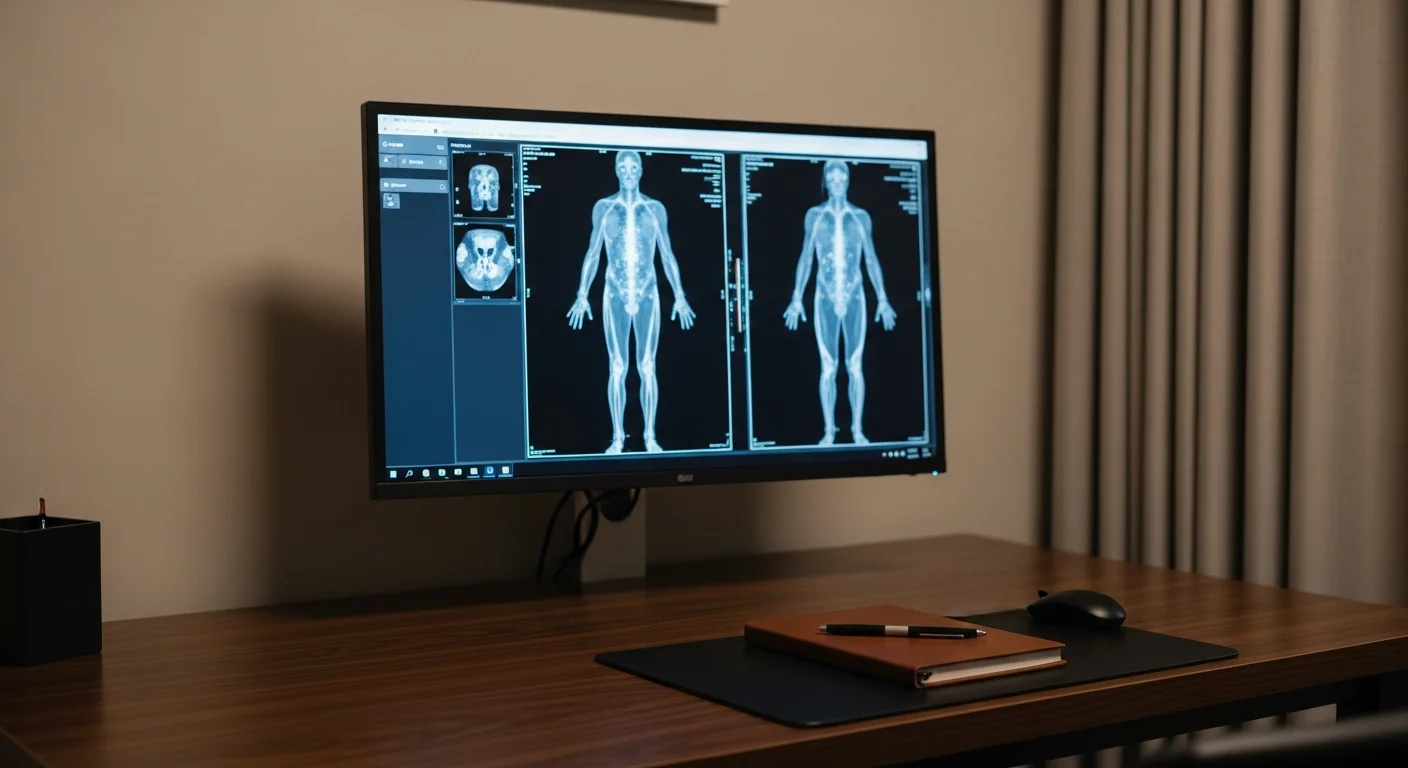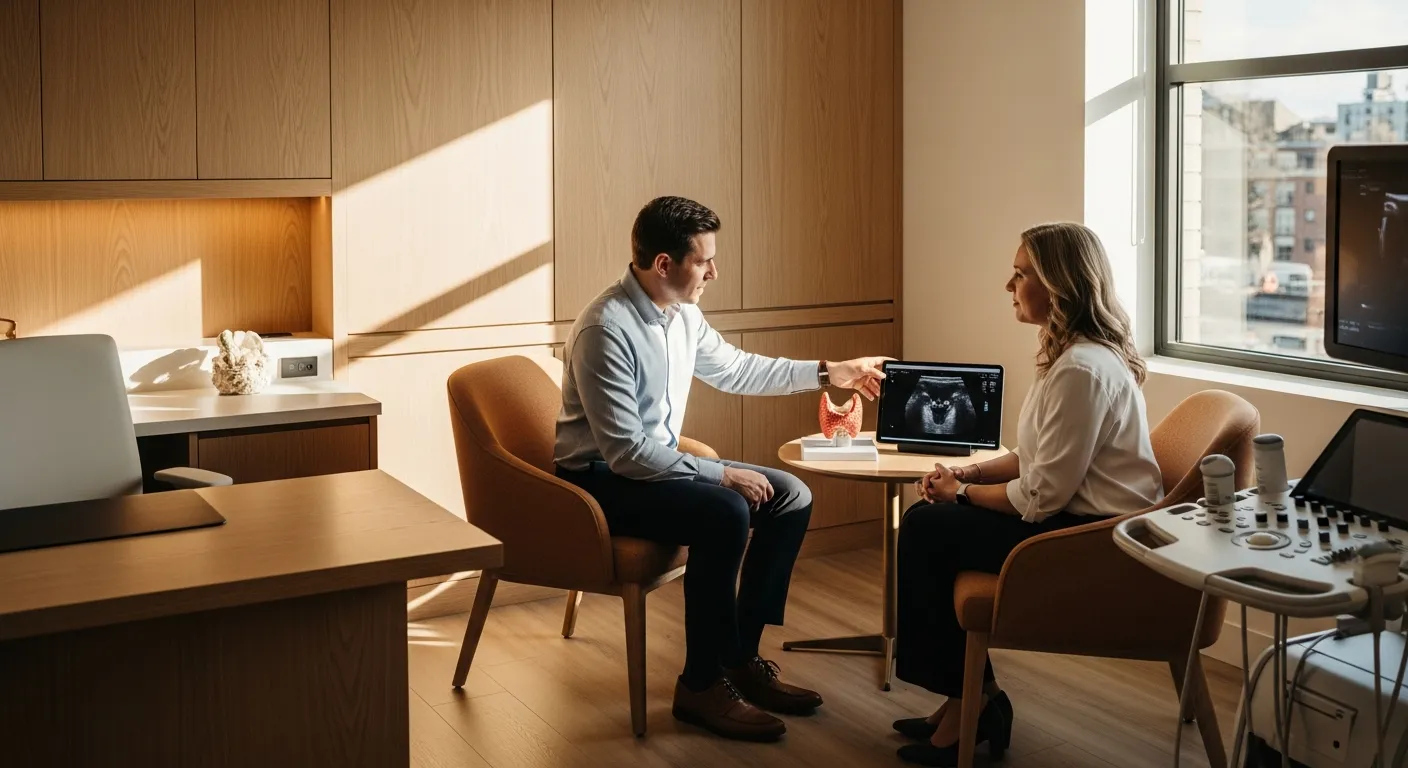

A thyroid nodule found by chance on a scan is usually nothing to fear. High- resolution ultrasound finds nodules in a large share of healthy adults, and around 90 percent are benign. Thyroid cancer diagnoses in the United States have roughly tripled since the 1970s, mostly small papillary cancers picked up by imaging, while the death rate has stayed low and nearly flat, the signature of overdiagnosis rather than a true epidemic. Autopsy studies show a large reservoir of tiny thyroid cancers in people who died of other causes, which means finding one does not mean it would ever have harmed you. So the US Preventive Services Task Force recommends against screening the thyroid in people without symptoms. When a nodule is found, the sound workup is a TSH, a dedicated ultrasound with risk scoring, and a needle biopsy only when the pattern and size cross a threshold; many small nodules are simply watched, and even many small cancers can be monitored rather than removed. The exceptions that do need prompt attention are a rapidly growing or hard fixed lump, a hoarse voice, enlarged neck nodes, or trouble swallowing.
TL;DR: A thyroid nodule found by chance, often on a full-body MRI, a carotid ultrasound, or an executive-physical scan, sets off more fear than the facts justify. High-resolution ultrasound turns up thyroid nodules in a large fraction of perfectly healthy adults, and roughly 90 percent are benign. The bigger picture is one of the clearest cases of overdiagnosis in medicine: thyroid cancer diagnoses in the United States have about tripled since the 1970s, driven mostly by small papillary cancers that imaging can now see, while the death rate has barely moved. South Korea ran the natural experiment, adding thyroid ultrasound to routine screening and watching diagnoses climb roughly fifteenfold with no change in deaths. Autopsy studies explain why: a large reservoir of tiny thyroid cancers lies silently in people who die of other causes, so finding one does not mean it would ever have threatened you. That is why the US Preventive Services Task Force recommends against thyroid screening in people without symptoms. When a nodule does turn up, the responsible path is a blood test for TSH, a dedicated ultrasound that scores the nodule's risk, and a needle biopsy only when the pattern and the size together warrant it, with many small nodules simply watched, and even many small cancers now safely monitored rather than removed. The boundary is that this calm applies to incidental, low-suspicion nodules: a fast-growing or hard fixed lump, a hoarse voice, enlarged neck nodes, or trouble swallowing is a different situation that needs prompt care.
How common are thyroid nodules, and how often are they cancer?
Thyroid nodules are extremely common, and modern imaging is why. When researchers scan the necks of ordinary adults with high-resolution ultrasound, they find nodules in a large share of them, in one careful study 68 percent of people scanned with a high-frequency probe, with the number climbing steadily with age.11 Most of these people feel nothing and have no thyroid problem; the nodule is simply there, the way gray hairs are there.
The number that should calm the initial panic is the malignancy rate. Of the nodules that come to medical attention, only about 7 to 15 percent turn out to be cancer, so the large majority are benign.1 The odds are even more reassuring for the incidental kind, the nodule spotted in passing on a CT, an MRI, or a carotid ultrasound done for another reason. Those scans cannot judge a nodule's character, so the right response to one is a dedicated thyroid ultrasound rather than a reflexive biopsy. There is one exception to keep in mind: a nodule that lights up in a single focused spot on a PET scan carries a higher risk, around a third, and does warrant a closer look. But the everyday incidental nodule, found while looking for something else, is far more likely to be harmless than not.
Why has thyroid cancer tripled if it barely kills anyone?
This is the heart of the story, and it reframes what a nodule means. Over the past several decades, the number of thyroid cancers diagnosed in the United States has roughly tripled, yet the number of people dying from thyroid cancer has stayed low and close to flat.2 When diagnoses soar and deaths do not follow, the most likely explanation is not a new epidemic of disease but an epidemic of diagnosis: better imaging finding more small, harmless cancers that would never have caused trouble. The cancers driving the rise are overwhelmingly small papillary tumors, the least aggressive kind.
South Korea made the pattern impossible to miss. When thyroid ultrasound was added to the country's routine cancer screening, thyroid cancer diagnoses rose roughly fifteenfold over about two decades, while the death rate held steady.3 A worldwide analysis estimated that more than half a million people, around 470,000 women and 90,000 men, across a dozen high-income countries were overdiagnosed with thyroid cancer, meaning they were told they had a cancer that was never going to hurt them.4 One qualifier keeps this from tipping into false comfort: the overdiagnosis is not total. Careful tracking has found a small rise in deaths from advanced papillary cancer, so a small, dangerous minority does exist.5 The takeaway is not that thyroid cancer never matters, but that the vast growth in diagnoses is mostly the detection of harmless disease, which is why a small nodule on a scan is a reason for a measured workup rather than alarm.
Why are most small thyroid cancers not dangerous?
The reason so many small thyroid cancers turn out to be harmless is that the body carries a large hidden supply of them. When pathologists examine the thyroids of people who died of unrelated causes and slice them thinly enough, they find tiny papillary cancers in a striking fraction, in one classic study more than a third,10 though most of those were smaller than a millimeter and pooled estimates across many studies land closer to one in ten.12 The lesson is the same either way: a great many people walk around their whole lives with a microscopic thyroid cancer that never grows, never spreads, and never announces itself.
That hidden reservoir is why finding one does not mean it was going to harm you. It also fits the survival numbers, which are among the best in all of oncology: for thyroid cancer that is still confined to the thyroid, the five-year survival is around 99 to 100 percent. A cancer that is common in the graveyard of people who died of something else, and that almost never kills when found, is a different kind of problem from the aggressive cancers screening is meant to catch. Holding that in mind changes how heavily a small papillary cancer should weigh on a decision.
Should I get my thyroid screened?
Given all of this, the guidance on screening is clear and perhaps surprising: do not do it. The US Preventive Services Task Force recommends against screening for thyroid cancer in adults who have no symptoms, giving it a grade D, its designation for a service where the harms outweigh the benefits.6 No major medical society endorses population thyroid screening either. The reasoning follows directly from the overdiagnosis story: a screening neck ultrasound in a well person mostly finds harmless nodules and indolent cancers, sends people down the path of biopsies and surgery, and has never been shown to lower the death rate.
This is worth stating plainly because it runs against the prevention-minded instinct to check everything. With the thyroid, more looking produces more diagnosis without more lives saved, and the diagnoses carry their own harms. The sound position for someone without symptoms is to leave the thyroid alone rather than go hunting, and to reserve the workup for a nodule that turns up on its own or for symptoms that call for a look.
What happens when a nodule is found?
A found nodule does not mean a biopsy, let alone surgery. The workup is a stepwise sort that most nodules pass through without ever needing a needle. The first step is a blood test for TSH, the pituitary hormone that drives the thyroid. If it is low, the nodule may be overactive, a so-called hot nodule, and hot nodules are almost never cancer; they are worked up for an overactive thyroid instead of for malignancy.
If the TSH is normal, the next step is a dedicated diagnostic ultrasound that scores the nodule's features. Radiologists use systems like TI-RADS and the American Thyroid Association patterns to rate suspicion based on things like whether the nodule is dense and dark, has tiny calcifications, is taller than it is wide, or has ragged edges.7 That risk score, combined with the nodule's size, decides whether a fine-needle biopsy is warranted, and the thresholds are deliberately set so that many small and low-suspicion nodules are watched rather than sampled. When a biopsy is done, the result is graded on a standard scale, and a slice of results come back indeterminate, neither clearly benign nor clearly cancer. For those, molecular tests that read the nodule's genes can often rule cancer out and spare a person a diagnostic surgery, though it helps to understand their role: they are best at safely saying no, and a worrisome molecular result is a reason for more evaluation rather than a cancer diagnosis on its own.
What is active surveillance, and can cancer really be watched?
One of the biggest changes in thyroid care is that a proven small cancer no longer automatically means an operation. For low-risk papillary cancers about a centimeter or smaller, without worrisome features or involved lymph nodes, careful monitoring, called active surveillance, has become an accepted alternative to immediate surgery. The idea is to watch the tumor with periodic ultrasound and to operate only in the minority that show true growth, keeping surgery in reserve rather than doing it reflexively.
Fishtown Medicine
A 90-minute conversation with Dr. Ash. A written plan you can follow.
The evidence behind this is now substantial. In the Japanese program that pioneered it, patients whose small papillary cancers were watched had, at ten years, tumor growth of a few millimeters in only about 8 percent, new spread to lymph nodes in under 4 percent, no distant spread, and no deaths, and those whose tumors did grow were still cured by delayed surgery.8 A large American program reported the same reassuring pattern, with growth uncommon and no cancer spreading during surveillance.9 Active surveillance is not ignoring cancer; it is structured monitoring with curative treatment on standby, chosen because for these tumors the watching is as safe as the cutting and avoids the costs of surgery.
What are the harms of treating a nodule that never needed it?
The case for restraint rests on the fact that treatment is not free. Removing the thyroid is a major operation with meaningful risks. It commits a person to taking thyroid hormone every day for life. It can injure the tiny parathyroid glands that control calcium, sometimes permanently, and it can damage the nerve to the voice box, causing a hoarse or weakened voice, in a small but meaningful share of cases. Follow-on radioactive iodine, often unnecessary for low-risk disease, carries its own downsides, including dry mouth and salivary problems. When the cancer being treated was one that would never have caused harm, these are pure costs with no benefit.
There is also a quieter harm that the numbers do not capture. Turning a healthy person into a lifelong cancer patient carries a weight of anxiety, follow-up, and effects on insurance and peace of mind that lasts for years. This is the core of the overdiagnosis argument: when a diagnosis leads to treatment that cannot help because the disease was never going to progress, the whole cascade can leave a person worse off than never knowing. That is the reason the field has moved toward watching, and toward not looking in the first place.
When is a thyroid nodule worth worrying about?
None of this means shrugging off the thyroid, and the reverse mistake is as serious as the overdiagnosis one. The calm story applies to incidental, small, low-suspicion nodules in people without symptoms. A different set of signs calls for prompt attention, and they are the ones to learn.
See someone quickly for a nodule or neck mass that is growing fast, that feels hard and fixed in place rather than soft and mobile, or that comes with a hoarse voice or a change in the voice that does not pass. Enlarged, firm lymph nodes in the neck, trouble swallowing or breathing, or a sense of pressure in the throat all raise the priority. So does a nodule that lights up focally on a PET scan, a history of radiation to the neck in childhood, or a family history of medullary thyroid cancer or the MEN2 syndrome. Aggressive thyroid cancers, including medullary and anaplastic types, are dangerous and are not part of the harmless reservoir, so these features deserve a dedicated ultrasound, the right biopsy, and specialist referral without delay. The goal is not to fear every nodule or to dismiss every nodule, but to match the response to the risk.
Guidance from the Clinic

Key Takeaways
- Thyroid nodules are very common, appearing on high-resolution ultrasound in a large share of healthy adults, and roughly 90 percent are benign.
- Thyroid cancer diagnoses have about tripled in the United States while deaths stayed low and flat, and South Korea's screening boom raised diagnoses roughly fifteenfold with no mortality change, the signature of overdiagnosis, though a small true rise in advanced disease means it is not wholly so.
- A large reservoir of tiny thyroid cancers exists in people who die of other causes, and localized thyroid cancer has around 99 to 100 percent five-year survival, so finding a small one does not mean it would ever have harmed you.
- The US Preventive Services Task Force recommends against thyroid screening in people without symptoms; when a nodule is found, the workup is a TSH, a dedicated ultrasound with risk scoring, and a biopsy only when pattern and size warrant, with many small nodules simply watched and many small cancers safely monitored rather than removed.
- The reverse error is as serious as the overdiagnosis one: a fast-growing or hard fixed lump, a hoarse voice, enlarged neck nodes, trouble swallowing, focal PET uptake, childhood neck radiation, or a medullary cancer family history all call for prompt evaluation, because aggressive thyroid cancers are not part of the harmless reservoir.
Related at Fishtown Medicine
- Boutique Scans and Whole-Body MRI: A Clinical Review - where incidental thyroid nodules most often come from, and how to think about incidental findings
- Full-Body MRI Screening - what whole-body imaging finds, including the incidentalomas
- Skin Cancer and Melanoma Screening - the same overdiagnosis logic for another common cancer
- PSA and Prostate Cancer Screening - a third screen where overdiagnosis is the central question
- Neck Lump That Comes and Goes - when a lump in the neck is worth worrying about
- The Metabolic Thermostat: Thyroid Optimization - how we read thyroid function, which a nodule scan does not measure
- A Mouthwash Invented a Disease - how a finding becomes a condition people go looking for
Scientific References
- Haugen BR, Alexander EK, Bible KC, et al. "2015 American Thyroid Association Management Guidelines for Adult Patients with Thyroid Nodules and Differentiated Thyroid Cancer." Thyroid. 2016;26(1):1-133.
- Davies L, Welch HG. "Current Thyroid Cancer Trends in the United States." JAMA Otolaryngology-Head & Neck Surgery. 2014;140(4):317-322.
- Ahn HS, Kim HJ, Welch HG. "Korea's Thyroid-Cancer 'Epidemic' - Screening and Overdiagnosis." New England Journal of Medicine. 2014;371(19):1765-1767.
- Vaccarella S, Franceschi S, Bray F, et al. "Worldwide Thyroid-Cancer Epidemic? The Increasing Impact of Overdiagnosis." New England Journal of Medicine. 2016;375(7):614-617.
- Lim H, Devesa SS, Sosa JA, et al. "Trends in Thyroid Cancer Incidence and Mortality in the United States, 1974-2013." JAMA. 2017;317(13):1338-1348.
- US Preventive Services Task Force. "Screening for Thyroid Cancer: US Preventive Services Task Force Recommendation Statement." JAMA. 2017;317(18):1882-1887.
- Tessler FN, Middleton WD, Grant EG, et al. "ACR Thyroid Imaging, Reporting and Data System (TI-RADS): White Paper of the ACR TI-RADS Committee." Journal of the American College of Radiology. 2017;14(5):587-595.
- Ito Y, Miyauchi A, Kihara M, et al. "Patient Age Is Significantly Related to the Progression of Papillary Microcarcinoma of the Thyroid Under Observation." Thyroid. 2014;24(1):27-34.
- Tuttle RM, Fagin JA, Minkowitz G, et al. "Natural History and Tumor Volume Kinetics of Papillary Thyroid Cancers During Active Surveillance." JAMA Otolaryngology-Head & Neck Surgery. 2017;143(10):1015-1020.
- Harach HR, Franssila KO, Wasenius VM. "Occult Papillary Carcinoma of the Thyroid. A 'Normal' Finding in Finland. A Systematic Autopsy Study." Cancer. 1985;56(3):531-538.
- Guth S, Theune U, Aberle J, et al. "Very High Prevalence of Thyroid Nodules Detected by High Frequency (13 MHz) Ultrasound Examination." European Journal of Clinical Investigation. 2009;39(8):699-706.
- Furuya-Kanamori L, Bell KJL, Clark J, et al. "Prevalence of Differentiated Thyroid Cancer in Autopsy Studies Over Six Decades: A Meta-Analysis." Journal of Clinical Oncology. 2016;34(30):3672-3679.

Frequently Asked Questions
Common Questions
Deep-Dive Questions
Ready when you are
The chat is our AI assistant, answering from our published guides. To talk it through with Dr. Ash himself, start with the intake.