
FishtownFish wrapped around the rod of AsclepiusMedicine
Philadelphia Primary Care
How It Works
What People Say
Patient reviews across 6 platforms
Pricing & Membership
Transparent membership pricing
Articles
Symptoms
What your body is telling you
Treatments
Protocols, prescriptions, therapies
Longevity
Medicine 3.0 strategies
Heart Health & Risk
Protect your heart & vessels
Metabolism
Insulin, blood sugar, weight
Hormones
TRT, thyroid, menopause, andropause
Performance
VO2 max, muscle, sleep, gut
Playbooks
Step-by-step frameworks
Dispensary
Dr. Ash's professional-grade supplement picks
About
Meet Dr. Ash
Your Physician
GER·O·SPAN
Our Clinical Framework
FAQ
Common Questions
Book a Free Call
Fishtown Medicine•7 min read
4.96 (124)

Counterfeit Skincare and Supplements

Ashvin Vijayakumar MD

Medically Reviewed

Ashvin Vijayakumar MD•Updated May 26, 2026
On This Page
  • Why this matters more than for most things you buy
  • How fakes get in: the supply chain
  • The single most protective move: buy from the source
  • On big marketplaces, check who is actually selling
  • When it arrives, inspect it
  • Supplements deserve extra suspicion
  • Guidance from the Clinic
  • Actionable Steps
  • Common Questions
  • Does this mean everything on Amazon or Walmart is fake?
  • Whats actually wrong with buying from a third-party seller to save a few dollars?
  • How can I tell if my skincare is counterfeit after it arrives?
  • Are counterfeit supplements really dangerous, or just a waste of money?
  • Is a "gray market" import the same as a counterfeit?
  • Whats the safest way to buy the products you recommend?
  • Deep Questions
  • Why are cosmetics and supplements such a big counterfeit target?
  • What has actually been found inside fake beauty products and supplements?
  • Does a valid lot code mean the product is real?
  • What is third-party testing, and why does it matter so much for supplements?
  • Why dont brands just warn everyone loudly that fakes exist?
  • Key Takeaways
  • Scientific References

Get a preventive doctor that knows you.

Consult Dr. Ash
TL;DR · 30-second take

Counterfeit and diverted skincare and supplements are common on third-party online marketplaces, and they can be ineffective, oxidized, expired, or genuinely contaminated. The single best protection is to buy from the brand directly or from an authorized first-party retailer, confirm who actually ships and sells the item, and treat a price that looks too good to be true as a warning rather than a win.

Counterfeit Skincare and Supplements: Why the Source Matters as Much as the Product

TL;DR: We spend a lot of time recommending specific products, a serum, a sunscreen, a supplement. The question we dont get asked enough is where to buy them, and that turns out to matter as much as what you buy. Third-party online marketplaces are full of counterfeit, diverted, expired, and tampered skincare and supplements, and unlike a fake phone charger, these go on or in your body. Buy direct from the brand or an authorized first-party retailer, check who actually sells and ships the item, and treat a too-good price as a warning, not a win.
I can pick the perfect serum or the right supplement for you. But if the version that lands on your doorstep is a counterfeit, none of that planning matters, and at worst it does harm. This is the part of the conversation that gets skipped, so lets have it.

Why this matters more than for most things you buy

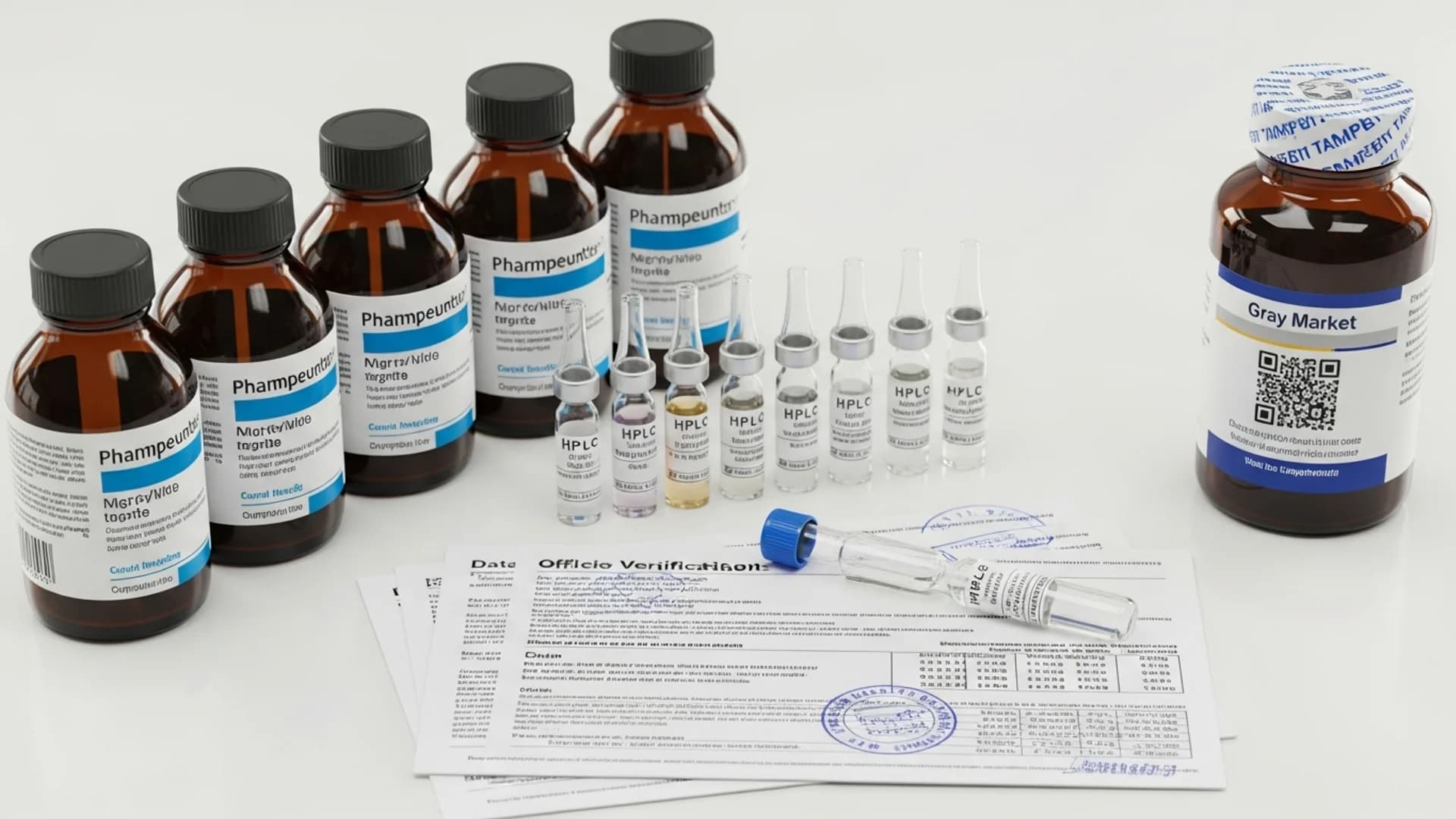
A fake phone case is annoying. A fake serum or supplement is a different category of problem, because it goes on your skin or into your body. Over the years, seized counterfeit cosmetics have been found to contain bacteria, mold, and substances no one should put on their face, and people have ended up in the emergency room with rashes and infections after using what they thought was a trusted brand. Counterfeit supplements have been found spiked with hidden prescription drugs or dosed wildly differently from the label. And the failure mode is not always dramatic. A "real enough" product that has been diverted, stored badly, or left to expire can simply be inert. A vitamin C serum that arrives orange instead of pale yellow has oxidized and lost most of its potency. You paid for an active ingredient and got a dud. So the stakes run from "wasted money" to "genuinely unsafe," which is why this is worth a few minutes of care.

How fakes get in: the supply chain

Understanding how a fake reaches your cart makes the whole problem less mysterious. When you buy through an authorized, first-party channel, the path is short and controlled: the brand makes the product and sends it to a retailer it has approved, who sends it to you. Few hands touch it, and its history is accounted for. A third-party (unauthorized) marketplace path is longer and murkier. Products move through returns, overstock, closeouts, and liquidation warehouses, and they can change hands among several brokers before they are listed for sale. Each of those handoffs is a place where a counterfeit, a diverted item, or an expired one can slip into the stream. By the time it reaches you, no one can really vouch for where it has been. Counterfeiters exploit exactly those gaps, feeding fakes into liquidation lots, broker inventory, and marketplace listings. The more steps between the manufacturer and you, the more room there is for a problem to hide.

The single most protective move: buy from the source

If you remember one thing, remember this: buy from the brand directly, or from an authorized first-party retailer. That means the brands own website, a real pharmacy, or an established beauty retailer that is contracted to sell the brand. Orders from a brands own site are packed and shipped by the brand itself, which is about as safe as it gets. One caution: watch for typo-squatting scam sites that swap a letter or two in the web address. The real site usually matches the brand name exactly, so slow down and read the URL.

On big marketplaces, check who is actually selling

Large marketplaces are confusing because the same brand can be sold there by the platform itself (often fine) and by unknown third parties (often not), sometimes on the same page. A few habits sort it out:
  • Read "ships from" and "sold by." You want to see the brand or the platform itself, not an unfamiliar third-party seller name.
  • Check the brand line. Wording like "Visit the [brand] store" usually signals an authorized seller; a bare "Brand: [name]" often signals an unauthorized one.
  • Ignore the confidence badges. "Top seller," editor-style picks, "100% authentic" in the listing text, and a high star rating do not verify that an item is genuine. They are not the same as buying from the source.
  • Treat a too-good price as a red flag. A discount of a third or more off the usual price is a classic warning sign, not a lucky find.
  • Notice sloppy details. Wrong units (grams where ounces or milliliters belong), a product name that is slightly off, or odd ingredient wording all suggest a listing worth skipping.

When it arrives, inspect it

Authentic and fake can look nearly identical online, so the package itself is your next checkpoint.

Longevity Medicine

A personalized longevity strategy starts with knowing your real baselines.

Start Your Longevity Assessment
  • Packaging. Compare the font weight and spacing, the exact wording, and the box color against what you know. Legitimate cosmetics usually list measurements in both ounces and milliliters and meet basic type-size standards; off-brand type, a beige-tinted box where the real one is white, or text that is unusually bold or oddly small are all worth a second look.
  • The product itself. Color, texture, and smell are the easiest tells. A cream that should be white and thick arriving yellow and watery, or a serum that should be pale yellow arriving orange (a sign it has oxidized), means something is wrong.
  • The lot code. That string of letters and numbers identifies the batch, and free tools can check it against a manufacturers records and flag an expired or non-existent code. A valid code does not prove authenticity (anyone can copy real digits), but a missing or impossible one is a clear red flag.

Supplements deserve extra suspicion

Supplements start from a harder place than cosmetics, because the category is loosely regulated even when the product is genuine: what is on the label is not always what is in the bottle, and the FDA acts mostly after problems surface, not before. Counterfeits and adulterated knockoffs make that worse. Investigators have repeatedly found supplements spiked with undeclared prescription drugs, dosed far from the label, or contaminated with heavy metals. Two protections matter most. First, buy from reputable brands through authorized sellers, the same source rule as above. Second, favor products that carry genuine third-party testing, an independent verification (USP, NSF, or a credible independent lab) that what is in the bottle matches the label and is free of key contaminants. We go deeper on this in our guide to supplement safety and independent testing. This is exactly why, when we recommend a supplement, we name a specific brand and tell you to buy it direct.

Guidance from the Clinic

"I can choose the perfect product for you, but if you buy a counterfeit of it, none of that matters, and at worst it hurts you. The fix is boring and it works: buy from the brand or an authorized seller, and be suspicious of a bargain. Saving twelve dollars is not worth rubbing bacteria into your skin or swallowing a mystery dose." Dr. Ash
Fish wrapped around the rod of Asclepius

Let's get healthier

Not ready to join yet? Get Dr. Ash's health checklist.

Bi-weekly clinical insights on the markers that matter most - what to track, what to ask your doctor, and what 'normal' actually means. Trusted by 1,248+ Philadelphians.

Evidence-informed clinical signal · no marketing · no spam

Actionable Steps

Make the source your first decision, not an afterthought.
  1. Buy direct. Order from the brands own site or an authorized first-party retailer (a real pharmacy, an established beauty retailer). Double-check the web address for sneaky typos.
  2. On marketplaces, read "ships from / sold by." If its an unknown third party, close the tab.
  3. Ignore badges and bargains. Confidence labels dont verify authenticity, and a price thats too good to be true usually is.
  4. Inspect on arrival. Check the packaging, the color, texture, and smell, and look up the lot code and expiration.
  5. For supplements, favor third-party-tested products, and see our independent testing guide before you order.
Book Your Warm Invitation Call

Key Takeaways

  • Where you buy matters as much as what you buy, because fakes go on and in your body.
  • Buy direct from the brand or an authorized first-party retailer, and read the URL for typos.
  • On marketplaces, check "ships from / sold by"; ignore badges and too-good prices.
  • Inspect on arrival: packaging, color, texture, smell, and the lot code.
  • For supplements, favor independently third-party-tested products, and lean on us for both the product and the source.

Scientific References

  1. U.S. Customs and Border Protection. "Intellectual Property Rights Seizure Statistics: Fiscal Year 2024." 2025.
  2. U.S. Government Accountability Office. "Intellectual Property: Agencies Can Improve Efforts to Address Risks Posed by Changing Counterfeits Market." GAO-18-216. 2018.
  3. Cohen PA. "Hazards of Hindsight: Monitoring the Safety of Nutritional Supplements." New England Journal of Medicine. 2014;370(14):1277-1280.
  4. U.S. Food and Drug Administration. "Tainted Products Marketed as Dietary Supplements." Health Fraud Product Database.
Further reading: For a hands-on investigation, NYT Wirecutter lab-tested a dozen suspicious beauty products bought from third-party online sellers in I Hired a Lab to Counterfeit-Test a Dozen Suspicious Beauty Products I Bought Online.

Medical Disclaimer: This resource provides clinical context for educational purposes. In the world of Precision Medicine, there is no "one size fits all". The right plan must be matched to your unique history, physiology, and goals. Consult Dr. Ash to determine if this approach is right for you, especially if you have chronic health conditions or are taking prescription medications.
Ashvin Vijayakumar MD (Dr. Ash)

Fishtown Medicine | Longevity

2418 E York St, Philadelphia, PA 19125·(267) 360-7927·hello@fishtownmedicine.com·HSA/FSA Eligible

Book Your Diagnostic

Frequently Asked Questions

Common Questions

No. The catch is who is doing the selling. These platforms are sometimes the authorized, first-party seller of a brand, which is generally fine, and sometimes they merely host unknown third-party sellers, which is where most counterfeit risk lives. On the same product page you might find both. Look at "ships from" and "sold by," and favor the brand or the platform itself over an unfamiliar third-party name.
The problem is that you lose the chain of custody. A third-party item may have passed through returns, liquidation, and several brokers, any of which is a point where a counterfeit, a diverted, or an expired product can enter. You are trading a small saving for a real chance of getting something that is ineffective or unsafe. Sometimes you get the genuine article. You just cant know.
Compare it to what you know or to the brands official images. Watch for packaging that is subtly off (fonts, wording, box color, missing dual ounce-and-milliliter measurements), and trust your senses: the wrong color, a watery instead of thick texture, or an off smell are strong signals. A serum that should be pale yellow but arrives orange has likely oxidized. You can also look up the lot code online to check for expiration.
They can be both. At best a fake is inert and you have wasted your money. At worst, investigators have found supplements spiked with undeclared prescription drugs, contaminated with heavy metals, or dosed far from the label, any of which can cause real harm, especially if you take other medications. Because supplements are loosely regulated even when authentic, the source and independent testing matter a great deal.
Not exactly. A gray-market item is a genuine product made for another country or channel and sold outside its intended market. It may be authentic but formulated differently, labeled in another language, or not legal to sell where you are. A counterfeit is an outright fake. Both are reasons to prefer the authorized source, because with either one you lose the guarantees that come with buying direct.
Buy from the brands own website or an authorized first-party retailer, full stop. If you shop a big marketplace, confirm the item ships from and is sold by the brand or the platform itself. When in doubt, ask us. Part of our job is pointing you to the right product *and* the right place to buy it.

Deep-Dive Questions

They are small, high-margin, brand-driven, and bought online in huge volume, which is everything a counterfeiter wants. Personal-care fakes are only a slice of the global counterfeit trade by volume, but they are among the most concerning, precisely because they are applied to skin or swallowed. The combination of strong brand demand and easy online distribution keeps the incentive high.
Over the years, seized counterfeit cosmetics have been found to contain bacteria, mold, and contaminants you would never knowingly apply, and clusters of users have developed rashes and infections from them. On the supplement side, regulators have repeatedly identified products spiked with hidden pharmaceuticals (in categories like weight loss, sexual enhancement, and "natural" energy), along with heavy-metal contamination and doses that bear little relation to the label.
No, and this trips people up. A lot code can tell you whether a batch is expired or whether the code even exists in a manufacturers records, which is genuinely useful. But a counterfeiter can copy a real, valid lot code straight off a legitimate box, so a code that "checks out" is reassuring, not conclusive. Treat it as one signal among several (source, packaging, the product itself), not as proof.
Third-party testing means an independent organization, not the brand, verifies that what is in the bottle matches the label and is free of specified contaminants. Marks from programs like USP Verified or NSF, or testing by a credible independent lab, are the closest thing the supplement world has to a quality guarantee, because the category is otherwise regulated mostly after the fact. It does not make a supplement right for you, but it does raise your confidence that you are getting what the label claims.
Mostly because no company wants its name attached to the word "counterfeit." Brands work hard behind the scenes against fakes, but saying so publicly risks scaring customers and implying that anything bought anywhere might be fake. That silence is understandable, but it leaves shoppers to figure out the rules on their own, which is why a plain-English explanation like this one is useful.

Still have a question?

He answers personally. Usually within a few hours.

Related Intelligence

Longevity Strategies | Fishtown Medicine

Longevity Strategies | Fishtown Medicine

Strategies to extend your healthspan and optimize lifespan in Philadelphia.

Read Deep Dive
The Architecture of Facial Aging: Why Your Face Changes Shape, Not Just Texture

The Architecture of Facial Aging: Why Your Face Changes Shape, Not Just Texture

Facial aging is not just wrinkles. It is the fat pads deflating, the bone receding, and the ligaments pulling. Understanding the layers explains the tired look, and points to what you can actually control.

Read Deep Dive
Healthy Skin Aging: The Evidence on What Actually Protects Your Skin Over Time

Healthy Skin Aging: The Evidence on What Actually Protects Your Skin Over Time

Most of what looks like aging skin is sun damage, not the calendar. The small set of interventions with real evidence (sunscreen, retinoids, glucose control), why your skin mirrors how the rest of you is aging, and the anti-aging hype worth ignoring.

Read Deep Dive

Talk it through with Dr. Ash.

If anything you read here raised a question, this is a free 20-minute Warm Invitation Call. Pick a time and we’ll work through it together.

HSA/FSA eligible
No initiation or cancellation fees
No copays

Loading scheduler...

Having trouble with the scheduler? Book directly on Dr. Ash’s calendar

FishtownFish wrapped around the rod of AsclepiusMedicine
Philadelphia Primary Care
2418 E York St, Philadelphia, PA 19125Home visits in Greater PhiladelphiaPricing & membership

Serving Fishtown · Art Museum · Bella Vista · Callowhill · Center City · Center City West · Chestnut Hill · East Kensington · Fairmount · Fitler Square · Graduate Hospital · Logan Square · Manayunk · Northern Liberties · Old City · Olde Richmond · Poplar · Port Richmond · Queen Village · Rittenhouse · Roxborough · Society Hill · Southwark

Explore by topic

Women’s Health
  • Perimenopause
  • Menopause 3.0
  • PCOS
  • Fertility
Men’s Health
  • TRT Therapy
  • TRT Safety
  • TRT vs Enclomiphene
  • Low Libido
Metabolic
  • Medical Weight Loss
  • Ozempic vs Metformin
  • Fasting Protocols
  • Visceral Fat
Cardiovascular
  • apoB & Heart Health
  • apoB vs LDL
  • Lp(a) Cholesterol
  • ED & Heart Risk
Longevity + Performance
  • Healthspan vs Lifespan
  • Biological Age
  • VO2 Max
  • Zone 2 Training
Supplements
  • Magnesium
  • Creatine
  • Omega-3
  • Foundational Stack
  • Shop the Dispensary

Content is for educational purposes only and does not constitute medical advice.

TermsPrivacyScope of PracticeClinical Independence