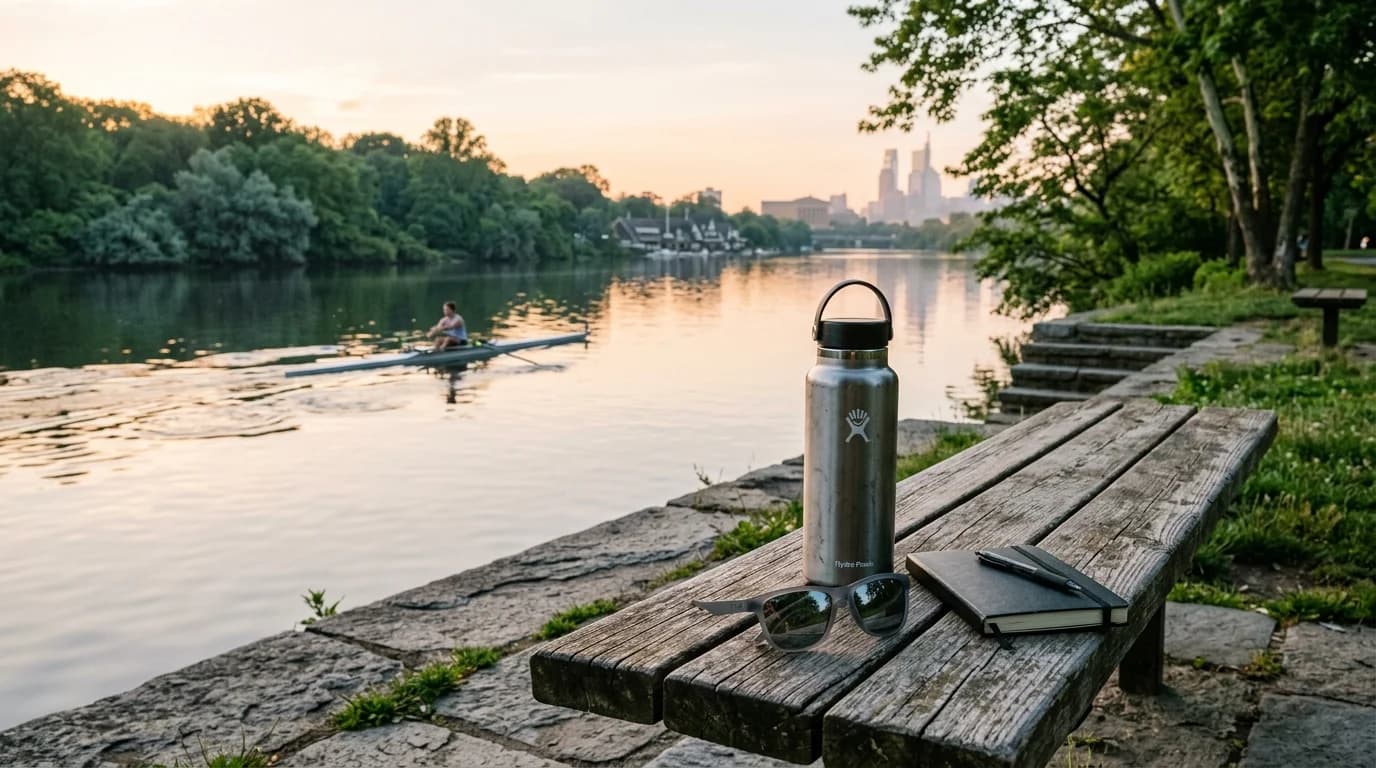

June is Philadelphia's setup month: the hydration habit you start now carries you through July and August, the travel-health conversation works best 4 to 6 weeks before the trip, and the air-quality plan should exist before the next smoke week arrives. Fishtown Medicine's June guide walks through each one, including the medications that change the math on all 3.
June is the month Philadelphia decides what kind of summer it is going to have. School lets out, the block parties start, the shore houses get opened and aired, and the light stretches past 8:30 for the first time since last year. It is also the quiet planning month, the window where a few small setups, a hydration habit, a travel conversation, an air-quality plan, decide whether July and August feel easy or feel like catching up. This guide walks through those setups one at a time.
How to set up summer hydration
Philadelphia humidity changes what hydration means. Your body cools itself by evaporating sweat off your skin, and when the dew point climbs into the 60s and 70s, which it does most June afternoons, that evaporation slows down. The body responds the only way it can: it sweats more to get the same cooling. So on a humid 88-degree day you lose fluid and sodium faster than the thermometer suggests, and a long afternoon at a block party or a hard run on the Schuylkill Banks can put you a liter behind before thirst says a word.
Plain water alone does not repair that. Water needs sodium and potassium to hold it in your tissues; without them, most of what you drink passes through the kidneys and leaves within an hour or two, and the headache and heaviness at the end of a hot day are often that cycle on repeat. Our full hydration and electrolytes guide walks through the physiology, and the June version, the habit worth starting now so it is automatic by July, looks like this:
- Put a pinch of low-sodium salt in your water through the day. Low-sodium salt is sold in any grocery store, and the label is a little misleading: it blends sodium chloride with potassium chloride, which is the combination most people run short on. A pinch per glass is enough. You are not trying to taste salt.
- If you prefer a packet, judge it by the label, not the marketing. Look for one that leads with sodium, roughly 500 to 1,000 mg per serving, and keeps sugar low. Most sports drinks carry 30 to 40 grams of sugar with modest sodium, which puts them closer to dessert than to rehydration. The brand matters far less than those 2 numbers.
- Front-load before the big days. A glass of salted water before the cookout, the June bike ride, or the first hot Broad Street commute does more than 3 glasses afterward, because you are keeping the deficit from opening instead of chasing it once it has.
- Let your medication list set the plan. Diuretics remove sodium and fluid by design. SGLT2 inhibitors, the diabetes medicines ending in "-flozin," pull glucose and water out through the urine, so anyone taking one is on a mild continuous diuretic whether they think of it that way or not. Lithium is the one that concerns me most in summer: its blood level rises as you get dehydrated, which can push a stable dose toward toxicity during a hot week. If any of these are on your list, or you are over 65, June is the month to ask your doctor how your medications and the heat interact, before the first heat wave rather than during it.
How to travel without a medical scramble
June is when Philadelphia's travel season opens, the shore every weekend, the summer trip abroad, the family reunion 3 time zones away, and most of the medical stress of travel is avoidable with a few weeks of lead time. The ideal window for a travel-health conversation is 4 to 6 weeks before an international trip, which means the June conversation covers the July and August departures.
The first piece is refills. Counting pills the night before a flight is a tradition worth retiring. Most insurance plans allow an early fill for travel, sometimes called a vacation override, which your pharmacy requests with a phone call and your doctor's office can support with a note; controlled substances have tighter rules and need more notice. The practical move is to look at your trip dates, look at your refill dates, and flag any prescription that runs out mid-trip at least 2 weeks ahead. We sort travel refills for our patients all the time, and the earlier the ask, the smoother it goes.
The second piece is destination-specific vaccines, and this is where the lead times live. Hepatitis A protects well even when the first dose goes in close to departure, so it is almost never too late for that one. Typhoid works best with about 2 weeks of lead time. Yellow fever, required for entry in parts of South America and Africa, must be given at least 10 days before arrival for the certificate to be valid, and only certain clinics stock it. Rabies pre-exposure vaccination, worth discussing for long trips or remote areas, is a 2-dose series spread over a week. Malaria prevention is a pill rather than a vaccine, and depending on which medicine fits your health history, it starts anywhere from 2 days to 2 weeks before you land. None of this needs to be memorized; it needs a conversation early enough that the calendar cooperates.
The third piece is a small documents-and-doses kit that lives in your carry-on, never checked luggage. A printed list of your medications with generic names and doses, since brand names change across borders and a customs officer or foreign pharmacist can work with "rosuvastatin 10 mg" far better than a brand. Your allergy list and a 2-line summary of your major conditions. A photo of your insurance card and your doctor's contact information. The medications themselves in their original labeled containers, with a few extra days' supply in case the trip stretches.
Time zones deserve a specific plan for a handful of medications. For most once-daily prescriptions, blood pressure medicines, statins, thyroid replacement, a few hours of drift does not matter, and you can simply start taking them on local time when you arrive. The ones that need a worked-out schedule are insulin, where long flights across many zones change how doses land, anticoagulants, where consistency protects you, and oral contraceptives, where some formulations have a narrow window measured in hours. If you take any of these, bring the itinerary to the travel conversation and leave with the schedule written down.
That conversation, when it is done well, covers all of the above plus the destination itself: food and water precautions, altitude if the trip involves it, what to do about traveler's diarrhea before it happens, and which local symptoms mean finding care rather than waiting out the week. It is 30 minutes in June that buys a trip where the medical part stays invisible.
Your air-quality plan for smoke season
Philadelphia shares one reference point for this section: the week in June 2023 when Canadian wildfire smoke turned the sky over the skyline orange, ballgames were postponed, and the masks came back out of drawers. The Air Quality Index, which runs below 50 on a normal Philadelphia day, spent that week climbing through tiers most of us had never seen locally, well into the hazardous range. Wildfire seasons to our north have not gotten shorter since, so the framing is that smoke weeks are now a summer possibility to plan for, the way we plan for heat waves.
The AQI itself is worth 2 minutes of fluency. It is a 0 to 500 scale, and the tiers carry the plan: 0 to 50 is good, and everything outdoors is on the table. 51 to 100 is moderate, fine for most people, worth noticing if you are unusually sensitive. 101 to 150 is unhealthy for sensitive groups, the tier where asthma, heart disease, pregnancy, kids, and adults over 65 should move hard exercise indoors and cut outdoor hours. 151 to 200 is unhealthy for everyone, the tier where healthy adults should shorten and lighten anything outdoors. Above 200, and certainly above 300, outdoor time itself is the exposure, and the day belongs indoors. Our Philadelphia AQI guide walks through every tier with the full playbook, including masks and what the numbers mean for training.
The sensitive-group list deserves a plain reading, because it is broader than people expect. Asthma and COPD are the obvious ones; wildfire smoke is fine particulate matter, PM2.5, and inflamed airways feel it first. But PM2.5 is small enough to cross into the bloodstream, so heart disease is on the list too, and smoke weeks are followed by a measurable rise in cardiac admissions, not just breathing ones. Pregnancy is on the list because PM2.5 exposure is associated with low birth weight and preterm birth. Kids are on the list because their lungs are still developing and they breathe more air per pound than adults do.
The indoor plan is where most of the protection lives, and it is worth setting up in June rather than shopping for a purifier mid-smoke-week alongside the rest of the city. Close the windows when the AQI climbs and run the air conditioning on recirculate rather than fresh-air intake. If your system takes a furnace filter, a MERV-13 rated filter catches a meaningful share of smoke particles. A portable HEPA purifier sized to your bedroom turns one room into a refuge, and the bedroom is the right room because you spend 8 unbroken hours there. During a smoke stretch, skip the indoor additions, candles, incense, high-heat frying, since indoor air is the budget you are protecting.
The last step is deciding, now, on your personal number that changes plans. A healthy adult who trains hard outdoors might set it at 125: above that, the run moves indoors. Someone with asthma, heart disease, or a pregnancy might set it at 100, and a parent planning a kid's outdoor day camp might use the same line. Put a weather app's air-quality alert on your phone, pick your number while the sky is blue, and the next smoke week becomes a plan you execute instead of a scramble you improvise.
Fishtown Medicine
A 90-minute conversation with Dr. Ash. A written plan you can follow.
The strongest sun of the year
One June fact surprises almost everyone: the sun is more intense this month than it will be in August. UV follows the sun's angle, not the temperature, so it peaks at the solstice in late June, when Philadelphia's midday UV Index regularly reaches 9 or 10, and then eases while the heat keeps building. The pleasant 78-degree June afternoon at Spruce Street Harbor Park delivers more UV than a brutal 95-degree August one, and the mild air is why June burns catch people off guard.
The practical response is simple: treat the 10 AM to 4 PM window with respect starting now, not in July. Broad-spectrum sunscreen, SPF 30 to 50, in a texture you like enough to re-apply, and shade or a brimmed hat through midday. Our UV Index guide covers what each number means and what to do at every tier, and it is worth a read before the first shore weekend rather than after the first burn.
Guidance from the clinic

Actionable Steps
3 moves to set up in June.
- Buy the low-sodium salt and put it next to the water glass. A pinch per glass, starting now, so the habit is automatic before the first heat wave.
- Look at your summer trips and your refill dates together. Flag anything that runs out mid-trip, and book the travel-health conversation 4 to 6 weeks before any international departure.
- Pick your air-quality number while the sky is blue. Set a phone alert, choose the AQI that moves your plans indoors, and make sure a HEPA purifier or a MERV-13 filter is in the house before smoke season needs it.
Key Takeaways
- Humidity makes you lose fluid and sodium faster than the temperature suggests; a pinch of low-sodium salt in water through the day, started in June, carries the whole summer.
- If you take a diuretic, an SGLT2 inhibitor, or lithium, or you are over 65, your hydration plan should be built with your doctor before the first heat wave.
- Travel medicine runs on lead time: the ideal conversation is 4 to 6 weeks out, early refills take about 2 weeks of notice, and several vaccines need days to weeks before departure to work.
- Carry a documents-and-doses kit: medications in labeled containers in your carry-on, a generic-name medication list, allergies, and a photo of your insurance card.
- Decide your personal AQI threshold now, set a phone alert, and prepare the indoor plan (closed windows, recirculated air, HEPA in the bedroom) before the next smoke week.
Scientific References
- Dockery, D. W., Pope, C. A., Xu, X., et al. (1993). An association between air pollution and mortality in six U.S. cities. New England Journal of Medicine, 329(24), 1753-1759.
- Pope, C. A., Burnett, R. T., Thun, M. J., et al. (2002). Lung cancer, cardiopulmonary mortality, and long-term exposure to fine particulate air pollution. JAMA, 287(9), 1132-1141.
- Cogswell, M. E., Loria, C. M., Terry, A. L., et al. (2018). Estimated 24-hour urinary sodium and potassium excretion in US adults. JAMA, 319(12), 1209-1220.
- Centers for Disease Control and Prevention. (2023). CDC Yellow Book 2024: Health Information for International Travel. Oxford University Press.
Related at Fishtown Medicine
- Hydration and electrolytes - why plain water alone does not hydrate you, and the daily protocol
- Philadelphia AQI guide - the full tier-by-tier playbook for smoke season
- UV Index in Philadelphia - what each number means and what to do
- July in Philly - the shore kit, rowhome sleep, and the heat illness ladder
- Sun protection for Philly and the Jersey Shore - sunscreen, UPF clothing, and treating a burn
- Philadelphia city health resources - cooling centers, air alerts, and who to call
- World Cup 2026 in Philadelphia - match-day heat, crowds, and care for visiting fans
- The Philly health ecosystem - the food, training, and recovery resources we point patients toward across the city

Frequently Asked Questions
Common Questions
Deep-Dive Questions
Ready when you are
The chat is our AI assistant, answering from our published guides. To talk it through with Dr. Ash himself, start with the intake.