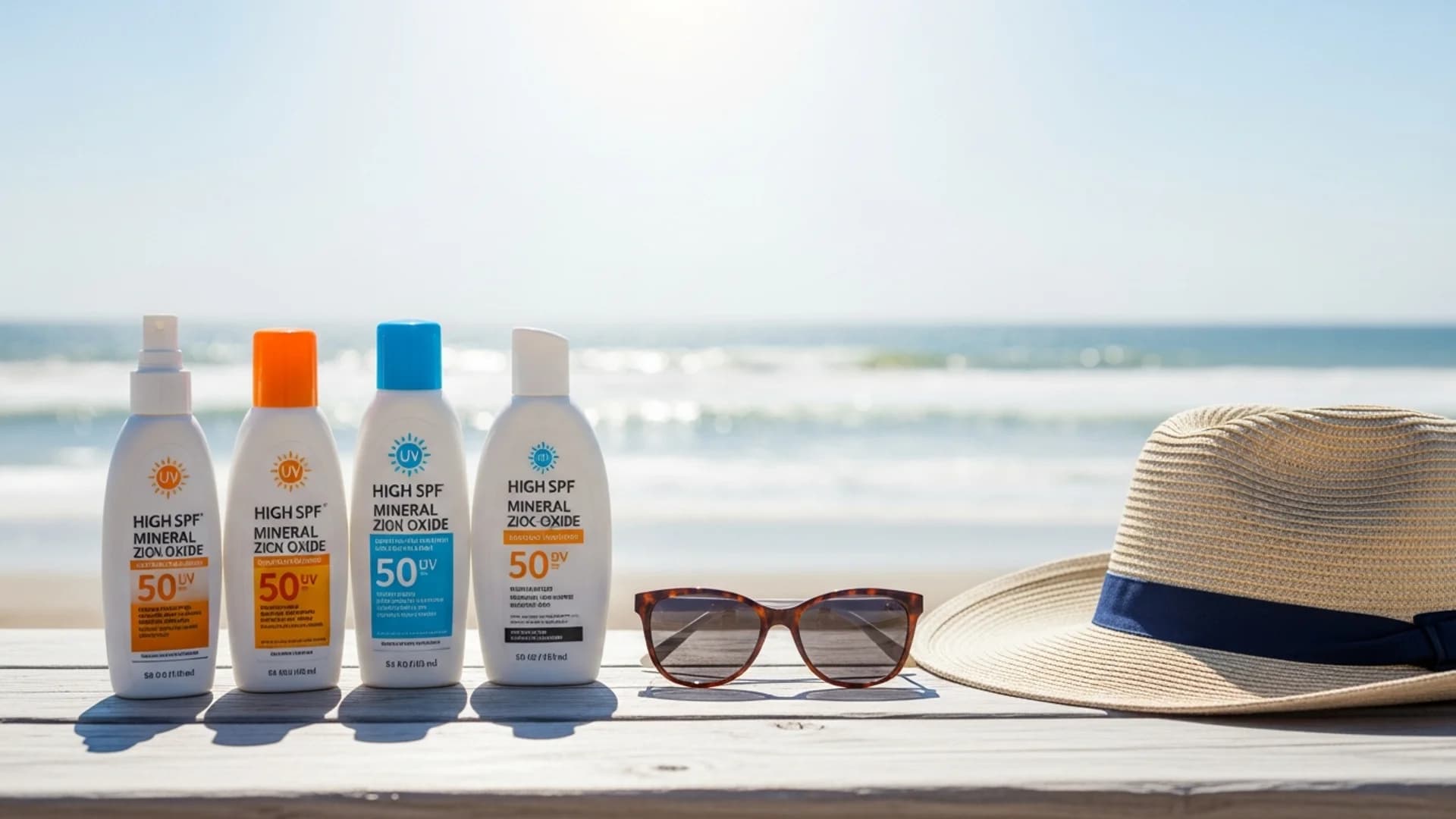

The single best sun protection is the clothing you keep on: a wide-brim hat, a UPF shirt or rash guard, sunglasses, and shade during peak hours (about 10 AM to 4 PM). Sunscreen covers what clothing cannot, a broad-spectrum SPF 30 or higher, and the catch is that most people use about a quarter of what they need and forget to reapply. The fix is simple: a shot glass of sunscreen for the body, reapplied every 2 hours and after every swim or towel-off. The shore burns you faster than your backyard because sand and water bounce extra UV at you, and even a cloudy beach day burns. If a burn sneaks through, cool it, hydrate, and soothe it, and know the few signs that mean it is time to call.
Down the shore is a Philadelphia birthright: the drive over the bridges, a day in Wildwood or Ocean City or Cape May, the slow burn you do not notice until the ride home. Sun is the one exposure that both ages your skin and causes the most common cancer in the country, and it is also one of the most preventable. The people who get this right for a living are lifeguards, who spend 8 to 10 hours a day in the worst of it. Their approach is not a magic sunscreen. It is a hierarchy: cover up first, then fill the gaps with sunscreen, and reapply like it is part of the job.
Why the shore burns you faster than your backyard
A beach day is a different UV environment than a walk in Fishtown, and it stacks the deck against your skin in a few ways.
- Reflection. Sand bounces back a meaningful share of UV, and water and the wet boardwalk add more. You are getting hit from above and below, including under the brim of a hat and on the underside of your chin.
- All day, no shade. A backyard has trees and a porch. A blanket on open sand at noon does not, so exposure is continuous for hours.
- Cloudy days still burn. Most UV passes through clouds. A gray, muggy shore day feels safe and is not, because UVA (the aging and cancer ray) is barely filtered by cloud cover.
- The water washes it off. Even water-resistant sunscreen is only rated to last about 80 minutes in the water, and toweling off takes more with it. Every swim resets the clock.
Cover up first: what lifeguards rely on
Ask a career lifeguard how they avoid frying, and the answer is rarely a bottle. It is fabric. Clothing is the most reliable UV block there is, because it does not wash off, sweat off, or wear off in 2 hours.
- A UPF shirt or rash guard. UPF (ultraviolet protection factor) is to clothing what SPF is to sunscreen. A rash guard for the water and a loose, long-sleeve sun shirt for the sand cover the most skin for the least effort. Thicker, darker, looser fabric protects better than thin, light, tight fabric.
- A wide-brim hat. A proper brim shades the face, ears, and the back of the neck, the spots people most often miss and where skin cancers love to show up. A baseball cap leaves the ears and neck exposed.
- Sunglasses. UV damages the eyes and the thin skin around them. Wraparound, UV-blocking lenses earn their place.
- Shade and timing. UV peaks from roughly 10 AM to 4 PM. An umbrella, a tent, or a midday lunch break off the sand cuts your dose more than any product.
The principle is the same one we use for everything: do the high-yield, low-effort thing first. For specific gear, the Wirecutter sun-protective clothing guide is a sound place to start. We focus on the strategy and leave the brand picks to guides like that.
Sunscreen, done right
Sunscreen is the second layer, for the skin you cannot or will not cover. When it fails, the problem is almost always how it gets used.
- Broad-spectrum, SPF 30 or higher. Broad-spectrum means it covers both UVA and UVB. SPF 30 blocks about 97% of UVB and SPF 50 about 98%, so the jump is small. We often suggest SPF 50 for the beach anyway, because it buffers the common mistake of applying too little.
- Use enough. This is the big one. The SPF on the label is based on about 1 ounce, a shot glass, for the exposed body, and most people apply roughly a quarter of that. For the face alone, think half a teaspoon, or a line of sunscreen along 2 fingers. When in doubt, more.
- Time it. Put it on about 15 minutes before you go out, so it can set.
- Reapply. Every 2 hours, and after every swim, heavy sweat, or towel-off. Set a phone timer, because this is the step that prevents the shore sunburn.
- Do not miss the easy-to-forget spots: ears, the part in your hair and scalp, lips (a lip balm with SPF), the back of the neck, and the tops of the feet.
- Mineral or chemical, both work. Mineral sunscreens (zinc oxide, titanium dioxide) sit on top and reflect UV, and tend to suit sensitive skin; chemical sunscreens absorb it and rub in clearer. Applied correctly and often, they protect equally well, so the best sunscreen is simply the one you will wear.
- Skip the spray as your main defense. It is easy to under-apply, much of it blows away, and you still have to rub it in, so something is missed. If you use one, rub it in, and do not inhale it. Sticks work for the face but need a few passes back and forth.
- Check the date. Sunscreen expires, generally good for about 3 years, and an old bottle baking in a beach bag is past its prime.
A note on reef-safer sunscreen
If your summer includes a trip somewhere tropical, some destinations restrict sunscreen ingredients that can harm coral. The reef-friendlier choice is a mineral sunscreen using non-nano zinc oxide or titanium dioxide, and the friendliest choice of all for marine life is to cover up with a rash guard and use less sunscreen. The Jersey Shore is not coral country, so this is more of a travel note than a shore one. Wirecutter keeps a reef-safe sunscreen guide if you want specific picks.
When the burn sneaks through: treating a sunburn
Even careful people get caught. A typical sunburn is a first-degree burn, and the goals are to stop it, cool it, and support healing.
- Stop the burn. Get out of the sun and cover up. The damage continues as long as you are exposed.
- Cool it. A cool (not ice-cold) shower or a cool, damp compress eases the heat. Do it a few times in the first day.
- Hydrate. A burn pulls fluid to the skin, so you can get dehydrated. Drink water.
- Soothe it. A thin layer of plain petrolatum or a fragrance-free moisturizer locks in moisture, and pure aloe vera gel (kept in the fridge for extra relief) calms the sting. Skip butter and oils.
- Treat the pain. An over-the-counter anti-inflammatory like ibuprofen helps with pain and swelling if you can take it.
- Leave blisters alone. If blisters form, do not pop them, since intact skin is your barrier against infection.
- Avoid the "-caine" sprays. Benzocaine and lidocaine sprays sold for sunburn can irritate or sensitize the skin and are best skipped.
When a sunburn needs a doctor
Most sunburns heal at home in a week or so. Get medical care if you see:
- Widespread blistering, or a burn covering a large portion of the body.
- Fever, chills, nausea, headache, confusion, or fainting, which can signal sun poisoning or heat illness, a same-day concern.
- Signs of dehydration, like dizziness, a racing heart, or barely urinating.
- Signs of infection in a blistered area: spreading redness, warmth, pus, or increasing pain after a day or two.
Longevity Medicine
A personalized longevity strategy starts with knowing your real baselines.
Severe heat illness with confusion or collapse is an emergency. When in doubt, message us and send a photo.
Why we care so much: the longevity angle
A ruined beach weekend is the least of it. Sun exposure is the main driver of both skin aging and skin cancer, and the link to melanoma, the most dangerous skin cancer, is direct: a history of blistering sunburns meaningfully raises your risk. That is why we treat sun protection as a longevity habit, the same way we treat blood pressure or ApoB.
- It is cumulative and it is preventable. Most of what looks like aged skin is sun damage, and most melanomas trace back to UV. The protection you use at 30 pays off for decades. We go deeper in our guide to healthy skin aging and in The Skin Playbook.
- Darker skin needs it too. Skin cancer is less common but often caught later and more dangerous in people with darker skin, and UV still drives aging and uneven tone. Sunscreen and cover-up are for everyone.
- Know your skin. We do annual skin checks and teach the ABCDE warning signs for moles (Asymmetry, Border irregularity, Color variation, Diameter over 6 mm, Evolving). A changing spot is worth a look, and early melanoma is highly curable. See our cancer screening guide.
- You do not need to burn for vitamin D. A few minutes of incidental light is plenty, and if your level is low, the simple fix is a vitamin D supplement.
For the broader shore-day picture, including heat, hydration, and water safety, see our guide to staying healthy at the Jersey Shore. August in Philly covers the rest of what the last full beach month brings.
Guidance from the Clinic
"Every June, the same conversation comes up with patients headed down the shore. The sunscreen argument is the wrong argument. Put on a shirt and a proper hat, sit under the umbrella from noon to two, and then use sunscreen for the rest. The people who get burned are almost never the ones who forgot sunscreen. They are the ones who put a little on at 9 AM, went in the ocean twice, and never reapplied. Protection is a habit you run all day, from the parking lot through the last swim."
Dr. Ash
Actionable Steps
A shore-day sun plan that holds up.
- Pack cover-up first. A wide-brim hat, a rash guard or UPF shirt, sunglasses, and an umbrella. These do most of the work.
- Apply enough, early. A shot glass for the body about 15 minutes before you leave the house, face and ears included.
- Set a 2-hour reapply timer, and reapply after every swim or towel-off, no matter what the timer says.
- Take the midday break. Get off the open sand from roughly 10 AM to 4 PM when you can, or stay under the umbrella.
- Check your skin a few times a year, and bring any new or changing spot to us. Annual skin checks are part of prevention, not vanity.
Key Takeaways
- Cover up first: a wide-brim hat, a UPF shirt or rash guard, sunglasses, and shade from roughly 10 AM to 4 PM do the heavy lifting.
- Use enough sunscreen (a shot glass for the body) and reapply every 2 hours and after every swim or towel-off; under-application is the most common reason burns happen.
- The shore burns faster because sand and water reflect extra UV, and cloudy days still burn through UVA.
- Treat a sunburn by cooling, hydrating, and soothing with petrolatum or aloe; seek care for widespread blistering, fever, confusion, or dehydration.
- Sun protection is a longevity habit: blistering sunburns raise melanoma risk, the damage is cumulative, and annual skin checks catch problems early.
Scientific References
- Green AC, Williams GM, Logan V, Strutton GM. "Reduced melanoma after regular sunscreen use: randomized trial follow-up." Journal of Clinical Oncology. 2011;29(3):257-263.
- Hughes MCB, Williams GM, Baker P, Green AC. "Sunscreen and prevention of skin aging: a randomized trial." Annals of Internal Medicine. 2013;158(11):781-790.
- American Academy of Dermatology. "Sunscreen FAQs" and "How to apply sunscreen." Recommendations on broad-spectrum SPF 30+, application amount, and reapplication.
- Skin Cancer Foundation. "Sunburn and Your Skin" and "Skin Cancer Facts." On blistering sunburns and melanoma risk.
- Centers for Disease Control and Prevention. "Sun Safety" and the UV Index.

Frequently Asked Questions
Common Questions
Deep-Dive Questions
Ready when you are
The chat is our AI assistant, answering from our published guides. To talk it through with Dr. Ash himself, start with the intake.