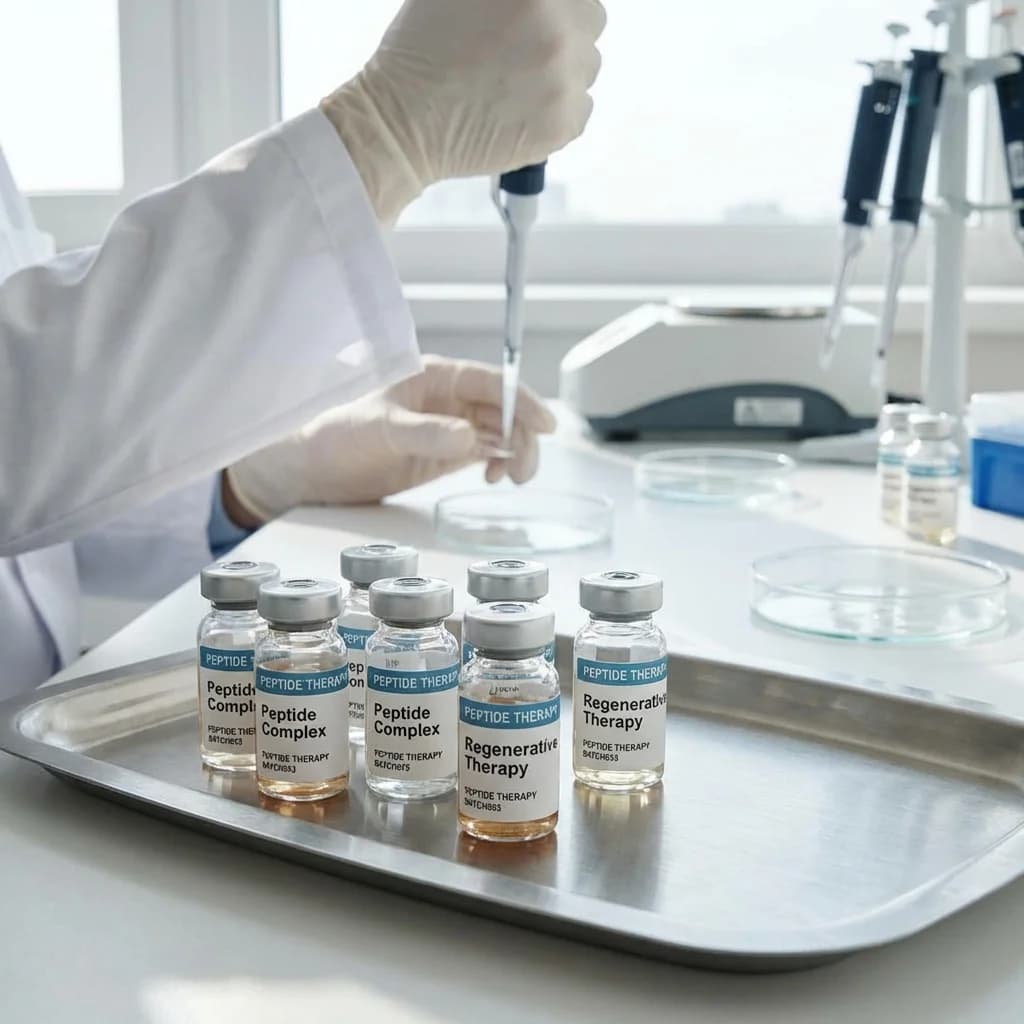

Fishtown Medicine prescribes FDA-approved peptide medications obtained through licensed US pharmacies. These include GLP-1 receptor agonists (semaglutide, tirzepatide) and Tesamorelin where clinically indicated. Sermorelin, whose FDA approval was withdrawn, is prescribed selectively as a preparation compounded by a licensed pharmacy. We do not prescribe, recommend, administer, or supply research-grade or non-FDA-approved peptides. State medical boards have made clear that physician involvement with non-FDA-approved peptides is prohibited.
Important: Fishtown Medicine does not prescribe, recommend, administer, or supply research-grade or non-FDA-approved peptides. This article is provided for general educational purposes only and is not medical advice or an offer of treatment. We prescribe only FDA-approved peptide medications obtained through licensed US pharmacies. State medical boards across the country have clarified that any recommendation, prescription, or administration of non-FDA-approved peptides by a medical professional constitutes the unauthorized practice of medicine.
What Peptides Are
Peptides are short chains of amino acids, the same building blocks proteins are made from. In the body, peptides act as signaling molecules: instructions that tell cells when to repair tissue, release a hormone, or modulate inflammation. Insulin is a peptide. Many of the hormones your body produces every day are peptides.
A subset of peptide medications are FDA-approved and sit firmly inside the prescription landscape. These are manufactured under FDA oversight, tested for safety and efficacy, and dispensed through licensed pharmacies. They are what physicians can legally prescribe.
A much larger group of compounds marketed online as "peptides" are not FDA-approved. They are sold as research chemicals or compounded products outside of FDA oversight. The compounds in this category, frequently discussed in podcasts and longevity-adjacent forums, have not been tested or approved for human use by the FDA, and their manufacturing standards, purity, and dosing accuracy cannot be verified.
The Regulatory Landscape
The peptide landscape has shifted significantly. The FDA's compounding categories (503A and 503B) have been clarified, and many compounds that were available a few years ago through compounding pharmacies are no longer compoundable. State medical boards have followed with explicit guidance that prohibits physicians from prescribing, recommending, administering, or supplying non-FDA-approved peptides.
The boards have stated that:
- Physicians may only purchase prescription products from entities permitted by the relevant State Board of Pharmacy.
- All drugs administered or dispensed to a patient must be prescription-quality.
- Compounding, administering, or dispensing a non-FDA-approved or research-grade peptide is prohibited.
- This prohibition includes advising, recommending, supplying, prescribing, or administering.
- Patient consent forms purporting to identify a product as "research-grade" are ineffective and do not eliminate professional or legal liability.
- A medical professional cannot delegate this work to a nurse practitioner or physician assistant.
What this means in practice:
- FDA-approved peptide medications are prescribed through the normal process when clinically indicated, sourced from licensed pharmacies, and integrated into a broader care plan.
- Research-grade and non-FDA-approved peptides are outside the scope of what any licensed physician can ethically and legally provide. We do not prescribe, recommend, or coordinate their use.
When a patient independently acquires and self-administers such substances, the associated risk rests solely with the patient. Fishtown Medicine takes no part in that decision and provides no clinical guidance on those substances.
What We Do Prescribe
The FDA-approved peptide medications we use, when the clinical picture warrants them:
GLP-1 Receptor Agonists
The most clinically useful peptide medications for the majority of patients.
- Examples. Semaglutide, tirzepatide, liraglutide, dulaglutide.
- FDA-approved indications. Type 2 diabetes, obesity treatment, cardiovascular risk reduction in selected populations. Several have indications beyond weight.
- Why we use them. Strong human safety data over multiple years, clear prescribing framework, and meaningful effect on metabolic disease. We prescribe brand-name FDA-approved products dispensed by licensed pharmacies.
- Emerging data. Neuroprotective effects and possible cognitive benefits are being actively studied, and we cover where that stands in GLP-1s and your brain. We follow the evidence rather than the marketing.
Sermorelin
A growth-hormone-releasing-hormone analog that stimulates the pituitary to release growth hormone in natural overnight pulses.
- Status. Not FDA-approved today. It was approved as Geref, the approval was withdrawn, and what is prescribed now is a preparation compounded by a licensed pharmacy.
- Where it fits. Adult patients with documented growth hormone deficiency, after appropriate workup. Not a first-line longevity tool.
- What to watch for. Headache and vision changes can show up on any growth hormone peptide, and they are a reason to call us rather than wait it out.
Tesamorelin
A growth-hormone-releasing-hormone analog approved for specific FDA-labeled indications.
- Status. FDA-approved.
- Where it fits. FDA-labeled use for HIV-associated lipodystrophy. Off-label use in carefully selected patients requires explicit consent, monitoring, and clinical justification.
What We Do Not Prescribe
Fishtown Medicine
A 90-minute conversation with Dr. Ash. A written plan you can follow.
We do not prescribe, recommend, administer, or supply any of the following:
- BPC-157 (injectable or otherwise marketed for clinical use)
- TB-500 / Thymosin Beta-4
- CJC-1295
- Ipamorelin
- GHK-Cu (for clinical injection)
- Melanotan I or II (research-grade; afamelanotide, the FDA-approved Scenesse, is a different matter)
- PT-141 (research-grade; bremelanotide, the FDA-approved Vyleesi, is prescribed when indicated)
- Selank, Semax, DSIP
- Any compound marketed as "research-grade" or "for research use only"
This list is illustrative, not exhaustive. If a compound is not FDA-approved or has been removed from the compoundable substances list, we do not provide it and we do not provide clinical guidance on its use.
Why We Don't Prescribe Research-Grade Peptides
3 reasons, in order of importance:
- Patient safety. When manufacturing oversight does not exist, neither the physician nor the patient can verify the contents of a vial, the purity of the compound, or the consistency of the dose. The "peptide" sold online may not contain what the label claims.
- Legal and licensing exposure. State medical boards have made the rule explicit. A physician who recommends, prescribes, or administers a non-FDA-approved peptide is practicing outside the scope authorized by their license.
- Long-term evidence. Even the most-studied research-grade peptides have limited long-term human safety data. The evidence base does not support the confidence that wellness marketing implies.
How We Think About This With Patients
When a patient asks about peptides, the conversation usually starts with the clinical goal: weight loss, recovery, sleep, performance, longevity. We work backward from the goal to the evidence-based, FDA-approved tools that exist for that goal. Sometimes a peptide medication is part of the answer. More often, the foundational work (sleep, training, nutrition, stress, and standard medications) covers most of the ground.
Patients who arrive already using a research-grade peptide are not judged, and that is a personal choice. We do not provide clinical advice on substances we cannot legally prescribe, so we will not interpret, optimize, or troubleshoot a research-grade protocol, and we will not write replacement prescriptions for compounds outside the FDA-approved formulary. What we can do:
- Discuss the broader clinical picture you are trying to address.
- Order labs that may be relevant to your overall health, independent of any peptide.
- Help you weigh FDA-approved alternatives that may serve the same goal.
- Coordinate care with your other physicians.
Guidance from the Clinic

Actionable Steps in Philly
Thinking about peptide therapy?
- Define the goal. Weight, metabolic health, sleep, recovery - the goal determines the tool.
- Get the workup. Fasting insulin, A1c, ApoB, full thyroid, vitamin D, ferritin, and sex hormones. Most decisions get easier with the data in front of you.
- Fix the foundation. Sleep, training, protein, and stress carry most of the result. No peptide replaces them.
- Ask about FDA-approved options. If a peptide medication fits your situation, we will say so and walk through what it does and does not do.
Book Your Warm Invitation Call Here
Scientific References
- Wilding JPH, et al. "Once-weekly semaglutide in adults with overweight or obesity." NEJM. 2021.
- Jastreboff AM, et al. "Tirzepatide once weekly for the treatment of obesity." NEJM. 2022.
- Walker RF. "Sermorelin: a better approach to management of adult-onset growth hormone insufficiency?" Clin Interv Aging. 2006.
- Falutz J, et al. "Effects of tesamorelin (TH9507) on visceral adipose tissue in HIV-infected patients." NEJM. 2007.

Frequently Asked Questions
Common Questions
Deep-Dive Questions
Ready when you are
The chat is our AI assistant, answering from our published guides. To talk it through with Dr. Ash himself, start with the intake.