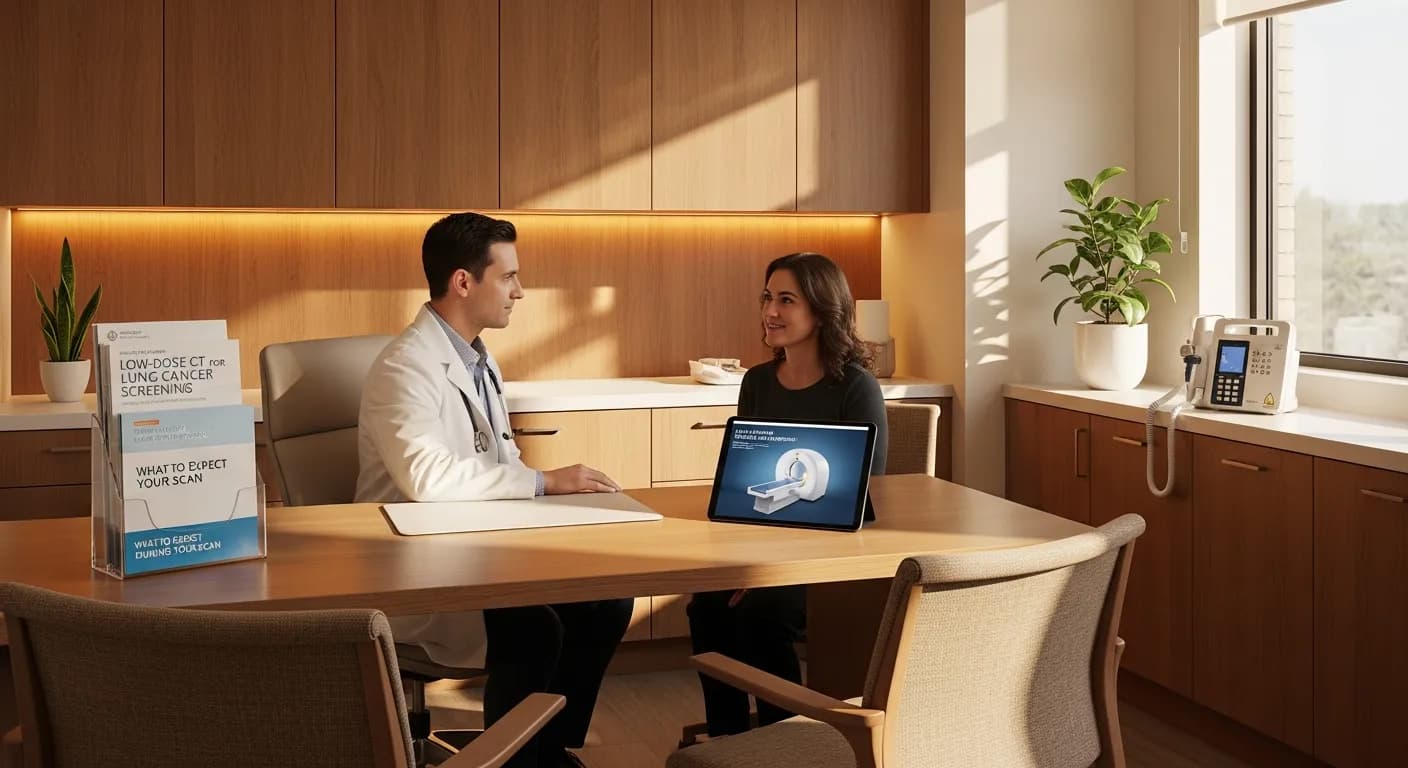

A low-dose CT lung scan is one of the better-proven cancer screens in medicine, but only for the right people. It is recommended for adults 50 to 80 who have a 20 pack-year smoking history and either still smoke or quit within the past 15 years. In that high-risk group, annual scans cut the risk of dying from lung cancer by about 20 to 24% in large trials. It is not recommended for low-risk never-smokers, where it mostly finds harmless spots and creates false alarms. The main downsides are false positives, which modern reporting has sharply reduced, and a small amount of overdiagnosis. A whole-body MRI does not cover your lungs, and no scan replaces quitting, which remains the single biggest step against lung cancer.
TL;DR: A low-dose CT lung scan is one of the better-proven cancer screens in medicine, but only for the right people. It is recommended for adults 50 to 80 who have a 20 pack-year smoking history and either still smoke or quit within the past 15 years. In that high-risk group, annual scans cut the risk of dying from lung cancer by about 20 to 24% in large trials. It is not recommended for low-risk never-smokers, where it mostly finds harmless spots and creates false alarms. The main downsides are false positives, which modern reporting has sharply reduced, and a small amount of overdiagnosis. A whole-body MRI does not cover your lungs, and no scan replaces quitting, which remains the single biggest step against lung cancer.
If you smoke or used to, and you have wondered whether you should get your lungs scanned, this page lays out who benefits, who does not, and what the scan involves. Lung cancer screening is a case where the evidence is strong but narrow: it saves lives in a specific high-risk group and does more harm than good outside it. Knowing which side of that line you are on is what matters most.
What is a low-dose CT lung scan?
A low-dose CT, or LDCT, is a quick chest scan that uses a fraction of the radiation of an ordinary CT to look for early lung cancer in people at high risk, before any symptoms appear. It takes about ten minutes, needs no dye or needles, and involves a single breath-hold.
The dose is easy to put in context. A screening LDCT delivers roughly 1.5 to 2 millisieverts of radiation, compared with about 7 for a standard diagnostic chest CT and about 3 that you get from natural background sources over a year of ordinary life.7 So one scan is on the order of a few months of everyday background radiation: low, but not nothing, which is one reason screening is aimed only at people whose risk of lung cancer is high enough to justify it.
Who should get screened?
The guidelines are specific, and all three conditions have to be true. The US Preventive Services Task Force recommends yearly screening for adults aged 50 to 80 who have at least a 20 pack-year smoking history and who either smoke now or quit within the past 15 years.3 A pack-year is one pack a day for a year, so a pack a day for 20 years, or two packs a day for 10, both reach 20 pack-years.
The two major guidelines no longer agree on the last part of that. The National Comprehensive Cancer Network has removed the 15-year limit on how long ago you quit, so under its criteria the pack-years and the age are what decide, and the quit date does not. We follow that, and you can read our reasoning further down.
These criteria were widened in 2021, down from the older bar of age 55 and 30 pack-years, which nearly doubled the number of eligible Americans and, deliberately, extended screening to more women and Black adults, who tend to develop lung cancer at lower smoking exposures. Screening is meant to stop once someone has gone 15 years without smoking, or develops a health problem that would keep them from benefiting or from having lung surgery if a cancer were found. Coverage by insurance generally follows these rules, though checking your own plan is wise.
Does lung screening work?
Yes, and the evidence is unusually strong. Two large randomized trials settled it. In the National Lung Screening Trial, which enrolled over 53,000 high-risk people, three years of annual LDCT cut the risk of dying from lung cancer by about 20% compared with chest X-ray, and even nudged down deaths from all causes.1 Roughly 320 people needed to be screened to prevent one lung-cancer death, a benefit comparable to or better than mammography.
The European NELSON trial went further, comparing LDCT against no screening at all, closer to everyday practice. Over 10 years it reduced lung-cancer death by about 24% in men, with a larger but less certain reduction in women.2 Two big trials on two continents pointing the same way is why every major guideline endorses screening for the high-risk group. This is not a marginal or disputed benefit.
What are the downsides?
The trade-offs matter, and being clear about them is part of doing screening well.
- False positives. The scanner finds a lot of small spots, and the great majority are harmless. In the original trial, about 39% of people had a positive result at some point over three rounds, and about 96% of those turned out to be false alarms.1 The good news is that newer, standardized ways of reading the scans, which raised the size threshold for calling a spot suspicious, have cut the false-positive rate roughly in half, and the volume-based method used in NELSON cut it far more.6
- Overdiagnosis. Screening can catch some cancers so slow-growing they would never have caused harm, leading to treatment that was not needed. Early estimates put this near 18% of screen-found cancers, but with longer follow-up the figure fell to around 3%, so it happens but is smaller than first feared.45
- Incidental findings. Because the scan also sees the heart, thyroid, adrenal glands, and upper abdomen, it often turns up unrelated spots. Some are useful, like coronary artery calcium that flags heart risk; many are harmless but set off more testing.
- Radiation and follow-up procedures. The radiation is low but not zero, and a suspicious result can lead to a biopsy or surgery, which carry their own small risks.
The reassuring truth is that an abnormal screen almost always means a repeat scan in a few months rather than a cancer diagnosis or an operation.
Why it is not for everyone
The benefit was shown only in the heavy-smoking, high-risk group, and that limit matters. In never-smokers and other low-risk people, the odds that a spot is cancer are so low that screening does more harm than good: the same scanner finds mostly benign nodules and slow, unimportant findings, with no proven reduction in death. That is why the guidelines restrict screening to high-risk people and do not recommend it for low-risk never-smokers.
The more common problem, oddly, is the opposite of over-screening. Most people who do qualify are still not being screened. So the practical failure in this area is under-use among the high-risk rather than over-use, which is backward from the health-optimizer instinct to scan everything.
Does a whole-body MRI cover my lungs?
No, and this is a common and costly misunderstanding. MRI is poor at seeing small lung nodules, because air-filled lung gives little signal and the constant motion of breathing and the heartbeat blurs the picture. CT is the right tool for the lung. Whole-body MRI and boutique full-body scans have no evidence of reducing cancer death, and they generate their own flood of false alarms and incidental findings.
Fishtown Medicine
A 90-minute conversation with Dr. Ash. A written plan you can follow.
The principle to take from this is that better screening is not more scanning; it is the right test matched to the right risk. LDCT earns its place by being the proven test for the one organ and the one group where lung screening saves lives. A whole-body scan is not a substitute for it, and is not a validated lung-cancer screen for anyone.
Screening does not replace quitting
For all the value of screening, it is the second most powerful thing you can do about lung cancer. The first is not smoking, and for people who smoke, quitting. A screening visit is a good moment to start that conversation, and the two work together rather than as substitutes.
Quitting lowers lung-cancer risk steadily over time, cutting it substantially over ten to fifteen years, and quitting earlier in life avoids most of the added risk. The catch is that the risk does not fall all the way back to a never-smoker's, and it does not stop mattering on a set date either. That is the part to hold onto, because it is why the 15-year window has been dropped from one of the two major guidelines and why we do not use it. Screening catches what quitting could not prevent; it does not undo the need to quit.
How Fishtown Medicine approaches lung screening in Philadelphia
We approach lung screening the way we approach all screening: match the test to the risk, and skip the ones that do not fit. If your history puts you in the eligible group, we walk through the benefits and the trade-offs together, arrange the scan, and pair it with practical help quitting if you still smoke, because that is the larger prize. If you fall outside the criteria, we will tell you plainly that a lung scan is more likely to cause a false alarm than to help.
One place we differ from the Task Force, and we want to say plainly that this is our preference rather than a settled finding: we do not turn anyone away for having quit too long ago. If you have 20 pack-years behind you and you are between 50 and 80, we will have the conversation whether you stopped last year or twenty years ago. Your risk did not reset on the fifteenth anniversary, and being told you no longer count is a strange reward for having done the hard thing. The practical catch is money rather than medicine. Insurance coverage for the scan follows the Task Force rule, so if you are past that window you are likely paying out of pocket, and we will tell you what it costs before you decide.
We also ask about the parts of your history that have nothing to do with cigarettes. Radon at home, asbestos and silica and diesel at work, years spent in somebody else's smoke. About four in ten Pennsylvania homes that get tested come back above the action level, and radon is the leading cause of lung cancer in people who never smoked, so a test kit is one of the better things you can spend fifteen dollars on. None of those exposures makes a lung scan the right test if you never smoked, and we will say so. What they change is how seriously we take a cough that will not settle.
We also read the incidental findings sensibly, using a coronary calcium score that shows up on the scan as useful heart information while not chasing every harmless spot into a cascade of tests. And we push back on the idea that a whole-body scan covers your lungs, because it does not. Whether you are in Fishtown or Cherry Hill, the goal is the right test for your risk, done well and followed through.
Guidance from the Clinic

Key Takeaways
- Low-dose CT lung screening saves lives, but only in the high-risk group: adults 50 to 80 with a 20 pack-year history. We do not apply the 15-year limit on how long ago you quit, and we will say plainly that this is our preference and that coverage may not follow it.
- The benefit is well proven, with two large trials showing a roughly 20 to 24% drop in lung-cancer death.
- It is not for low-risk never-smokers, where it mostly finds harmless spots and does more harm than good.
- The main downsides are false positives and some overdiagnosis, both reduced by modern reporting and long-term data.
- A whole-body MRI does not cover your lungs; CT is the right test, and more scanning is not better screening.
- No scan replaces quitting, which stays the single most powerful step against lung cancer.
Related at Fishtown Medicine
- Early Cancer Detection - where lung screening fits a fuller prevention plan
- Should You Get a Full-Body MRI? - why whole-body imaging does not cover the lungs
- Whole-Body Boutique Scans - the targeted-versus-indiscriminate screening question
- Melanoma and Skin Cancer Screening - another screen where risk decides who benefits
- Colorectal Cancer Screening - the screen that has moved to earlier ages
- Why We Choose a CT of the Chest - the diagnostic version of the scan, and how a nodule is followed once one is found
Scientific References
- Aberle DR, Adams AM, Berg CD, et al. "Reduced lung-cancer mortality with low-dose computed tomographic screening." New England Journal of Medicine. 2011;365(5):395-409.
- de Koning HJ, van der Aalst CM, de Jong PA, et al. "Reduced lung-cancer mortality with volume CT screening in a randomized trial." New England Journal of Medicine. 2020;382(6):503-513.
- US Preventive Services Task Force. "Screening for lung cancer: US Preventive Services Task Force recommendation statement." JAMA. 2021;325(10):962-970.
- Patz EF Jr, Pinsky P, Gatsonis C, et al. "Overdiagnosis in low-dose computed tomography screening for lung cancer." JAMA Internal Medicine. 2014;174(2):269-274.
- National Lung Screening Trial Research Team. "Lung cancer incidence and mortality with extended follow-up in the National Lung Screening Trial." Journal of Thoracic Oncology. 2019;14(10):1732-1742.
- Pinsky PF, Gierada DS, Black W, et al. "Performance of Lung-RADS in the National Lung Screening Trial: a retrospective assessment." Annals of Internal Medicine. 2015;162(7):485-491.
- Larke FJ, Kruger RL, Cagnon CH, et al. "Estimated radiation dose associated with low-dose chest CT of average-size participants in the National Lung Screening Trial." American Journal of Roentgenology. 2011;197(5):1165-1169.

Frequently Asked Questions
Common Questions
Deep-Dive Questions
Ready when you are
The chat is our AI assistant, answering from our published guides. To talk it through with Dr. Ash himself, start with the intake.