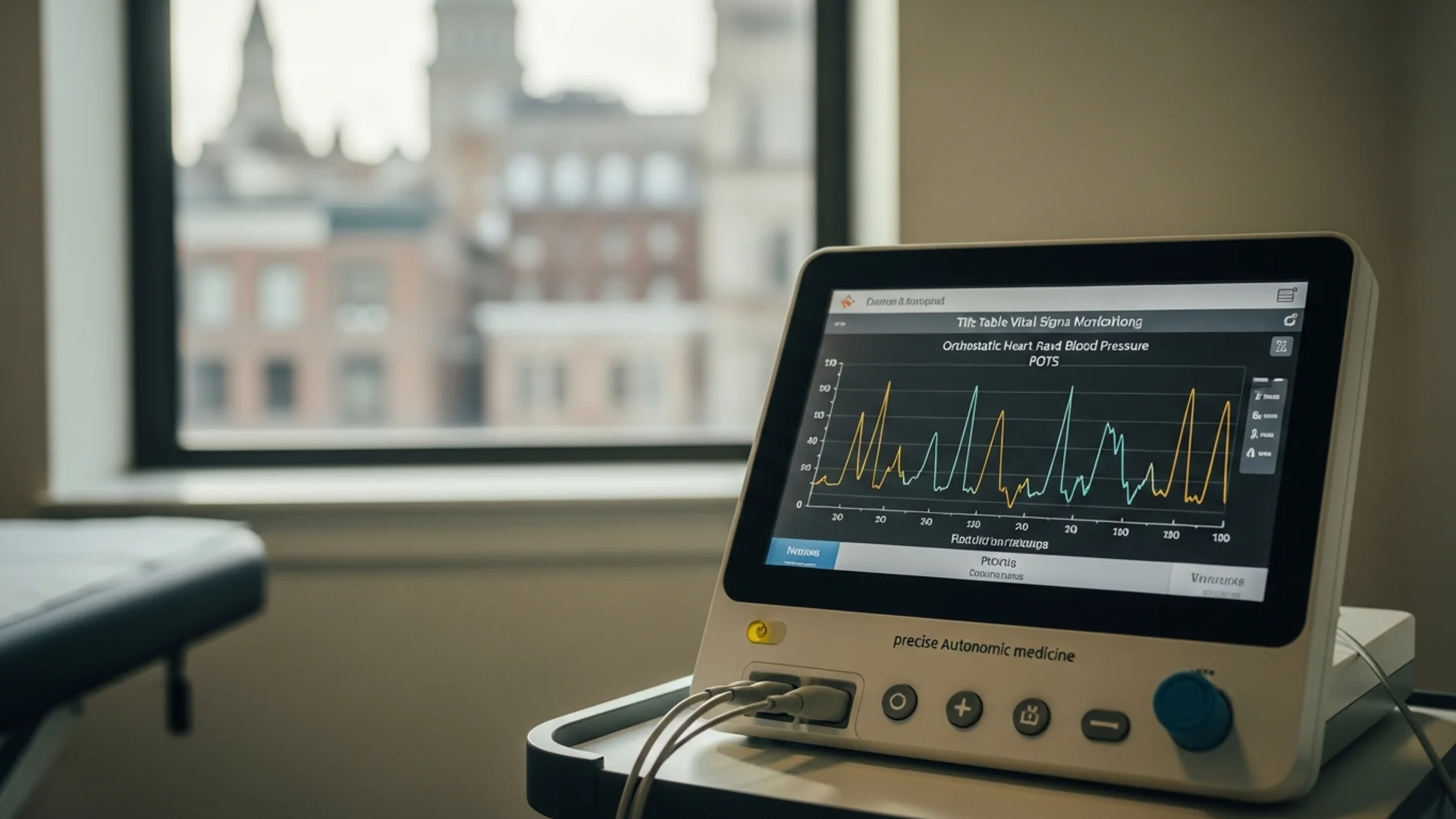
A 31-year-old with years of near-fainting on standing, hives and flushing, hypermobile joints, and IBS-labeled gut trouble had seen cardiology, allergy, GI, and orthopedics, each with reassuring tests. Her own research pointed to a recognized cluster: POTS, MCAS, and hypermobile Ehlers-Danlos syndrome (hEDS). A 90-minute evaluation confirmed it: a Beighton score of 7 of 9 with the 2017 hEDS criteria met, an active stand test showing a 38 beat-per-minute rise without a blood pressure drop, and a mast cell picture that responded to H1 and H2 antihistamines. Treatment started the same day: fluids, 8-10 grams of sodium, waist-high compression, recumbent-first exercise, cetirizine and famotidine, stability-focused physical therapy, and iron repletion.
A patient I will call Erin came to me at 31 with a folder of printouts and an apology for bringing it.
She had organized years of her own medical history into a timeline, matched it against published diagnostic criteria, and arrived at an answer that 5 specialists had not offered her. She was right, and the apology was the part that stayed with me.
The story started in childhood, the way these stories usually do. She was the bendy kid whose party trick was pulling her thumb to her forearm, praised by her gymnastics coach for flexibility while her ankles rolled over and over through high school. In college came the episodes: hot showers that grayed out her vision, concerts where she had to sit on the floor while everyone else stood, 1 trip to an emergency room where the EKG was normal and the discharge paperwork said dehydration.
Her 20s added new threads. Hives after red wine and reheated takeout. A flush that spread across her chest in warm rooms and stressful meetings. Bloating and cramping that a GI visit at 28 labeled irritable bowel syndrome, with fiber and reassurance as the plan. At 29 she wore a heart monitor for 2 weeks after months of palpitations; it showed sinus tachycardia, her echocardiogram was normal, and the visit ended with a recommendation to consider treatment for anxiety.
Her mother, it turned out, had the same double-jointed hands, a lifelong "sensitive stomach," the same flush, and decades of dizziness she had learned to treat as a personality trait rather than a finding.
Why did 5 specialists see 5 different patients?
Every specialist Erin saw did their job well. Cardiology answered the cardiology question: her heart's structure and rhythm were normal. Allergy answered the allergy question: her skin-prick tests were negative, so this was not a classic IgE allergy. GI answered the GI question: nothing inflammatory or structural, so the label was IBS. Orthopedics wrapped the ankle and recommended caution.
The problem is that the conditions in Erin's cluster live between those silos. POTS is diagnosed by watching heart rate respond to standing over 10 minutes, which no echocardiogram measures. MCAS involves mast cells releasing histamine inappropriately, which negative allergy testing does not exclude. Hypermobile Ehlers-Danlos syndrome (hEDS) is diagnosed with a bedside exam and a criteria checklist, which no scan or blood test replaces. Each test came back reassuring because each test was asking a different question than the one her body was raising.
So her chart filled up with normal results while the pattern went unread. Nobody was assigned to the whole person.
What did she figure out on her own?
The turn came, as it often does, at 2 AM. She searched the combination instead of the pieces: dizziness plus hives plus bendy joints. What she found was a large patient community describing her life in detail, and behind it a medical literature describing the same thing: POTS, MCAS, and hypermobility clustering together, documented in EDS cohorts and reviewed as a triad in the allergy and immunology literature. She read the 2017 hEDS criteria and scored her own Beighton exam at her kitchen table.
She brought the folder to an appointment and heard some version of "I would be careful about what you read online."
What I want you to know is that Erin's homework was sound. The cluster she found is described in peer-reviewed journals, not just forums, and patients who arrive having connected these dots are describing a recognized pattern. Research like hers deserves an exam, and the exam takes time, which is the resource her previous visits never had.
What does an unhurried evaluation look like?
Erin's first visit ran 90 minutes, and most of it was history: the timeline from bendy kid to grayed-out showers to hives, in order, with her mother's story alongside it. Then the measurements, none of them fancy:
Get Real Answers
Tired of being told your labs are 'normal'? Dr. Ash digs deeper.
- A Beighton exam. She scored 7 of 9 on the standard 9-point hypermobility exam, well past the adult threshold of 5.
- The 2017 hEDS criteria checklist. Soft skin, mild stretch marks that appeared without weight change, years of joint pain and recurrent sprains, and a first-degree relative with the same picture. She met the criteria. Just as important, she had none of the red flags for rarer EDS types: no fragile skin with wide scars, no family history of aneurysm or organ rupture.
- An active stand test. After 10 minutes lying flat, her heart rate was 74 with a blood pressure of 108/68. Standing still, she hit 112 by minute 7 while her pressure held steady, a rise of 38 beats per minute. With her years of orthostatic symptoms, that is POTS.
- The mast cell picture. Episodic flushing, hives, and gut flares tied to histamine-rich triggers like wine and leftovers, with a normal baseline tryptase, which is common in MCAS because mediator release is episodic. The diagnosis rests on the clinical picture and is supported by treatment response.
- Labs to exclude mimics. Her ferritin was 19, low enough to amplify the fatigue and palpitations. Vitamin D was 21. Thyroid, blood counts, and metabolic panel were reassuring.
Then the conversation she had been waiting years for: she was right. Each dot she had connected now had a measurement attached to it, a name, and a plan.
What changed once the picture had names?
Treatment started the same day, and none of it required a specialist:
- The POTS foundation. About 3 liters of fluid daily, 8-10 grams of sodium on purpose, waist-high compression at 20-30 mmHg, and an exercise program that starts recumbent: rowing, recumbent bike, and leg strength work, progressing toward upright over months.
- The mast cell trial. Cetirizine 10 mg and famotidine 20 mg twice daily, plus a simple trigger log. Her hives faded within 3 weeks, which doubles as support for the diagnosis.
- Hypermobility-aware physical therapy. Stability and proprioception work around her ankles and shoulders, low-load progressive strengthening, and a firm steer away from the stretching-heavy routines that had been part of every previous rehab.
- Pacing. Breaking the boom-bust cycle, where 1 ambitious Saturday cost her the next 3 days, in favor of planned, even activity.
- The basics. Iron repletion for the ferritin of 19, vitamin D, and a consistent sleep window, because every autonomic symptom is louder after a bad night.
At 6 months her standing heart-rate rise was down to 24 beats per minute, the hives were rare, and her gut had calmed considerably once the histamine load and the autonomic stress both dropped. She finished her first sprain-free season in years, on ankles she had strengthened rather than stretched. She is not cured, because hEDS is lifelong. But her picture is understood and managed, she is improving, and 1 physician holds the whole thread.
What I want you to take from Erin's case
If you have connected dots like these, joints that bend too far, a heart that races on standing, skin and gut that flare in patterns, and every visit has ended with a normal test and a raised eyebrow, the pattern you found has a medical literature behind it. Confirming it takes an unhurried history, a Beighton exam, a 10-minute stand test, a histamine-focused review of systems, and labs to exclude mimics. All of it fits in a primary care office with time, and the full workup and treatment approach lives on our hypermobility and hEDS care page. You did the hard part already. Bring the folder.
Key Takeaways
- Joint hypermobility, POTS, and MCAS cluster together, and finding one should prompt screening for the other 2.
- All 3 are bedside diagnoses: a Beighton exam with the 2017 hEDS criteria, a 10-minute active stand test, and a histamine-focused history with selective labs.
- Normal specialist tests exclude the dangerous alternatives; they do not exclude this cluster, which lives between the silos.
- First-line treatment is low-risk and starts day 1: fluids, deliberate sodium, compression, recumbent-first exercise, H1 and H2 antihistamines, and stability-focused physical therapy.
- Patients who arrive having connected these dots are describing a recognized pattern in the medical literature, and that work deserves a careful exam.
Scientific References
- Malfait F, Francomano C, Byers P, et al. The 2017 International Classification of the Ehlers-Danlos Syndromes. Am J Med Genet C Semin Med Genet. 2017;175(1):8-26.
- Tinkle B, Castori M, Berglund B, et al. Hypermobile Ehlers-Danlos Syndrome (a.k.a. Ehlers-Danlos Syndrome Type III and Ehlers-Danlos Syndrome Hypermobility Type): Clinical Description and Natural History. Am J Med Genet C Semin Med Genet. 2017;175(1):48-69.
- Roma M, Marden CL, De Wandele I, Francomano CA, Rowe PC. Postural Tachycardia Syndrome and Other Forms of Orthostatic Intolerance in Ehlers-Danlos Syndrome. Auton Neurosci. 2018;215:89-96.
- Seneviratne SL, Maitland A, Afrin L. Mast Cell Disorders in Ehlers-Danlos Syndrome. Am J Med Genet C Semin Med Genet. 2017;175(1):226-236.
- Kucharik AH, Chang C. The Relationship Between Hypermobile Ehlers-Danlos Syndrome (hEDS), Postural Orthostatic Tachycardia Syndrome (POTS), and Mast Cell Activation Syndrome (MCAS). Clin Rev Allergy Immunol. 2020;58(3):273-297.
- Raj SR, Guzman JC, Harvey P, et al. Canadian Cardiovascular Society Position Statement on Postural Orthostatic Tachycardia Syndrome (POTS) and Related Disorders of Chronic Orthostatic Intolerance. Can J Cardiol. 2020;36(3):357-372.
Related at Fishtown Medicine
- Hypermobility and hEDS Care in Philadelphia - the full version of the workup and management this case walks through
- POTS Treatment in Philadelphia - diagnosis and the treatment ladder in detail
- MCAS Treatment in Philadelphia - the layered antihistamine approach
- Dizziness and a Racing Heart When You Stand - a patient case on catching POTS with a 10-minute stand test
- Chronic Fatigue Treatment in Philadelphia - the overlapping workup when exhaustion is the loudest symptom
- The Complex Multisystem Care Strategy - how overlapping diagnoses get worked as one problem
- Pelvic Venous Disease - the pelvic pain that turns up alongside connective tissue laxity
- Chest Wall Pain - why rib and sternal pain keeps returning in hypermobile people

Frequently Asked Questions
Common Questions
Deep-Dive Questions
Ready when you are
The chat is our AI assistant, answering from our published guides. To talk it through with Dr. Ash himself, start with the intake.