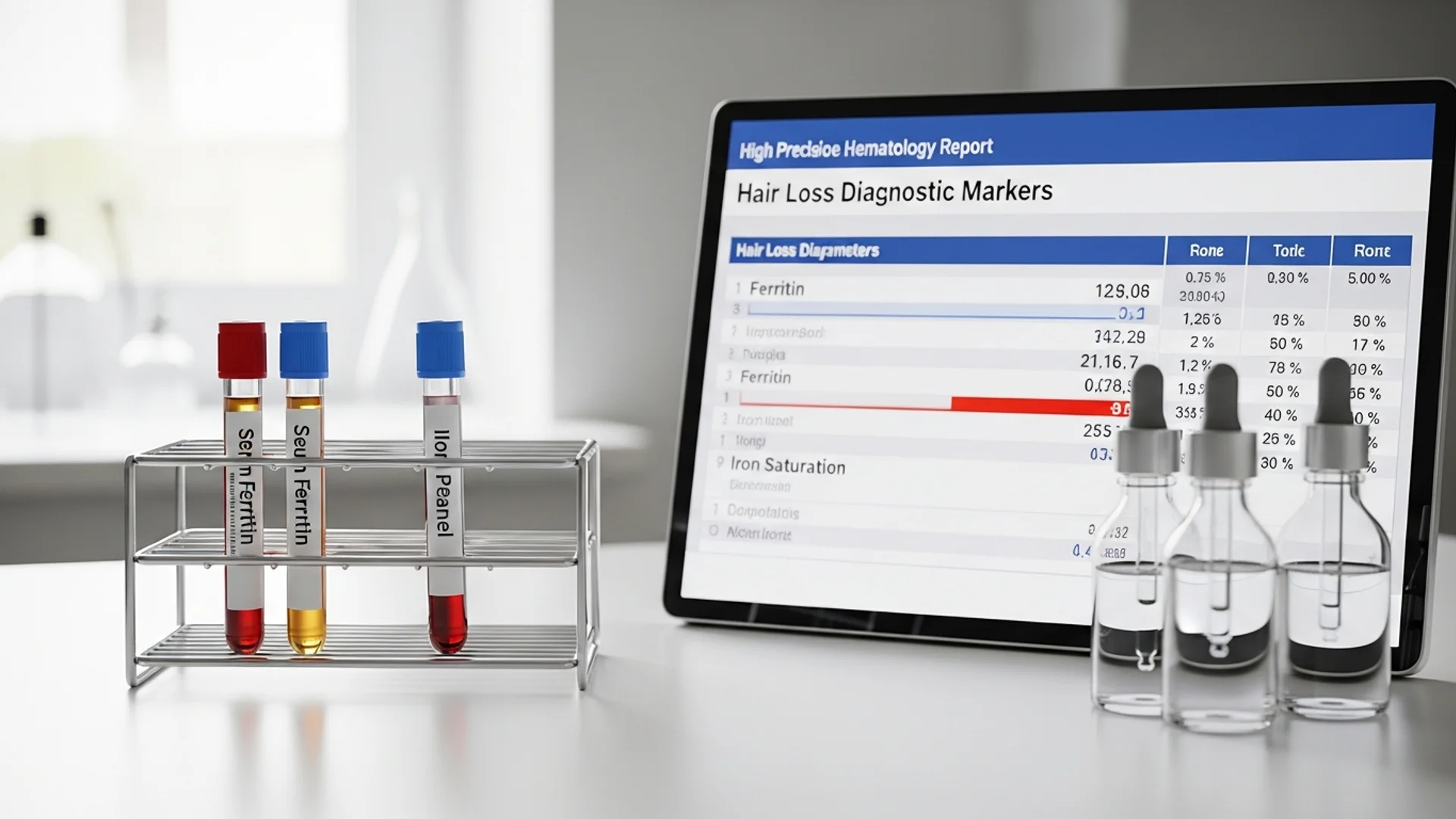

Hair loss in women is rarely one cause. The thoughtful workup looks at ferritin, full thyroid panel, vitamin D, sex hormones, and the timing of any postpartum or perimenopausal change before assuming pattern loss. The evidence-based treatments include minoxidil (topical or low-dose oral), spironolactone, and ruling out iron deficiency and thyroid disease, with a closer look at PCOS or perimenopause when the picture fits.
Most women who come to me about hair loss have already been told its just stress, or just aging, or just genetics. Some have been slowly losing hair for a year and only mention it after I ask. Others bring it up before they sit down, holding a Ziploc bag of what came out of the shower drain last week.
Hair loss in women rarely comes down to a single cause, and its rarely "just stress" either. Lets walk through what the workup looks like, what treatments have good evidence behind them, and what timeline to expect.
The differential is wider than people assume
When a woman tells me her hair is thinning or shedding, the first question is not "what should we treat" but "what are we looking at?" The patterns we sort between:
1. Telogen effluvium (diffuse shedding, usually temporary)
A large fraction of hairs move from the growth phase to the shedding phase at roughly the same time, then shed together 2 to 3 months after the trigger. The trigger can be:
- Significant illness, including COVID
- Surgery or general anesthesia
- Major weight loss (intentional or from a GLP-1 medication)
- Postpartum (very common; usually 3 to 6 months after delivery)
- Sudden major stress (loss, divorce, job change)
- Iron deficiency or vitamin D deficiency
- Starting or stopping certain medications (oral contraceptives, antidepressants)
Telogen effluvium usually resolves on its own as the underlying trigger resolves, with regrowth visible at 6 to 12 months. The key is identifying the trigger and addressing it.
2. Female pattern hair loss (FPHL)
This is the female version of androgenetic alopecia. The pattern looks different from mens: usually a widening center part with the thinning fanning out toward the front (dermatologists call it the "Christmas tree" pattern when you look straight down at the part), diffuse thinning across the top and crown, and the frontal hairline usually preserved. Unlike men, women rarely go bald in these areas. The hair thins and the scalp shows through, but the follicles hang on, which is part of why treatment can do so much. It is genetically driven and influenced by androgens (testosterone and DHT), but the relationship is more complex than in men. Many women with classic FPHL have normal androgen levels.
3. Postpartum shedding
A specific subtype of telogen effluvium. During pregnancy, high estrogen keeps more hair in the growth phase than usual; postpartum, those hairs all move to shedding together around month 3 to 6. The shedding is dramatic but expected. Most women see substantial regrowth by 9 to 12 months postpartum.
4. Thyroid-driven shedding
Both hypothyroidism and hyperthyroidism can drive hair loss, and the change can precede the clinical diagnosis by months. Hashimoto's, postpartum thyroiditis, and Graves' all show up this way at times.
5. Scarring alopecias and alopecia areata
These are different categories. Scarring alopecias (frontal fibrosing alopecia, lichen planopilaris, central centrifugal cicatricial alopecia) can permanently destroy follicles and need dermatology referral and biopsy. Central centrifugal cicatricial alopecia, which starts at the crown and spreads outward, is the most common scarring alopecia in Black women and is worth naming directly because it gets missed so often in its early, still-treatable stage. Alopecia areata produces well-defined patches of total loss and has its own treatment pathway. We screen for both during the initial workup.
6. Traction alopecia (from tight, repeated styling)
Years of tight ponytails, braids, weaves, or extensions pull on the follicles at the hairline and along the part, and over time that steady tension thins and eventually scars them. The earliest sign is often a fringe of tiny hairs left behind at the very front (the "fringe sign"), sometimes with small bumps or tenderness around the follicles. Caught early, it reverses once the tension comes off. Left for years, it can turn permanent. The fix is the part nobody loves to hear: looser styles, fewer extensions, and giving the hairline a rest. Minoxidil can help the surviving follicles in the meantime.
One more thing I always check for, because its rare but serious: signs that androgens are too high rather than just acting on sensitive follicles. If hair loss arrives alongside a deepening voice, new coarse hair on the face or body, acne that won't quit, or a sudden change in muscularity, that combination warrants a closer endocrine look (and sometimes imaging) to rule out a hormone-producing source. Most womens hair loss looks nothing like this, but its the kind of thing you screen for so you don't miss it.
The labs we run
Most women I see for hair loss have had "labs" before, but almost never the right ones. Heres the panel we use:
- Ferritin (iron storage). Below 50 ng/mL is suboptimal for hair growth in most studies; below 30 is frankly low. Standard "anemia" workups using hemoglobin alone routinely miss it.
- TSH, free T4, free T3, TPO antibodies. Full thyroid panel rather than just TSH. We are looking for early Hashimoto's, subclinical thyroid disease, and postpartum thyroiditis.
- 25-OH vitamin D. Deficiency is widespread in Philadelphia winters and associated with worse hair density.
- CBC and CMP. Baseline, plus the CBC catches the rare anemia that's driving things.
- Sex hormones. Total and free testosterone, DHEA-S, SHBG, estradiol, progesterone (in the right phase of the cycle for premenopausal women). If the picture fits PCOS, we add fasting insulin and HbA1c. If perimenopause is the driver, we add FSH and LH.
- HbA1c and fasting insulin if metabolic disease is in the picture.
- Vitamin B12, zinc, biotin only if the dietary or absorption story suggests deficiency. We do not order these reflexively.
- ANA or other autoimmune labs if the pattern looks scarring or autoimmune.
This is more lab work than most women have had run on their hair before, and its the lab work that finds the driver.
Evidence-based treatments
Once we know what's driving the loss, the treatment options narrow.
Minoxidil
FDA-approved for female pattern hair loss as a topical (2% or 5% solution or foam, once or twice daily). It works by prolonging the growth phase, improving follicular blood flow, and helping miniaturized follicles produce thicker shafts.
Low-dose oral minoxidil (typically 1 to 2.5 mg daily for women) is increasingly used off-label in dermatology and primary care, particularly for women who don't tolerate the topical (scalp irritation, dryness, the visible residue at the part line). The side effect profile (mild lower-extremity edema, possible mild facial hair growth, occasional cardiovascular effects requiring monitoring) is manageable in most patients. We talk through the trade-offs openly.
Theres also a mechanistic reason oral can work when the topical did nothing. Topical minoxidil has to be activated by an enzyme called sulfotransferase in the scalp, and some women don't carry enough of it, so the topical never switches on. The oral form is activated by the liver and skips that bottleneck, which is why a faithful topical user who saw no results isn't necessarily a minoxidil non-responder.
Spironolactone
Get Real Answers
Tired of being told your labs are 'normal'? Dr. Ash digs deeper.
An oral medication originally used for blood pressure that blocks androgen activity at the receptor and reduces testosterone synthesis modestly. Typical dose for female pattern hair loss is 50 to 200 mg daily. It is not FDA-approved for hair loss but has decades of off-label use and a reasonable evidence base.
Spironolactone is particularly useful for women with PCOS-driven hair loss, or for FPHL not responding to minoxidil alone. It is a teratogen, so reliable contraception is required during use; we discuss this clearly before starting.
Hormone therapy in perimenopause and menopause
When hair thinning starts in the 40s or 50s and correlates with other perimenopausal symptoms (hot flashes, sleep disruption, cycle changes), addressing the underlying hormonal change often improves the hair as well. We treat the hormone story directly when its appropriate, rather than as a side note to a hair-only conversation.
Treating the trigger in telogen effluvium
When the workup reveals a specific driver (low ferritin, hypothyroid, vitamin D deficiency, major stress, postpartum), the treatment is to fix the driver. The hair follows on a 3 to 9 month timeline.
Topical finasteride and dutasteride
Compounded topical finasteride or dutasteride is sometimes used off-label for FPHL in postmenopausal women or women using reliable contraception. The evidence is smaller than for spironolactone, and we talk through the trade-off openly.
What we do not prescribe
A few things you may see online that we do not offer:
- Compounded peptides marketed for hair (GHK-Cu injectables, "hair peptides"). State medical boards prohibit physician prescribing of non-FDA-approved peptides.
- Generic hair-vitamin gummies with proprietary blends, biotin megadoses, and dozens of ingredients. Biotin at high doses can falsely alter several lab tests (TSH, troponin), and its rarely the missing nutrient.
- Expensive in-office treatments without evidence parity. PRP has modest, mixed evidence and we discuss it as an adjunct when patients ask.
The lifestyle and nutrition layer
Hair is structural protein, and the follicle is one of the most metabolically demanding tissues in the body. Stress it through any of the levers below and the hair tells the story months later.
- Protein. Chronically eating below 1.2 g/kg/day in active adults can drag on hair density. Vegetarian and vegan diets need extra attention to total protein and specific amino acids (lysine, methionine).
- Iron. Heavy menstrual bleeding, pregnancy, GI absorption issues, vegetarian diets, and certain medications (PPIs) all set up iron deficiency that can drive shedding even when the CBC looks "normal."
- Sleep. Chronic short sleep raises cortisol and worsens telogen effluvium. The relationship is direct.
- Crash dieting and rapid weight loss. Including from GLP-1 medications. We watch for it at the 3-month mark and adjust nutrition and titration.
- Major stress. We don't moralize. We acknowledge the load, address what can be addressed, and are clear about the timeline.
Guidance from the clinic
"Most women I see have been told their hair loss is just aging or just stress. Its almost never a single cause. The right answer usually shows up when we look at the labs they should have had run two years ago."
Actionable Steps in Philly
A practical plan for the next 30 days.
- Photo baseline. Three reference photos in consistent lighting: top of the head looking down, the part line straight on, and the temples. The mirror lies; pixels don't.
- Get the labs. Ask for ferritin, full thyroid panel (TSH, free T4, free T3, TPO Ab), 25-OH vitamin D, CBC, CMP, total + free testosterone, DHEA-S, SHBG, estradiol, and progesterone (timed to your cycle if premenopausal). Add fasting insulin and HbA1c if PCOS or metabolic disease is on the table.
- Time the shedding. Did anything happen 2 to 3 months before the shedding started? Illness, surgery, postpartum, major stress, a new medication, rapid weight loss. The 2-to-3-month window is the telogen effluvium signature.
- Fix the deficiencies first. Low ferritin, low vitamin D, untreated thyroid disease all need to be addressed before assuming pattern loss.
- If pattern loss is in the picture, decide on the route. Topical minoxidil first-line. Add spironolactone if androgens or PCOS are part of the story. Low-dose oral minoxidil if topical doesn't fit your life.
Scientific References
- Sinclair R. "Female Pattern Hair Loss: A Pilot Study Investigating Combination Therapy with Low-Dose Oral Minoxidil and Spironolactone." Int J Dermatol. 2018.
- Trost LB, et al. "The Diagnosis and Treatment of Iron Deficiency and Its Potential Relationship to Hair Loss." J Am Acad Dermatol. 2006.
- Ramos PM, Miot HA. "Female Pattern Hair Loss: A Clinical and Pathophysiological Review." An Bras Dermatol. 2015.
- Vincent M, Yogiraj K. "A Descriptive Study of Alopecia Patterns and Their Relation to Thyroid Dysfunction." Int J Trichology. 2013.
- Mirmirani P. "Hormonal Changes in Menopause: Do They Contribute to a 'Midlife Hair Crisis' in Women?" Br J Dermatol. 2011.
Related at Fishtown Medicine
- Acne - adult acne and the hormonal and metabolic inputs we test for
- Dandruff & Seborrheic Dermatitis - what works beyond the OTC shampoo aisle
- Premature Gray Hair - the nutritional and metabolic causes worth checking
- Hair Loss (overview) - the hair-loss workup, by pattern and biology
- Hair Loss in Men - androgenetic alopecia and the treatment paths that work
- Eyelash Health - when sparse lashes signal an underlying systemic issue
- The Hair Playbook - the labs that find the driver, and what the evidence supports
- Inositol: The PCOS Workhorse - what it does for the hormonal pattern behind female thinning
- Hormone Testing Before Birth Control - what testing can and cannot predict before starting or switching

Fishtown Medicine | Symptoms
Frequently Asked Questions
Common Questions
Deep-Dive Questions
Ready when you are
The chat is our AI assistant, answering from our published guides. To talk it through with Dr. Ash himself, start with the intake.