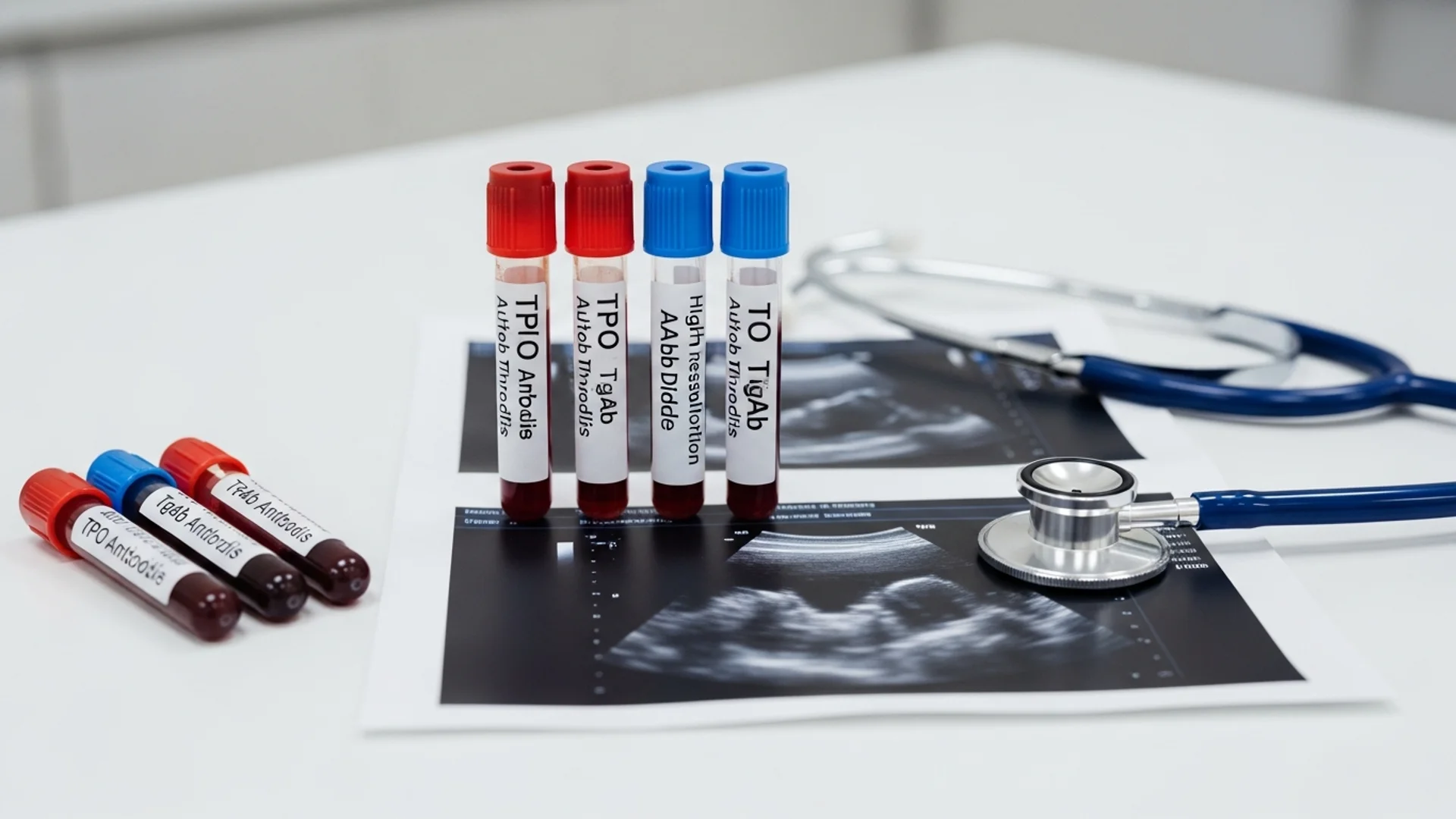

Positive thyroid antibodies with a normal TSH means your immune system has started acting against your thyroid, even though the gland is still keeping hormone levels in range. It is early Hashimoto's, caught before medication is needed. A standard TSH-only panel misses it. This is the window where correcting selenium, magnesium, and vitamin D, and monitoring over time, can slow or stall the process rather than waiting until the thyroid fails.
TL;DR: A positive thyroid antibody with a normal TSH points to something already underway. Your immune system has begun engaging your thyroid, while the gland is still working hard enough to keep your hormone levels in range. This is the earliest, most workable stage of Hashimoto's, and a standard TSH-only panel never sees it. You do not need thyroid medication at this point. You need the tests most panels skip, a look at the nutrients that drive thyroid hormone conversion, and a plan to monitor over time so the process is slowed rather than discovered years later when the gland has already failed.
Here is a scenario that plays out constantly. Someone has been tired for a long stretch, gets bloodwork, and hears the familiar verdict: your thyroid is normal. The number that got checked, TSH, was in range, so the door closed. But the fatigue stayed, and the family history, a mother or a sibling with thyroid disease, went unexplained.
When you look one layer deeper, a different picture often appears. The TSH is normal. The active thyroid hormone is in range. But the thyroid antibodies are positive, which means the immune system has already started acting against the gland. Nobody ran that test, so nobody saw it coming.
What I want you to know is that this early stage is the best possible time to find this. You have caught an autoimmune process before it has done lasting damage, in the window where it is most responsive to being slowed. The problem was never that your thyroid was fine. It was that the panel asked one question and stopped.
What does a positive thyroid antibody with a normal TSH mean?
Your thyroid makes hormone. TSH is the pituitary's signal telling it how hard to work, and it is the single number most doctors check. When TSH is normal, the standard reading is that the thyroid is healthy, and the workup ends.
Thyroid antibodies tell a separate story. The most common one, thyroid peroxidase antibody (TPO), is a marker that your immune system is producing antibodies against an enzyme your thyroid uses to build hormone. A positive result means autoimmune activity is underway. This is the mechanism behind Hashimoto's thyroiditis, the most common cause of an underactive thyroid.
Early in that process, the gland compensates. It works harder, pushes out enough hormone to keep your levels in range, and your TSH stays normal because the system is still keeping up. The antibodies are the early warning that arrives years, sometimes decades, before the TSH drifts and the gland can no longer keep pace. Antibody-positive people convert to an underactive thyroid at a meaningfully higher rate each year than antibody-negative people. Finding the antibodies now is finding the fire while it is still small.
Why does a standard thyroid panel miss this?
Because most panels check TSH alone, and sometimes a T4, and stop there.
A TSH-only approach is built to catch thyroid disease once it has already progressed far enough to move that number. It is not built to catch the autoimmune stage that comes first. To see the early picture, the panel has to include the tests that a routine order leaves off:
- TPO antibodies and thyroglobulin antibodies, the markers of autoimmune activity.
- Free T3, the active hormone your cells use, which is separate from the free T4 the gland releases.
- Reverse T3 in some cases, which can flag a conversion problem.
There is a second reason to look past the single number. A "normal" reference range on a lab report is built from a broad population, roughly ages 18 to 99, and that population is not a picture of health. When a value is near the edge of that range, "normal" and "optimal" are not the same thing. A TSH technically in range, paired with positive antibodies and ongoing symptoms, is a different situation than an all-normal panel, even though the report says normal for both.
If my thyroid is still "working," why do I feel tired?
Get Real Answers
Tired of being told your labs are 'normal'? Dr. Ash digs deeper.
Two reasons, and they often travel together.
The first is conversion. Your thyroid mostly releases T4, an inactive storage form. Your body then has to convert T4 into T3, the active hormone that does the work in your cells. That conversion depends on enzymes, and those enzymes depend on specific minerals, particularly selenium, along with adequate zinc and iron. When those are low, the gland can be releasing plenty of T4 while your cells stay short on the active T3 they need. Your TSH and T4 can look fine on paper while you feel the symptoms of an underactive thyroid, because the bottleneck is downstream of what the standard panel measures.
The second is the autoimmune activity itself. The low-grade immune process of Hashimoto's contributes to fatigue independent of the hormone numbers, and it frequently travels alongside the very deficiencies that impair conversion. Fatigue in this setting rarely has a single cause. It is usually a stack: a conversion bottleneck, a nutrient gap or two, and the autoimmune process running underneath.
What can I do in this window, before medication?
This is the part that makes catching it early worth so much. When Hashimoto's is found at the antibody stage with a normal TSH, the goal changes from replacing a failed thyroid to protecting a working one. The levers are specific:
- Selenium. This is the mineral most directly tied to both thyroid antibody levels and T4-to-T3 conversion. Several trials have shown that correcting a selenium deficiency can lower TPO antibody levels, and selenium is a required cofactor for the enzymes that activate thyroid hormone. The dose matters and the window is narrow: the body needs micrograms, not milligrams, and too much selenium is harmful, so this is done with a targeted dose rather than casual supplementation.
- Magnesium. Widely deficient, it supports the enzymatic machinery around thyroid hormone and shows up low in a large share of people. Correcting it helps conversion and often helps sleep and energy at the same time.
- Vitamin D. Low vitamin D is common at Philadelphia's latitude and is associated with autoimmune thyroid activity. Bringing it into a healthy range is a reasonable and low-cost lever.
- Iron and the B vitamins, when the rest of the workup shows they are needed, because both feed into thyroid hormone production and use.
None of this is a promise of a cure. Autoimmune conditions are not switched off. But the aim in this window is clear and achievable: to lower the autoimmune activity where possible, remove the nutrient bottlenecks that are making you feel worse than your numbers suggest, and slow the slide toward a thyroid that eventually needs replacement. Some people hold steady for years. That is a win, and it is only available if someone looked early.
How is this monitored over time?
The plan is patience and tracking rather than a single fix. After correcting the deficiencies, the thyroid numbers and antibodies get rechecked on a sensible interval, often around 3 months at first, to see which direction things are moving. TSH creeping up over time, or symptoms worsening, is the signal to reassess and, if needed, begin low-dose thyroid medication. Antibodies trending down and symptoms improving is the signal that the early intervention is working.
Timing matters twice as much after a birth: the postpartum year is a common window for autoimmune thyroid disease to surface or flare, which is part of the fourth-trimester workup. The point of monitoring is to stay ahead of the process rather than to wait for a crisis. Someone who knows they are antibody-positive gets rechecked deliberately. Someone whose antibodies were never measured only finds out when the TSH has failed, having spent the intervening years tired and told they were fine.
Key Takeaways
- Positive thyroid antibodies with a normal TSH is early Hashimoto's, caught before the gland fails.
- A TSH-only panel cannot see this stage; it takes antibody testing plus free T3.
- The gland can keep hormone levels in range while a conversion bottleneck leaves your cells short on active T3.
- Selenium, magnesium, and vitamin D are the main modifiable levers in this window, at careful doses.
- The goal is to slow the autoimmune process, close nutrient gaps, and monitor over time rather than start medication you do not yet need.
- "Normal range" is a population band rather than a definition of optimal, so a value near the edge with symptoms deserves a second look.
Scientific References
- Hollowell JG, Staehling NW, Flanders WD, et al. Serum TSH, T4, and thyroid antibodies in the United States population (1988 to 1994): NHANES III. Journal of Clinical Endocrinology and Metabolism. 2002;87(2):489-499.
- Vanderpump MP, Tunbridge WM, French JM, et al. The incidence of thyroid disorders in the community: a twenty-year follow-up of the Whickham Survey. Clinical Endocrinology. 1995;43(1):55-68.
- Toulis KA, Anastasilakis AD, Tzellos TG, Goulis DG, Kouvelas D. Selenium supplementation in the treatment of Hashimoto's thyroiditis: a systematic review and meta-analysis. Thyroid. 2010;20(10):1163-1173.
- Gartner R, Gasnier BC, Dietrich JW, Krebs B, Angstwurm MW. Selenium supplementation in patients with autoimmune thyroiditis decreases thyroid peroxidase antibodies. Journal of Clinical Endocrinology and Metabolism. 2002;87(4):1687-1691.
- Rayman MP. Multiple nutritional factors and thyroid disease, with particular reference to autoimmune thyroid disease. Proceedings of the Nutrition Society. 2019;78(1):34-44.

Fishtown Medicine | Symptoms
Frequently Asked Questions
Common Questions
Deep-Dive Questions
Ready when you are
The chat is our AI assistant, answering from our published guides. To talk it through with Dr. Ash himself, start with the intake.