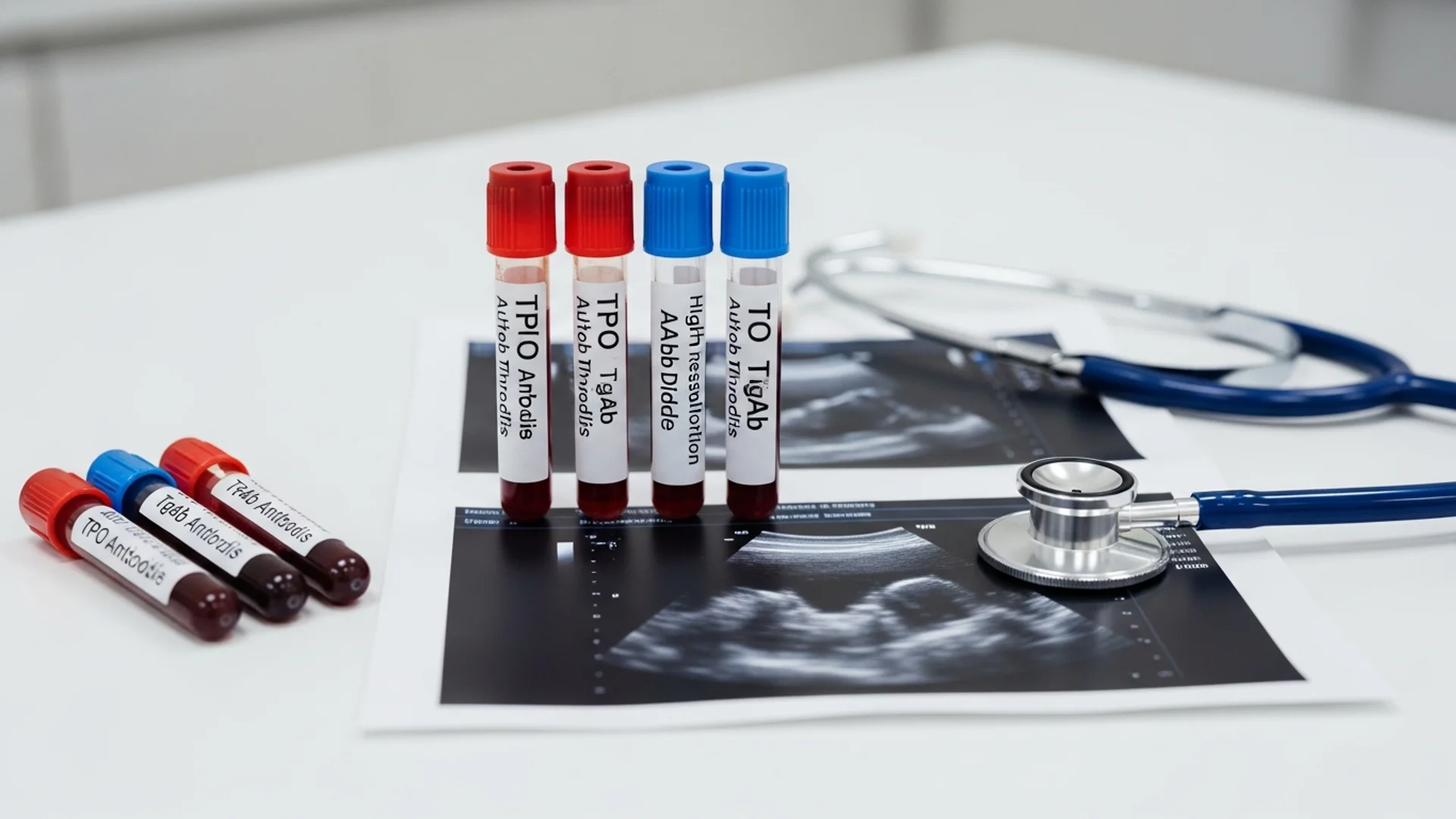

Hashimoto's thyroiditis is an autoimmune condition in which T-cells and thyroid peroxidase antibodies (TPOAb, positive in 90% to 95% of cases) or thyroglobulin antibodies (TgAb) slowly damage thyroid follicles. Treatment depends on hormone output instead of antibody height: euthyroid patients (normal TSH and Free T4) get checkups every 6 to 12 months. Overt hypothyroidism (low Free T4 or TSH 10 mIU/L or higher) and symptomatic younger adults or pregnancy plans with TSH above 2.5 to 4.5 mIU/L need levothyroxine (LT4) titrated to a TSH of 1.0 to 2.5 mIU/L.
TL;DR:
- Confirmed by antibodies, dosed by TSH and Free T4: Over 90% to 95% of people with Hashimoto's test positive for TPO antibodies (with TgAb catching most remaining cases).1 Medication doses target TSH (1.0 to 2.5 mIU/L) and Free T4 (0.8 to 1.8 ng/dL) instead of antibody numbers.2
- Watch and wait early; treat clear hormone loss: Euthyroid patients progress at only 2% to 4% per year (Whickham Survey).3 Start levothyroxine (~1.6 mcg/kg/day) for overt hypothyroidism or pregnancy plans when TSH exceeds 2.5 to 4.5 mIU/L.4
- Fix pill timing first: Espresso, breakfast, iron, calcium, and reflux pills cut levothyroxine absorption by 20% to 40%; high-dose biotin skews lab results falsely low.25
- Screen for the autoimmune nutrient cluster: Up to 15% to 30% of Hashimoto's patients carry stomach antibodies (autoimmune gastritis) and 2% to 5% have celiac disease, draining ferritin and B12.67
What causes Hashimoto's thyroiditis, and which lab tests confirm it?
Hashimoto's thyroiditis starts when immune T-cells and thyroid antibodies slowly inflame the gland over years. Over time, this reduces the gland's ability to make T4 and T3.1
Family risk drives about 70% to 80% of cases. Extra iodine, postpartum shifts, quitting smoking, or viral illness can also trigger it. Diagnosis relies on four blood tests paired with clear clinical ranges:
- TSH (Thyroid-Stimulating Hormone): Optimal target is 1.0 to 2.5 mIU/L (borderline-high 2.5 to 4.5 mIU/L; high >= 4.5 mIU/L). Draw blood in the morning before taking any biotin pill.5
- Free T4 (0.8 to 1.8 ng/dL) and Free T3 (2.3 to 4.2 pg/mL): Show active hormone levels in blood. These catch pituitary gaps or poor T4-to-T3 conversion.
- TPO Antibodies (TPOAb) and Thyroglobulin Antibodies (TgAb): TPOAb confirms 90% to 95% of Hashimoto's cases.1 Adding TgAb catches the ~5% of cases with TgAb alone. Once positive, antibodies confirm the cause and rarely need repeat checks.
We skip routine thyroid ultrasounds for positive antibodies alone. Routine scans often spot tiny benign nodules that cause needless biopsies (see Thyroid Nodules & Overdiagnosis). Instead, we scan the neck only for a felt lump, swelling, or trouble swallowing.
When does Hashimoto's require levothyroxine vs. watchful waiting?
Start levothyroxine (LT4) when Free T4 drops low or TSH hits 10 mIU/L or higher. Doctors also prescribe it during pregnancy planning with positive antibodies and TSH > 2.5 to 4.5 mIU/L, and for symptomatic adults under 65 with TSH from 4.5 to 9.9 mIU/L.248
| Clinical Stage | Typical Lab Pattern | Standard Progression Risk | Recommended Clinical Action |
|---|---|---|---|
| Stage 1: Euthyroid Autoimmunity | Positive TPOAb/TgAb, TSH 1.0 to 2.5 mIU/L, normal Free T4 | 2% to 4% per year overt progression (Whickham Survey)3 | Monitor every 6 to 12 months. No pill needed; see Thyroid Antibodies With Normal TSH. |
| Stage 2: Mild Subclinical Hypothyroidism | Positive TPOAb, TSH 4.5 to 9.9 mIU/L, normal Free T4 | Up to 40% revert on repeat draw; higher progression if TSH > 6 | Confirm in 6 to 12 weeks. Trial LT4 if age < 65 with clear symptoms; hold in adults >= 65 without symptoms (TRUST Trial).8 |
| Stage 3: Preconception, IVF, or Pregnancy | Positive TPOAb with TSH > 2.5 mIU/L (or preexisting LT4) | Higher first-trimester demand (+20% to 30% LT4 need) | ATA 2026 Guidelines: Target TSH < 2.5 mIU/L when positive; add 2 extra weekly doses on a positive pregnancy test.4 |
| Stage 4: Overt Hypothyroidism | TSH >= 10 mIU/L** and/or **Free T4 < 0.8 ng/dL | Clear hormone drop raising cholesterol, fatigue, and low mood | Start levothyroxine (~1.6 mcg/kg/day) in healthy young adults (start 25 to 50 mcg/day if age >= 65 or heart disease); recheck in 6 weeks.2 |
In adults over 65 with mild subclinical TSH (4.6 to 10 mIU/L), the TRUST trial (NEJM 2017, n = 737) tested pills vs. placebo. Levothyroxine gave no fatigue or life-quality benefit while risking overtreatment.8
Why do some patients still feel tired on levothyroxine?
Ongoing fatigue when TSH reaches 1.0 to 2.5 mIU/L often points to blocked pill uptake, biotin lab skew, low iron or B12, sleep apnea, or a weak T4-to-T3 response.
- Pill Timing (Coffee, Food, Iron, Calcium): Coffee, milk, calcium, iron, magnesium, and acid blockers cut pill uptake by 20% to 40%.2 Take LT4 with water 30 to 60 minutes before coffee and breakfast, or at bedtime 3 to 4 hours after dinner (Bolk et al., Arch Intern Med 2010).9 Space iron and calcium by 4 hours.
- Biotin (Vitamin B7) Lab Skew: High-dose hair/nail pills (5,000 to 10,000 mcg/day) fool lab tests. They create a falsely low TSH and falsely high Free T4.5 Stop biotin 72 hours before blood draws.
- Autoimmune Nutrient Loss (Iron, B12, Celiac): About 15% to 30% of Hashimoto's patients develop autoimmune gastritis, and 2% to 5% have celiac disease.67 Low stomach acid blocks both pill uptake and iron or vitamin B12 absorption. Check ferritin (with the Ferritin/CRP ratio), methylmalonic acid (MMA), and tTG-IgA + total IgA.
- Combination LT4 + LT3 Trials: In broad randomized trials (Shakir et al., JCEM 2021), adding T3 or desiccated thyroid scored the same as LT4 alone for most adults.10 Still, endocrine societies support a 3-to-6-month LT4 + LT3 trial (13:1 to 16:1 ratio) if fatigue persists after optimal TSH, iron, B12, and sleep checks. Keep TSH inside normal limits to protect heart rhythm and bone.10
- Hidden Sleep and Metabolic Overlap: Rule out home sleep apnea testing and insulin resistance (fasting insulin target 3 to 6 uIU/mL), since both cause severe fatigue.
Fishtown Medicine
A 90-minute conversation with Dr. Ash. A written plan you can follow.
Do gluten-free diets, selenium, or red light therapy lower thyroid antibodies?
A gluten-free diet is necessary for confirmed celiac disease. Low-dose selenium trims TPO antibodies slightly in low-selenium areas, while neck light therapy remains an early small-study tool.
- Gluten-Free Diets: Test for celiac disease (
tTG-IgA+ total IgA) before dropping wheat, or results turn falsely negative. Without celiac disease, gluten removal gives mixed symptom gains while adding cost. - Selenium (
100 to 200 mcg/day): A 2024 Thyroid meta-analysis (Huwiler et al.) found ~20% to 30% TPOAb drops in regions with low soil selenium.11 Because US soils are selenium-rich and > 200 mcg/day tracked with diabetes risk in the NPC trial (Stranges 2007), skip chronic high doses without proven low levels.12 - Red / Near-Infrared Light Therapy: Small trials (Höfling 2013; Ferhatoglu 2020) saw minor pill dose drops after neck LED use. Larger studies are still needed before clinical use.
Guidance from the Clinic

Key Takeaways
- Confirm once with TPOAb (plus TgAb), then track TSH and Free T4: Optimal TSH stays at 1.0 to 2.5 mIU/L; antibodies never guide pill dosing.12
- Match care to stage: Monitor normal-TSH Hashimoto's every 6 to 12 months; start LT4 for overt hormone loss or preconception TSH > 2.5 to 4.5 mIU/L.34
- Protect pill uptake and lab tests: Space LT4 30 to 60 min from coffee/food, 4 hours from iron/calcium, and pause biotin for 72 hours before blood draws.259
- Check hidden nutrient deficits: Screen for autoimmune gastritis, celiac disease, low B12, and low ferritin when fatigue persists.67
Related at Fishtown Medicine
- Thyroid Antibodies With Normal TSH: What to Watch vs. Skip
- Thyroid Optimization and Hormone Targets
- Thyroid Nodules & Cancer Overdiagnosis
- Autoimmune Gastritis and Iron Deficiency
- Vitamin B12 Deficiency and Methylmalonic Acid (MMA)
- A Positive ANA: What It Means
- Red Light Therapy Clinical Evidence
Scientific References
- Dayan CM, Daniels GH. "Chronic Autoimmune Thyroiditis." New England Journal of Medicine. 1996;335(2):99-107.
- Jonklaas J, Bianco AC, Bauer AJ, et al. "Guidelines for the Treatment of Hypothyroidism: American Thyroid Association Task Force." Thyroid. 2014;24(12):1670-1751.
- Vanderpump MP, Tunbridge WM, French JM, et al. "The Incidence of Thyroid Disorders in the Community: A Twenty-Year Follow-Up of the Whickham Survey." Clinical Endocrinology. 1995;43(1):55-68.
- Korevaar TIM, Leung AM, Alexander EK, et al. "American Thyroid Association 2026 Guidelines for Thyroid Disease in Preconception, Pregnancy, and Postpartum." Thyroid. 2026.
- Food and Drug Administration. "Biotin Interference With Lab Tests: FDA Safety Communication." Updated November 2019.
- Checchi S, Montanaro A, Ciuoli C, et al. "Prevalence of Parietal Cell Antibodies in a Large Cohort of Patients With Autoimmune Thyroiditis." Thyroid. 2010;20(12):1385-1389.
- Roy A, Laszkowska M, Sundstrom J, et al. "Prevalence of Celiac Disease in Patients With Autoimmune Thyroid Disease: A Meta-Analysis." Thyroid. 2016;26(7):880-890.
- Stott DJ, Rodondi N, Kearney PM, et al. "Thyroid Hormone Therapy for Older Adults With Subclinical Hypothyroidism (TRUST)." New England Journal of Medicine. 2017;376(26):2534-2544.
- Bolk N, Visser TJ, Nijman J, et al. "Effects of Evening vs Morning Levothyroxine Intake: A Randomized Double-Blind Crossover Trial." Archives of Internal Medicine. 2010;170(22):1996-2003.
- Shakir MKM, Brooks DI, McAninch EA, et al. "Comparative Effectiveness of Levothyroxine, Desiccated Thyroid Extract, and Levothyroxine + Liothyronine in Hypothyroidism." Journal of Clinical Endocrinology & Metabolism. 2021;106(11):e4400-e4413.
- Huwiler VV, Maissen-Abgottspon S, Stanga Z, et al. "Selenium Supplementation in Patients With Hashimoto Thyroiditis: A Systematic Review and Meta-Analysis." Thyroid. 2024;34(3):295-313.
- Stranges S, Marshall JR, Natarajan R, et al. "Effects of Long-Term Selenium Supplementation on the Incidence of Type 2 Diabetes: A Randomized Trial." Annals of Internal Medicine. 2007;147(4):217-223.

Frequently Asked Questions
Common Questions
Deep-Dive Questions
Ready when you are
The chat is our AI assistant, answering from our published guides. To talk it through with Dr. Ash himself, start with the intake.