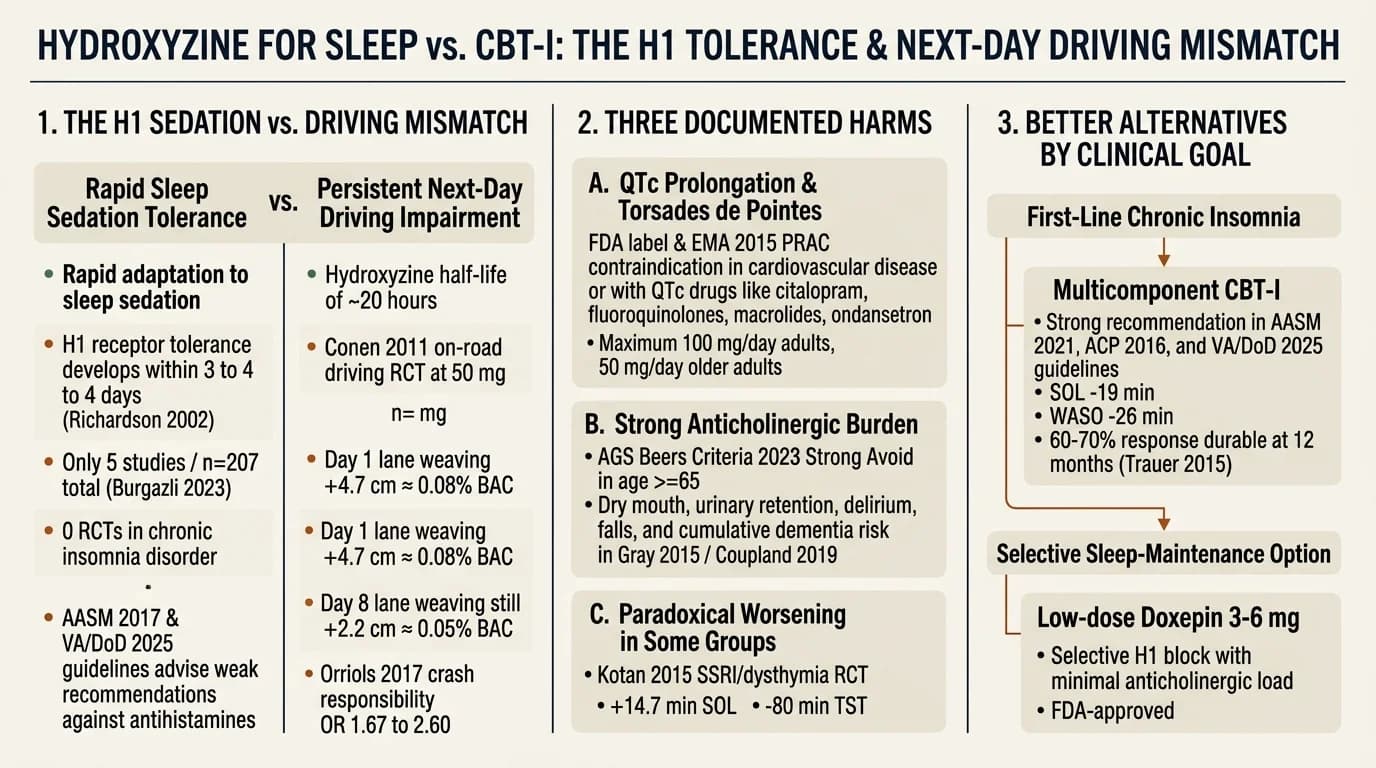

Although both drugs block brain histamine H1 receptors, low-dose doxepin (3 to 6 mg) and hydroxyzine (25 to 50 mg) act very differently in clinical trials. At 3 to 6 mg, doxepin binds H1 sites (Kd 0.24 nM) over 100 times more tightly than muscarinic or alpha-1 sites, holds sleep gains through 12 weeks without rebound, and is exempt in the 2023 AGS Beers Criteria. Hydroxyzine has zero RCTs in chronic insomnia, loses sedation in 3 to 7 days, impairs next-day driving for 20 hours, prolongs QTc, and is rated 'Avoid' at age 65+.
TL;DR:
- Dose defines selectivity: At 3 to 6 mg, doxepin binds H1 sites (Kd 0.24 nM) over 300 times tighter than muscarinic sites (Kd 83 nM), skipping dry mouth and brain fog.1
- Proof vs. guesswork: Low-dose doxepin carries AASM 2017 backing and FDA approval through Week 12 (WASO -22 to -23 min); hydroxyzine has zero RCTs in chronic insomnia.23
- Hydroxyzine tolerance and driving risk: Antihistamine sleepiness fades in 3 to 4 days, yet its 20-hour half-life impairs driving like 0.05% to 0.08% BAC and adds a QTc warning.45
- Beers Criteria split: The 2023 AGS Beers Criteria exempt doxepin <= 6 mg/day while flagging hydroxyzine and doxepin > 6 mg/day as "Avoid" in older adults.6
How do low-dose doxepin (3 to 6 mg) and hydroxyzine (25 to 50 mg) compare side by side?
Low-dose doxepin (3 to 6 mg) is an FDA-approved, non-anticholinergic sleep-maintenance pill. Hydroxyzine (25 to 50 mg) is an unapproved, fast-tolerant antihistamine with strong anticholinergic drag and a 20-hour half-life.235
Many patients assume these two drugs act alike because both block histamine. Comparing lab binding, 12-week trials, heart safety, and driving scores shows why guidelines split them:
| Clinical Dimension | Low-Dose Doxepin (3 to 6 mg) | Hydroxyzine (25 to 50 mg) |
|---|---|---|
| FDA Insomnia Approval | Yes (sleep maintenance at 3 and 6 mg)7 | No (approved for anxiety, itching, pre-op sedation)8 |
| AASM 2017 & VA/DoD Status | Suggested for sleep maintenance2 | Not recommended for chronic insomnia |
| Chronic Insomnia RCTs | Multiple placebo RCTs through Week 129 | Zero RCTs in primary chronic insomnia (Burgazli 2023)3 |
| H1 vs. Muscarinic Binding | Kd 0.24 nM (H1) vs. 83 nM (muscarinic) = selective1 | Moderate-to-strong anticholinergic load at 25 to 100 mg |
| Tolerance Over Time | Holds Hour-7 to Hour-8 benefit at Night 859 | Sedation fades within 3 to 4 days (Richardson 2002)4 |
| Half-Life & Metabolite | ~15 hours (parent); tiny nordoxepin load at 3 to 6 mg7 | ~20 hours (29 hours at age 65+) + active cetirizine |
| Next-Day Driving | Minimal signal when taken >= 3 hours after food | 0.08% BAC weave Day 1; 0.05% Day 8 (Conen 2011)5 |
| Heart QTc Risk | No clinical change at 3 to 6 mg7 | FDA/EMA warning for QTc / torsades (100 mg/day cap) |
| 2023 AGS Beers Criteria (>= 65) | Explicitly Exempt at <= 6 mg/day6 | Strong "Avoid" (delirium, falls, confusion)6 |
| Low-Cost Option | Generic 10 mg/mL oral liquid (0.3 mL = 3 mg, ~$10 to $15/mo) | Generic 25 mg tablets (~$10/mo) |
Why does 3 to 6 mg of doxepin avoid the anticholinergic side effects of 25 to 150 mg doxepin and hydroxyzine?
At 3 to 6 mg, doxepin blocks wake histamine H1 sites without spilling onto muscarinic, blood-pressure alpha-1, or heart hERG channels.17
Brain binding data (Richelson & Nelson, JPET 1984) measured doxepin's affinity at 0.24 nM for H1, vs. 24 nM for alpha-1 and 83 nM for muscarinic sites.1 Full mood doses (25 to 150 mg) flood those off-target sites, causing dry mouth, constipation, blurry vision, dizziness, and weight gain.
Shrinking the dose to 3 or 6 mg keeps levels inside the selective H1 zone. Because doxepin peaks ~3.5 hours after dosing, bedtime dosing covers the 3:00 AM to 7:00 AM histamine rise.79 That dose cutoff explains why anticholinergic cohort studies (Gray 2015, HR 1.54 at 3+ years; Coupland 2019) and the 2023 AGS Beers Criteria spare <= 6 mg/day doxepin.610
Why does hydroxyzine stop working after a few nights while causing a next-day hangover?
Brain H1 sedation fades within 3 to 5 nights. Meanwhile, hydroxyzine's 20-hour half-life lingers through the next afternoon, slowing driving reaction times.45
- Fast Sedative Tolerance (3 to 4 Days): Sleep-lab trials of first-generation antihistamines (Richardson et al., 2002) proved daytime sleepiness gains vanish by Day 4.4 Many people raise doses from 25 mg to 50 or 100 mg without sleeping better.
- Hidden Driving Risk (0.05% to 0.08% BAC): In highway driving tests (Conen et al., 2011), hydroxyzine 50 mg caused lane weave equal to 0.08% blood alcohol on Day 1 and 0.05% BAC on Day 8.5 Crash registries show 1.67x to 2.60x higher at-fault crash odds.11
- QTc Rhythm Risk: FDA and EMA alerts warn against hydroxyzine with baseline long QTc, low electrolytes, heart disease, or QTc-raising drugs, capping European doses at 100 mg/day (50 mg in older adults).
Evidence-Based Treatment
Dr. Ash reviews the research - and applies it to your specific biology.
How do you switch from hydroxyzine or Benadryl to CBT-I or low-dose doxepin safely?
Start CBT-I, screen for sleep apnea, stop bedtime antihistamines without needing a taper, and if 3:00 AM waking continues, take 3 mg doxepin at least 3 hours after dinner.
- Rule out breathing pauses: If you wake with snoring, dry mouth, or morning headache, test for obstructive sleep apnea first.
- Start CBT-I as your base: Sleep restriction and stimulus control rebuild deep sleep drive in 3 to 6 weeks.
- Stop hydroxyzine or diphenhydramine directly: Antihistamines do not trigger physical GABA withdrawal, so most adults can stop them on day one of CBT-I.
- Follow the 3-hour food rule for doxepin 3 mg: High-fat dinners boost doxepin levels by 41% and push its peak ~3 hours later into morning.7 Take 3 mg at least 3 hours after eating.
- Save money with 10 mg/mL liquid concentrate: Brand Silenor tablets can cost hundreds, and 10 mg capsules exceed the 6 mg Beers cap. Ask for generic doxepin 10 mg/mL liquid with a calibrated 0.3 mL (= 3 mg) syringe for ~$10 to $15/month.
Guidance from the Clinic

Key Takeaways
- 3 to 6 mg doxepin beats hydroxyzine: Proven in 12-week trials with selective H1 binding (Kd 0.24 nM), no tolerance, and 2023 Beers exemption <= 6 mg/day.169
- Hydroxyzine risks linger past morning: Sleepiness fades in 3 to 4 days, while a 20-hour half-life impairs driving (0.05% to 0.08% BAC) and raises QTc risk.45
- Use two doxepin rules: Take 3 mg at least 3 hours after dinner, and ask for 10 mg/mL liquid (0.3 mL = 3 mg) if tablets cost too much.7
- Pair with CBT-I: Pills support sleep maintenance while CBT-I restores natural sleep drive.
Related at Fishtown Medicine
- Doxepin (3-6 mg) for Sleep Maintenance: Full Clinical Guide
- Hydroxyzine for Sleep: Why Guidelines Recommend Against It
- Sleeping Pills Comparison Guide: DORAs, Doxepin, Z-Drugs & Trazodone
- Cognitive Behavioral Therapy for Insomnia (CBT-I)
- Trazodone for Sleep
- Gabapentin for Sleep (100-600 mg)
- Family History Prevention Plan (Anticholinergics & Brain Health)
Scientific References
- Richelson E, Nelson A. "Antagonism by Antidepressants of Neurotransmitter Receptors of Normal Human Brain In Vitro." Journal of Pharmacology and Experimental Therapeutics. 1984;230(1):94-102.
- Sateia MJ, Buysse DJ, Krystal AD, Neubauer DN, Heald JL. "Clinical Practice Guideline for the Pharmacologic Treatment of Chronic Insomnia in Adults." Journal of Clinical Sleep Medicine. 2017;13(2):307-349.
- Burgazli CR, Rana KB, Brown JN, Tillman F. "Efficacy and Safety of Hydroxyzine for Sleep in Adults: Systematic Review." Human Psychopharmacology. 2023;38(2):e2864.
- Richardson GS, Roehrs TA, Rosenthal L, Koshorek G, Roth T. "Tolerance to Daytime Sedative Effects of H1 Antihistamines." Journal of Clinical Psychopharmacology. 2002;22(5):511-515.
- Conen S, Theunissen EL, Van Oers AC, Valiente R, Ramaekers JG. "Acute and Subchronic Effects of Bilastine and Hydroxyzine (50 mg) on Actual Driving Performance." Journal of Psychopharmacology. 2011;25(11):1517-1523.
- 2023 American Geriatrics Society Beers Criteria Update Expert Panel. "2023 Updated AGS Beers Criteria for Potentially Inappropriate Medication Use in Older Adults." Journal of the American Geriatrics Society. 2023;71(7):2052-2081.
- Food and Drug Administration. "Silenor (Doxepin Hydrochloride) Tablets Prescribing Information." Updated January 2022.
- Food and Drug Administration. "Hydroxyzine Hydrochloride Prescribing Information." Updated June 2026.
- Krystal AD, Durrence HH, Scharf M, et al. "Efficacy and Safety of Doxepin 1 mg and 3 mg in a 12-Week Trial of Elderly Subjects With Chronic Primary Insomnia." Sleep. 2010;33(11):1553-1561.
- Gray SL, Anderson ML, Dublin S, et al. "Cumulative Use of Strong Anticholinergics and Incident Dementia: A Prospective Cohort Study." JAMA Internal Medicine. 2015;175(3):401-407.
- Orriols L, Luxcey A, Contrand B, et al. "Road Traffic Crash Risk Associated With Prescription Antihistamines: A Registry-Based Case-Crossover Study." Journal of Clinical Psychiatry. 2017.
- Coupland CAC, Hill T, Dening T, et al. "Anticholinergic Drug Exposure and the Risk of Dementia: A Nested Case-Control Study." JAMA Internal Medicine. 2019;179(8):1084-1093.

Frequently Asked Questions
Common Questions
Deep-Dive Questions
Ready when you are
The chat is our AI assistant, answering from our published guides. To talk it through with Dr. Ash himself, start with the intake.